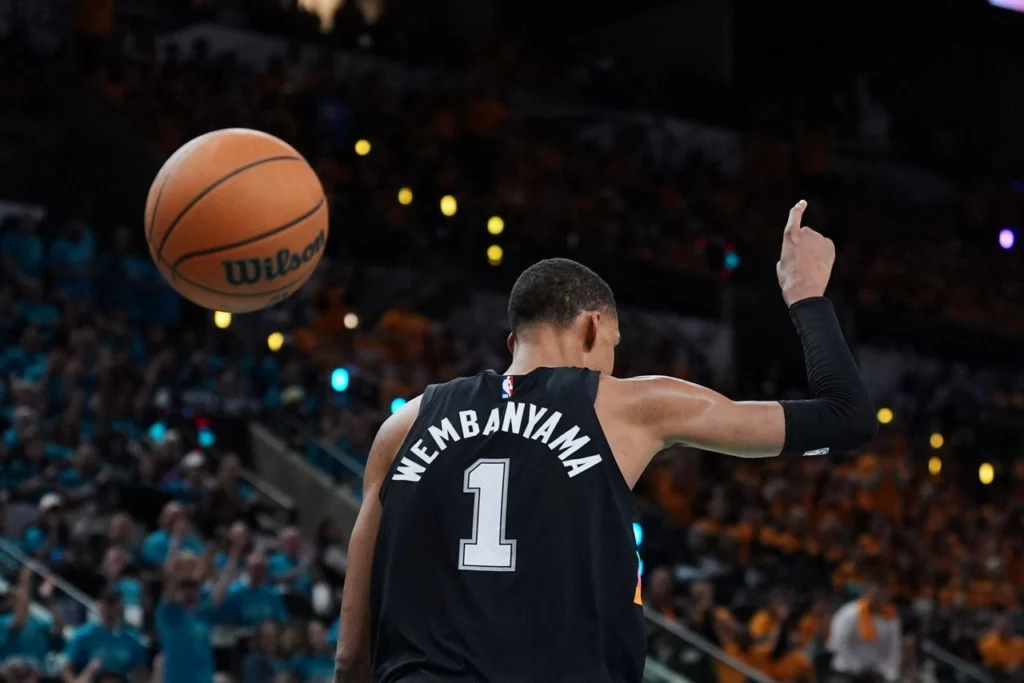
On April 21, 2026, the NBA officially placed Victor Wembanyama in a category of his own. The San Antonio Spurs superstar has been named the league’s Defensive Player of the Year in a unanimous vote, becoming the first player in history to receive every first place ballot. At just 22 years old, Wembanyama’s sophomore season has now been defined not only by dominance, but by a level of defensive control rarely seen in modern basketball.
A Historic Unanimous Decision That Redefines Defensive Excellence
We are looking at a moment that immediately reshapes how defensive greatness is measured in the NBA. The award, voted on by a global panel of 100 media members, saw Wembanyama receive all 100 first place votes, a clean sweep that had never occurred since the award’s creation in the 1982 to 1983 season.
This unanimous recognition reflects more than statistical dominance. It signals a shared consensus across analysts, coaches, and journalists that Wembanyama’s defensive presence altered how teams approached the entire Spurs roster. Opponents adjusted game plans before even stepping on the court, often shifting offensive strategies simply to avoid his reach in the paint.
Dominance Built on Blocks, Timing, and Court Awareness
Wembanyama’s defensive profile this season was overwhelming in both traditional and advanced metrics. He led the league in blocked shots at 3.1 per game, anchored one of the NBA’s top defensive units, and consistently disrupted driving lanes across every matchup.
What stands out most is not just volume, but precision. Many of his blocks were not reactive but predictive, arriving just as opponents committed to shots they believed were open. His timing created a psychological edge, forcing hesitation across entire opposing offenses.
Youngest Defensive Player of the Year in NBA History
That fact alone places his season in historical context. Defensive greatness in the NBA is typically built over time, through repetition, physical maturity, and postseason testing. Wembanyama has compressed that timeline, achieving peak defensive recognition within his first two full seasons.
San Antonio Spurs Return to Defensive Identity
For the Spurs organization, this award also represents a return to a familiar identity. The franchise has long been associated with elite defense, shaped in earlier eras by players who built championship foundations through discipline and structure.
Wembanyama now carries that legacy forward. He is the first Spurs player to win the award since Kawhi Leonard’s back to back Defensive Player of the Year seasons in 2015 and 2016, placing him within a lineage of elite defensive anchors who defined eras in San Antonio.
How Wembanyama Changed Game Planning Across the League
Opposing coaches spent much of the season redesigning offensive sets specifically to avoid Wembanyama’s defensive zone. His combination of height, mobility, and timing forced teams to abandon traditional paint attacks and shift toward perimeter oriented scoring.
Even elite scorers struggled to find consistent rhythm when matched against him. Drives were redirected, mid range attempts were rushed, and pick and roll coverage often collapsed simply due to his ability to cover ground faster than expected for a player of his size.
This type of impact does not always appear fully in box scores, but it is visible in shot charts, efficiency drops, and altered offensive spacing across the league.
The Statistical Case for a Unanimous Award
Beyond eye test dominance, Wembanyama’s numbers supported every aspect of the award. His defensive metrics placed the Spurs among the top tier defenses in the league, with opponents shooting significantly worse when he was on the floor.
Advanced tracking data showed one of the highest opponent field goal suppression rates in the NBA, particularly in the restricted area where his presence alone reduced shot quality across multiple possessions.
This combination of traditional statistics and advanced analytics created one of the clearest Defensive Player of the Year cases in recent memory.
Peers and Analysts Acknowledge a New Defensive Standard
League reaction has been immediate and unanimous in tone. Players, analysts, and former defensive greats have described Wembanyama’s season as a shift in what is physically and strategically possible in modern basketball.
Some comparisons have already emerged to past defensive icons, but the consensus remains that his style is unique. Rather than replicating traditional rim protection, he blends perimeter mobility with interior dominance in a way that forces offenses into constant uncertainty.
More Than an Award, A Career Defining Foundation
We should also recognize what this moment represents for his long term trajectory. Winning Defensive Player of the Year this early in his career establishes a baseline of expectation that few players ever reach, let alone sustain.
He now enters the next phase of his career already carrying both historical recognition and franchise responsibility. For San Antonio, his development is no longer about potential alone but about sustaining a defensive standard that reshapes the team’s identity moving forward.
The Broader NBA Impact of Wembanyama’s Rise
Across the league, his emergence is influencing how teams evaluate defensive prospects. Height and versatility are being redefined, with front offices increasingly prioritizing players capable of switching between perimeter containment and rim protection.
This shift reflects a larger evolution in basketball strategy, where positional flexibility is becoming essential rather than optional. Wembanyama’s season serves as a blueprint for what modern defensive dominance can look like when size and mobility are fully integrated.
A Season That Will Be Remembered in League History
We are witnessing a defining entry in NBA history. A unanimous Defensive Player of the Year is not just a statistical outcome, it is a statement of consensus across an entire league that a single player fundamentally changed the defensive landscape of a season.
Victor Wembanyama’s sophomore year will be remembered not only for awards, but for the way he altered expectations of what defense can look like in the modern NBA. From shot blocking to spatial control, his influence extended far beyond individual matchups into the structure of opposing offenses.
As the Spurs continue their playoff journey and Wembanyama adds MVP contention to his growing résumé, one reality is already clear. Defensive greatness in this era now has a new reference point, and it begins with his name.