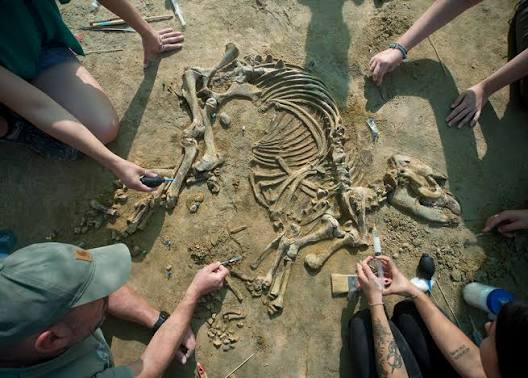
Paleontologists in Spain have uncovered what researchers describe as the most complete juvenile tapir skeleton yet identified in the European fossil record, dating back roughly 4 million years. The remarkable discovery gives scientists an unusually detailed opportunity to examine the anatomy, growth, and evolutionary history of a young animal that lived in Europe long before modern humans appeared. For researchers, the fossil is more than an exceptionally well preserved skeleton. It provides a physical record of how ancient mammals developed and adapted to changing environments over deep geological time.
A Rare Juvenile Skeleton Changes What Scientists Can Learn
Fossil discoveries often consist of isolated teeth, fragments of bone, or incomplete portions of an animal’s skeleton. Such remains can still reveal valuable information, but reconstructing the life of an extinct species becomes far easier when multiple parts of the body are preserved together.
The Spanish discovery is particularly significant because the specimen belonged to a juvenile tapir. Young animals preserve developmental information that adult fossils cannot provide. Their bones can reveal how the skeleton changed during growth, how limbs developed, and how body proportions differed between immature and mature individuals.
We tend to imagine prehistoric animals through the appearance of their adult forms, yet growth is an essential part of evolutionary biology. A young animal is not simply a smaller version of an adult. Its bones, muscles, movement patterns, and feeding behavior can change substantially as it matures.
Having such a complete juvenile skeleton allows researchers to study those changes with an unusual level of detail.
Tapirs Have a Much Older European History Than Many People Realize
Modern tapirs are associated primarily with tropical forests in Central and South America and parts of Southeast Asia. Their distinctive appearance, including a short trunk like nose, compact body, and sturdy limbs, can make them seem like highly specialized modern animals.
The fossil record tells a different story. Tapir relatives once occupied much broader geographic areas, including parts of Europe, Asia, and North America. Their history stretches across millions of years and includes periods when climates and ecosystems were very different from those found on the continents today.
The Spanish fossil therefore provides an important piece of a much larger evolutionary puzzle. Researchers can compare its anatomy with other fossil tapirs and with living species to investigate how characteristics developed over time.
What the skeleton can reveal
A well preserved juvenile skeleton can potentially provide information about several aspects of prehistoric biology:
- How the animal’s bones developed during growth
- How its limbs were adapted for movement
- Changes in body proportions between young and mature animals
- Relationships between extinct tapirs and later species
- Environmental conditions associated with the animal’s habitat
Each of these questions contributes to a more detailed picture of mammalian evolution.
Why Juvenile Fossils Are Scientifically Valuable
Growth leaves a record in bones. As mammals mature, their skeletons undergo predictable changes, including changes in bone shape, proportions, and the fusion of certain skeletal structures. Paleontologists can examine those patterns to estimate developmental stages and compare extinct animals with living relatives.
A juvenile fossil can also help researchers avoid a common problem in paleontology: mistaking young and adult individuals for separate species. Without enough examples from different growth stages, major differences in body proportions can sometimes be interpreted as evidence of separate species rather than normal development.
The Spanish specimen can therefore serve as a reference point for future research. Other fragmentary tapir fossils may become easier to interpret when scientists can compare them with a more complete juvenile skeleton.
Ancient Spain Was Home to Changing Mammal Communities
The Iberian Peninsula has produced an extraordinary variety of fossil discoveries because its landscapes preserved evidence from different periods of Earth’s history. Millions of years ago, the environments of what is now Spain included ecosystems that were dramatically different from modern Mediterranean landscapes.
Changes in temperature, rainfall, vegetation, and geography influenced which mammals could survive in particular regions. Rivers, wetlands, forests, and open habitats created different ecological opportunities for herbivores and predators.
A tapir is particularly interesting because living members of the group are strongly associated with habitats containing abundant vegetation and access to water. The fossil can therefore help researchers investigate what kind of environment existed around the animal when it was alive.
The surrounding geological evidence is just as important as the skeleton itself. Sediments, pollen, plant remains, other animal fossils, and chemical signatures can help scientists reconstruct the landscape in which the young tapir lived.
The Discovery Connects Paleontology With Evolutionary Biology
The significance of the find extends beyond identifying an extinct animal. Fossils allow researchers to examine evolutionary processes using physical evidence accumulated over immense periods of time.
Modern evolutionary health studies can benefit from this perspective because many biological characteristics have deep histories. Skeletal development, locomotion, body size, dental structure, and other traits are products of evolutionary processes that began long before modern species existed.
Comparing extinct mammals with living relatives can help scientists identify which characteristics are ancient and which emerged more recently. This distinction can improve our understanding of mammalian biology and the evolutionary pressures that shaped different body plans.
Researchers can also use modern imaging technologies to study fossils without damaging them. High resolution scanning can reveal internal structures, growth patterns, and anatomical details that are difficult or impossible to observe from the outside.
Modern Technology Is Changing Fossil Research
Paleontology has moved far beyond simply excavating bones and displaying them in museums. Digital imaging, three dimensional modeling, microscopic analysis, and advanced dating techniques now allow scientists to extract information from fossils at increasingly fine levels.
A nearly complete skeleton can be digitally reconstructed and compared with modern tapirs and other fossil species. Researchers can examine joint surfaces, limb proportions, skull anatomy, and other characteristics to investigate movement and development.
These approaches also make scientific collaboration easier. Digital models can be shared between research institutions, allowing specialists in anatomy, evolutionary biology, geology, and paleontology to examine the same specimen from different perspectives.
The Smithsonian National Museum of Natural History provides extensive educational and scientific resources illustrating how modern natural history research uses fossils to investigate Earth’s biological history.
A Fossil Can Preserve More Than Bones
When we look at a fossil skeleton, it can be tempting to see only stone and bone. For scientists, however, the specimen can contain clues about an individual animal’s life. The shape and condition of bones may reveal aspects of growth, movement, injury, and physical development.
The juvenile nature of the Spanish specimen gives researchers a rare opportunity to reconstruct part of the animal’s early life. It may help answer questions about how quickly the species grew, how its body proportions changed, and how its anatomy compared with that of adult tapirs.
Those details can also help scientists understand the ecological role of ancient herbivores. The size and structure of an animal’s limbs and feeding apparatus can provide clues about how it moved through its habitat and what kinds of food resources it may have relied upon.
What the Discovery Means for the European Fossil Record
The completeness of the specimen is one of its most important characteristics. European paleontology has produced numerous tapir fossils, but fragmentary remains can leave major gaps in the record. A complete juvenile skeleton provides a much stronger anatomical reference.
That matters because evolutionary history is rarely preserved as a smooth sequence. Fossil records contain gaps caused by geological processes, environmental conditions, erosion, and the simple improbability of an animal being preserved in the right circumstances.
Every unusually complete specimen can therefore help fill a missing section. The discovery in Spain may allow researchers to connect anatomical features across different fossil populations and improve estimates of how tapirs changed through time.
Preserving Fossils Protects Scientific Evidence
Discoveries such as this also demonstrate why fossil sites require careful protection. Once a scientifically important specimen is removed from its geological context without proper documentation, researchers can lose information about the environment in which the animal lived.
Professional excavation involves recording the exact position of bones, surrounding sediments, associated fossils, and other geological details. Conservation and museum collections then provide a long term home where the material can be studied by future generations.
The National Park Service fossil resources offer useful background on fossil preservation and the importance of protecting paleontological evidence for scientific research and public education.
One Young Tapir, Millions of Years of History
The Spanish fossil reminds us how much information can be contained within a single ancient skeleton. A young tapir that lived approximately 4 million years ago left behind remains that survived environmental change, geological upheaval, and countless generations before eventually reaching the hands of modern scientists.
Its importance lies not only in its age but in its completeness and developmental stage. By examining the skeleton, researchers can investigate growth, anatomy, ecology, and evolutionary relationships in ways that would be difficult with isolated bones.
For the public, the discovery also offers a tangible connection to a distant European landscape. Long before modern cities, roads, and farms reshaped the Iberian Peninsula, mammals such as tapirs moved through ecosystems shaped by rivers, forests, climate, and changing geography.
A New Chapter in the Study of Mammalian Evolution
The discovery of the juvenile tapir skeleton adds an unusually detailed piece to the European fossil record and provides researchers with a valuable reference for studying mammalian development. Its scientific importance will likely extend beyond the initial excavation as specialists continue analyzing its anatomy and comparing it with other fossil and living tapirs.
We often measure scientific discoveries by how dramatically they change what we know. Sometimes, however, their greatest value comes from filling a gap that has remained open for millions of years. This fossil does exactly that. It gives researchers a rare glimpse of a young animal from an ancient European ecosystem and helps reconstruct a biological history that would otherwise remain incomplete.
Four million years after this tapir lived, its skeleton is once again telling a story. This time, the story is being read not by the animals that shared its ancient habitat, but by scientists using modern tools to understand how life changed, developed, and survived across deep time.