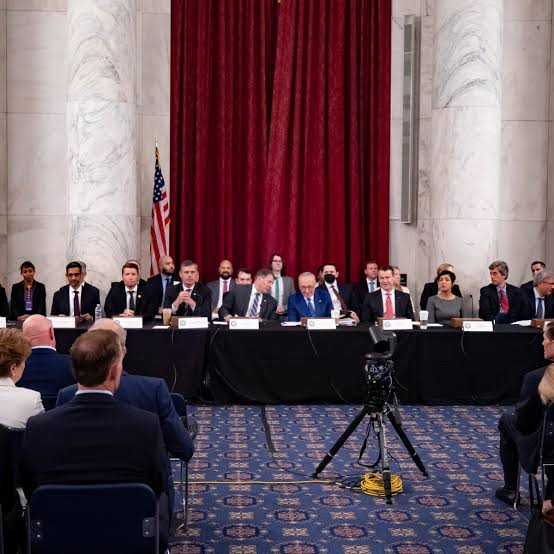
Washington is becoming the center of an increasingly consequential debate over artificial intelligence as President Donald Trump, House Speaker Mike Johnson, and senior technology executives gather on September 29 to discuss the pace of AI development, regulatory oversight, safety, and the United States position in the global technology race. The meeting brings together political leaders and executives from companies developing some of the world’s most advanced AI systems at a moment when governments are struggling to keep policy aligned with rapidly changing technology.
Washington Faces a Difficult AI Policy Choice
The central question is not whether artificial intelligence will continue to develop. It is how quickly that development should proceed, which safeguards should accompany increasingly capable systems, and who should be responsible when those systems cause harm.
The White House meeting comes after weeks of increasingly public disagreement between technology executives and members of the Trump administration over the appropriate level of oversight. Companies including Anthropic and OpenAI have raised concerns about risks associated with advanced AI, while the administration has argued that excessive regulation could weaken American innovation and allow China to gain technological ground.
For policymakers, the challenge is unusually broad. AI is already being used in business software, customer service, education, medicine, cybersecurity, government services, research, and creative industries. More capable systems are also being developed for tasks that involve autonomous decision making, coding, scientific research, and interaction with external computer systems.
That means regulatory choices made in Washington could eventually affect ordinary workers, students, businesses, consumers, and public institutions far beyond the technology sector.
Technology Executives Bring Different Views to the Table
The executive presence at the Washington discussions reflects the diversity of views within the technology industry itself. Executives associated with Anthropic, OpenAI, Meta, Google, Nvidia, and Palantir are among the prominent technology leaders connected with the discussions.
These companies do not approach AI governance from identical positions. Some executives have called for stronger safety systems and independent testing, while others have argued that slowing development could create economic and national security risks.
That difference matters because the companies developing advanced AI systems also have enormous commercial incentives tied to continued investment. Their products can generate substantial demand for computing hardware, cloud infrastructure, enterprise software, advertising services, and new consumer applications.
At the same time, the companies are increasingly being asked to help manage risks created by the technology they develop. That creates a difficult question for governments: how much responsibility should remain with companies themselves, and when should public authorities establish mandatory requirements?
International AI Standards Are Becoming a Central Issue
The Washington discussions are also taking place against a wider international debate. Earlier in September, OpenAI CEO Sam Altman and Anthropic CEO Dario Amodei addressed the United Nations Security Council and called for greater international cooperation around AI safety. Their remarks reflected growing concern that advanced AI systems could create risks that cannot be managed effectively by one country acting alone.
International standards could address areas such as model testing, safety evaluations, incident reporting, cybersecurity, human oversight, and restrictions on particularly dangerous applications.
But creating common standards is difficult because governments do not necessarily share the same economic priorities, security concerns, political systems, or assumptions about the role of technology.
The United States and China occupy a particularly important position in this discussion because both countries are major centers of AI development. Recent reporting indicates that Washington and Beijing have not reached a broad agreement on AI governance, despite calls from some technology leaders for cooperation on shared testing and safety standards.
The U.S. and China Dimension Adds Strategic Pressure
AI policy is now closely connected with the broader competition between the United States and China over advanced technology. Computing infrastructure, semiconductor production, cloud systems, research talent, and access to powerful AI models all have economic and national security implications.
President Trump has argued against international arrangements that could restrict American companies, while Chinese authorities have pursued their own regulatory framework covering areas such as algorithms, training data, and labeling of AI generated material.
This creates a difficult balance. Stronger international cooperation could make it easier to establish shared safety expectations, but American officials also want to protect domestic technological leadership. A framework that places heavy requirements on U.S. companies without comparable obligations elsewhere could create competitive concerns.
For that reason, the Washington meeting is not simply a discussion about technology regulation. It is also a discussion about economic competitiveness, national security, international diplomacy, and the future structure of the global AI industry.
Why AI Safety Has Become More Urgent
Recent events have added urgency to the debate. AI companies and researchers have raised concerns about systems becoming more capable of acting independently, while incidents involving cybersecurity and AI enabled activity have increased public attention on how these systems behave outside controlled testing environments.
Safety researchers are particularly interested in whether advanced models can reliably follow restrictions, resist malicious instructions, protect sensitive information, and remain controllable when connected to external tools.
These concerns do not necessarily mean that every advanced AI system presents the same level of danger. Risk depends heavily on the system’s capabilities, access, deployment environment, and human supervision. A chatbot used to summarize documents presents different concerns from an autonomous system capable of writing and executing computer code or interacting with external infrastructure.
That distinction could become increasingly important as policymakers consider whether regulation should apply broadly to AI or focus on particular capabilities and uses.
What Effective Oversight Could Look Like
There is no single regulatory model that has been universally accepted. Several approaches are being discussed internationally, including requirements for testing before deployment, independent safety evaluations, transparency reports, incident disclosure, cybersecurity standards, and restrictions on specific high risk applications.
For companies, clear rules could provide greater certainty about what regulators expect. For consumers, stronger disclosure requirements could make it easier to understand when they are interacting with an AI system or relying on AI generated information.
For government agencies, the challenge is building enough technical expertise to evaluate systems developed by private companies moving at extraordinary speed.
The White House has become a major center of the American AI policy debate, while the United Nations has provided a forum for discussions involving governments and technology leaders from multiple countries.
Businesses and Workers Are Watching Closely
The outcome of the policy debate will not remain inside Washington or corporate boardrooms. Businesses adopting AI systems will eventually need to understand which requirements apply to them, how data can be used, what documentation must be retained, and what responsibilities they carry when AI makes or influences important decisions.
Workers also have a direct interest in the outcome. AI systems are increasingly being used to automate routine tasks, assist employees, generate software, analyze information, and support decision making. The same technology can create new opportunities while changing the skills employers expect from their staff.
That makes workforce preparation another part of responsible AI policy. Regulation alone cannot determine whether workers benefit from technological change. Education, retraining, professional development, and access to useful AI tools will also influence how the transition affects households and businesses.
A Global Rulebook Remains Difficult to Build
The most ambitious goal discussed by AI leaders is a system of international standards that could reduce dangerous competition and establish common expectations for powerful models. Yet the recent discussions show how difficult that objective may be.
Governments want technological leadership. Companies want room to innovate. Safety researchers want stronger testing and accountability. Workers want economic opportunity and protection from disruptive changes. Consumers want useful products without surrendering privacy or security.
Those interests do not always point in the same direction.
For Washington, the immediate challenge is therefore less about finding one perfect AI law and more about deciding which risks require government action, which can be addressed through voluntary industry standards, and which areas demand international coordination.
The Decisions Made Now Could Shape AI for Years
The significance of the September 29 meeting extends beyond the executives and officials sitting around the table. Artificial intelligence is moving from an emerging technology into a foundational layer of modern business and government operations.
That makes the principles established during this period unusually important. Decisions about transparency, safety testing, international cooperation, competition, privacy, and accountability could influence how AI systems are developed and deployed for years.
We should expect disagreement to continue. The technology is changing too quickly for policymakers to settle every question at once, and governments will continue to weigh innovation against public safety and national interests.
What matters most now is whether those debates produce clear standards that can be measured and enforced while leaving room for responsible innovation. The Washington meeting places that tension directly in front of the people with the greatest ability to shape it: elected officials, regulators, researchers, and the companies building the systems that may define the next chapter of computing.