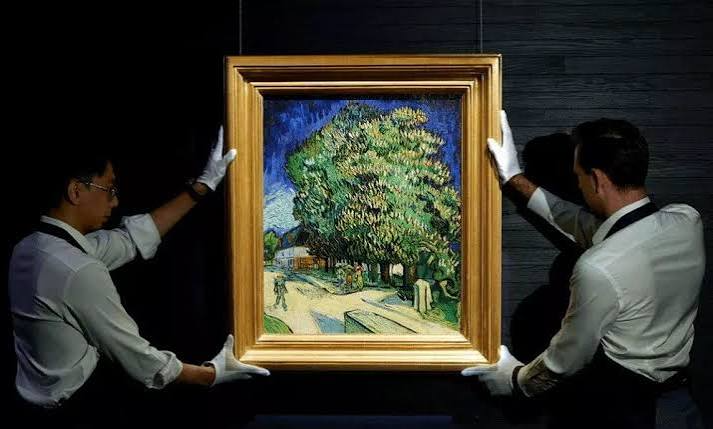
A Vincent van Gogh masterpiece painted during the final months of the artist’s life has sold for an extraordinary $190.4 million at Sotheby’s in New York, establishing a new auction record for the Dutch painter. The sale of Châtaigniers en fleurs, translated as Chestnut Trees in Blossom, took place on November 18, 2026, following an agreement that resolved a dispute involving the descendants of a Jewish family that owned the painting during the Nazi era. Announced on November 19, the historic result represents a major moment for the international art market while also bringing renewed attention to the complicated history of artworks affected by persecution and forced sales during the Holocaust.
The painting exceeded its estimated value of $180 million, reaching a final price of $190.4 million, including auction fees. It surpassed Van Gogh’s previous auction record of $117.2 million, established in 2022. Beyond the financial achievement, the transaction carries considerable historical and emotional significance because the painting’s ownership history became the subject of a dispute involving the family of its former owner, German Jewish publisher Samuel Fischer. The agreement between the current owners and Fischer’s descendants allowed the auction to proceed after questions about the circumstances of its 1936 sale had remained unresolved.
Van Gogh’s Chestnut Trees in Blossom Breaks the Artist’s Auction Record
Painted in May 1890, Châtaigniers en fleurs captures the beauty of the French countryside through Van Gogh’s distinctive use of color, expressive brushwork, and movement. The landscape depicts flowering chestnut trees surrounded by greenery, with several figures walking beneath the branches. Their colorful clothing and parasols provide a human presence within the peaceful rural setting.
The painting was created in Auvers sur Oise, a village northwest of Paris where Van Gogh spent the final two months of his life. During this period, the artist produced an extraordinary number of paintings and drawings, drawing inspiration from the surrounding countryside, gardens, village streets, and everyday activities.
Van Gogh’s final months were marked by remarkable artistic productivity. After leaving a psychiatric institution in Saint Rémy de Provence, he settled in Auvers sur Oise in May 1890. He continued working intensely until his death on July 29, 1890, at the age of 37.
Chestnut Trees in Blossom reflects the artistic energy of this final period. Its expressive colors and broad brushstrokes demonstrate the painter’s ability to turn an ordinary landscape into an emotionally engaging composition. The painting also offers a glimpse into the surroundings that influenced some of his final works.
How the $190.4 Million Auction Unfolded
Sotheby’s presented the painting as the leading work in a dedicated auction featuring 12 pieces from the Blaquier Arrieta Collection. The collection included important Impressionist and modern artworks assembled by the late Argentine collectors Nelly Arrieta de Blaquier and her husband, Carlos Pedro Blaquier.
The Van Gogh painting carried an estimated value of $180 million before the auction. Bidding opened at $135 million and increased through competitive offers. The hammer finally fell at $165 million, with the total reaching $190.4 million after the addition of auction fees.
The auction attracted considerable attention from collectors and art market observers because of the painting’s artistic importance, rarity, and complicated ownership history. The sale was also supported by an irrevocable bid, providing Sotheby’s with a financial guarantee that the artwork would sell.
The other works in the collection also achieved significant results. Paul Cézanne’s painting Arlequin sold for $111 million, making it another major highlight of the evening. All 12 artworks were sold, generating approximately $412 million in total proceeds.
The result placed the Van Gogh among the most expensive paintings ever sold at auction and made it the fourth most expensive artwork sold through an auction house. However, the overall collection total remained below Sotheby’s estimated figure of approximately $450 million.
The Nazi Era Ownership Dispute Behind the Historic Sale
Although the auction attracted attention because of its extraordinary price, the painting’s ownership history was equally significant. The artwork had previously belonged to Samuel Fischer, an influential German Jewish publisher who acquired it in Paris in 1909.
Fischer was an important figure in German publishing and cultural life. His family retained ownership of the Van Gogh after his death in 1934. However, the painting was sold in 1936, during a period when Jewish families in Germany faced increasing persecution, financial restrictions, discrimination, and pressure from the Nazi government.
Descendants of Fischer argued that the family had been forced to sell the artwork because of the financial circumstances created by Nazi persecution. They maintained that the sale could not be considered independently of the political and economic pressures facing Jewish families at that time.
The family’s concerns were particularly important because Nazi policies severely restricted the economic freedom and property rights of Jewish citizens. Financial restrictions, confiscations, discriminatory taxation, and forced emigration created circumstances in which families could lose valuable possessions under enormous pressure.
The Fischer heirs questioned whether their relatives had received fair market value for the painting in 1936. Their legal representative, Berlin based lawyer Gunnar Schnabel, had asked Sotheby’s to establish that the transaction reflected an appropriate market price and that the family would have sold the artwork even without the pressures created by Nazi persecution.
The dispute therefore involved more than the financial value of a painting. It raised questions about historical responsibility, ownership rights, and the difficulties families face when seeking recognition or restitution for property lost during one of the darkest periods in European history.
How the Blaquier Arrieta Family Reached an Agreement With the Fischer Heirs
The Blaquier Arrieta family acquired Châtaigniers en fleurs in 1975 and retained ownership for more than five decades. The painting became part of a distinguished private collection containing important works by leading Impressionist and modern artists.
As preparations for the November auction progressed, the Fischer descendants raised concerns about the circumstances surrounding the 1936 transaction. Their representatives sought to delay the sale until questions about the artwork’s historical ownership had been addressed.
On November 17, Sotheby’s announced that an agreement had been reached between the Blaquier Arrieta family and all legal descendants of Hedwig and Samuel Fischer. The agreement resolved the immediate dispute and allowed the scheduled auction to proceed.
The financial and legal details of the settlement were not publicly disclosed. However, Sotheby’s said the agreement recognized the painting’s complicated Nazi era history and the suffering experienced by the Fischer family during the Holocaust.
The Fischer heirs also expressed gratitude for what they described as a fair negotiation involving the current owners and Sotheby’s. Their statement acknowledged the importance of recognizing their family’s suffering and honoring Gisela Berman Fischer’s efforts to seek justice for her relatives.
Although the painting ultimately changed hands through a major auction, the agreement provided an opportunity to acknowledge the historical circumstances surrounding its earlier ownership. It also demonstrated how negotiations between current owners and descendants of previous owners can help address difficult provenance questions without necessarily requiring a prolonged courtroom dispute.
Why Nazi Era Art Restitution Remains an Important Issue
The Van Gogh sale highlights a broader issue affecting museums, private collectors, auction houses, and international art markets. Thousands of artworks changed ownership during the Nazi period, and many transactions took place under circumstances involving persecution, confiscation, forced migration, or severe financial pressure.
Jewish families were frequently forced to leave behind valuable possessions or sell property to finance their escape from Germany and other territories controlled by Nazi authorities. Some artworks were confiscated directly, while others entered the international market through transactions whose circumstances were difficult to establish decades later.
Following the Second World War, governments and cultural institutions began efforts to identify and return artworks taken from their original owners. However, the process has remained complicated because ownership records may be incomplete, families may have been displaced or murdered, and artworks may have passed through several private collections.
For this reason, provenance research has become an essential part of responsible art collecting. Provenance refers to the documented history of an artwork’s ownership, including its previous collectors, transactions, exhibitions, and movements between countries.
Collectors and auction houses increasingly examine historical ownership records before offering valuable artworks for sale. When questions arise, negotiations with descendants of previous owners can help establish a mutually acceptable resolution.
The Van Gogh agreement does not establish a universal legal outcome for other disputed artworks. Every case involves its own historical evidence, ownership records, legal circumstances, and applicable restitution principles. Nevertheless, the settlement demonstrates the continuing importance of addressing historical claims with transparency and sensitivity.
Van Gogh’s Market Value Continues to Reach Extraordinary Heights
The $190.4 million sale represents a substantial increase over Van Gogh’s previous auction record. In November 2022, his painting Verger avec cyprès, commonly known as Orchard with Cypresses, sold for $117.2 million at Christie’s in New York.
The latest transaction demonstrates the extraordinary demand for important works by internationally recognized artists. Van Gogh remains one of the most influential figures in modern art history, and paintings from his final creative period are particularly sought after by collectors.
Several factors contribute to the value of major Van Gogh paintings. Their artistic importance, historical background, rarity, exhibition history, and condition can all influence market interest. The availability of a major work from a significant period of his career can attract collectors willing to compete at the highest levels of the international art market.
The painting’s return to public attention was also significant because it had not been publicly displayed since 1964 before its recent exhibition preparations. Its appearance in the Sotheby’s auction program offered collectors and art enthusiasts an opportunity to see a work that had remained largely outside public view for decades.
What the Record Sale Means for the International Art Market
The transaction arrives during a period of considerable activity in the international market for major Impressionist and modern artworks. High value auctions remain important events for collectors seeking historically significant paintings, particularly when rare works from established private collections become available.
The successful sale of Chestnut Trees in Blossom demonstrates that exceptional artworks can attract substantial financial commitments even when their ownership histories involve complicated legal and ethical questions.
However, the result should not be interpreted as evidence that every valuable painting will experience similar demand. The market for fine art is highly selective, with prices influenced by artistic importance, provenance, rarity, economic conditions, and competition among individual buyers.
The auction also reinforces the importance of historical documentation. For collectors, a painting’s ownership history can be just as important as its visual qualities. Clear records help establish authenticity, support responsible transactions, and reduce the possibility of future disputes.
A Historic Auction With a Deeper Historical Meaning
Van Gogh’s record breaking sale is an extraordinary financial achievement, but its significance extends beyond the $190.4 million price. The painting represents a remarkable period in the artist’s short life, when he continued producing influential works despite personal difficulties and uncertainty about his future.
Its ownership history also reflects the experiences of Jewish families whose lives and property were affected by Nazi persecution. The resolution involving the Fischer descendants demonstrates why historical recognition and responsible negotiations remain important when artworks with complicated pasts enter the international market.
For Sotheby’s, the auction delivered one of the most significant Van Gogh sales in history. For the international art community, it renewed attention to the relationship between cultural heritage, private ownership, and historical accountability.
The final price will remain an important benchmark for the artist’s auction market. Yet the story behind the painting offers a lasting reminder that great works of art carry histories extending far beyond the auction room. Their value is measured not only in financial terms but also through the cultural experiences, human stories, and historical events they preserve.
Readers interested in the painting’s history, major international auctions, and the wider art market can explore the official Sotheby’s website and follow developments in international art and restitution reporting through Reuters.