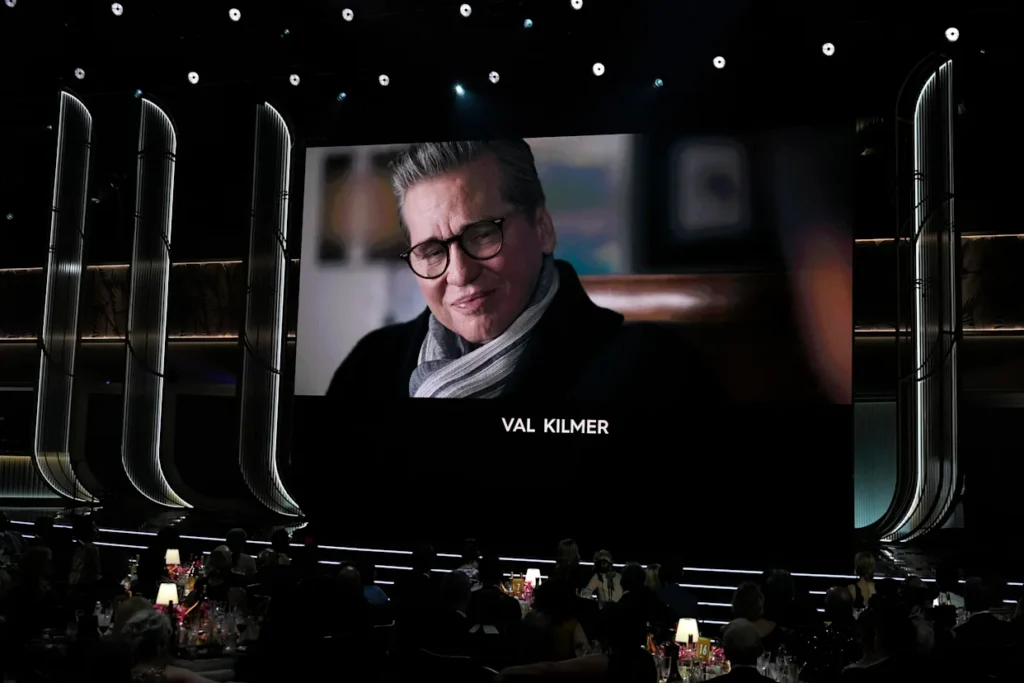
We are standing at a crossroads in cinematic history as filmmakers move forward with a bold and controversial decision to bring an AI generated version of the late Val Kilmer back to the screen. Announced on April 17, 2026, the upcoming feature film places the beloved actor at the center of a global conversation about technology, legacy, and the boundaries of creative expression.
For audiences who remember Kilmer’s commanding performances, from intense dramas to iconic action roles, the idea of seeing him again carries both emotional weight and ethical complexity. The project, built using generative artificial intelligence, raises a fundamental question that now echoes across Hollywood and beyond: just because technology can recreate a human presence, should it?
The Film That Sparked the Debate
The film at the center of the discussion, titled As Deep as the Grave, was originally developed with Kilmer attached to a major role. However, after his passing in 2025 following a long struggle with illness, production faced a difficult choice. Rather than recast the role, filmmakers turned to advanced AI tools to reconstruct his likeness, voice, and performance using archival footage and recordings.
According to reporting from Reuters coverage of the film’s development, the production team worked closely with Kilmer’s family and adhered to industry guidelines to ensure that the digital recreation was authorized and respectful. His children reportedly gave their consent, framing the project as a continuation of his artistic legacy rather than a replacement.
We are seeing how consent and collaboration have become central pillars in these emerging digital performances, yet they do not fully resolve the deeper questions that remain.
A Performance Built from Memory and Data
The process of recreating Kilmer involved assembling fragments of his past work into a cohesive digital presence. Engineers and artists analyzed footage from different periods of his life, mapped facial movements, and synthesized his voice using machine learning models trained on years of recordings.
In many ways, the result is not a traditional performance but a reconstruction of identity. The character he portrays in the film appears across multiple stages of life, blending archival authenticity with algorithmic interpretation. This raises an important distinction. What audiences will see is not Kilmer acting in real time, but a carefully curated version of him shaped by both human intent and machine logic.
We are witnessing a form of storytelling that exists between preservation and invention, where memory itself becomes a creative medium.
The Emotional Response from Audiences
Public reaction has been deeply divided. For some, the film represents a moving tribute, a chance to reconnect with an actor whose presence left a lasting impression. For others, it feels unsettling, even intrusive, as if a boundary has been crossed between honoring the past and rewriting it.
Online discussions have revealed strong emotions on both sides. Some viewers express gratitude for the opportunity to see Kilmer again, while critics argue that digital resurrection risks reducing human lives to reusable assets. The intensity of the response highlights how personal and cultural our relationship with actors can be.
We are not simply reacting to technology. We are responding to what it means to remember, to grieve, and to let go.
The Ethical Questions Facing Hollywood
The use of AI to recreate deceased performers introduces a complex web of ethical considerations. Consent from families and estates is one aspect, but it does not fully address broader concerns about artistic integrity and the rights of individuals after death.
Industry organizations have already begun to weigh in. Guidance from groups such as SAG AFTRA emphasizes the importance of transparency, authorization, and fair compensation when using digital replicas. These principles aim to protect both performers and their legacies, but they also acknowledge that the technology is evolving faster than regulations can keep pace.
We are entering a period where ethical frameworks must adapt quickly, balancing innovation with respect for human dignity.
Who Owns a Digital Legacy
At the heart of the debate lies a profound question of ownership. Does an actor’s likeness belong to their family, their estate, or the broader cultural memory they helped shape? And how should that likeness be used once the actor is no longer here to make decisions?
Legal systems are still grappling with these questions. Intellectual property laws provide some guidance, but they were not designed with generative AI in mind. As a result, each new project becomes a test case, shaping the norms that will define the future of digital performance.
We are observing the early stages of a legal and cultural shift that will likely influence creative industries for decades.
The Technology Driving the Transformation
The tools used to recreate Kilmer are part of a broader wave of innovation in artificial intelligence. Advances in deep learning, voice synthesis, and visual rendering have made it possible to generate highly realistic human representations with remarkable speed.
These technologies are not limited to film. They are being applied across industries, from gaming to virtual reality, where digital characters can interact with users in increasingly lifelike ways. Research published through platforms like arXiv scientific research archive continues to explore how AI can enhance storytelling and immersive experiences.
We are seeing how the boundaries between reality and simulation are becoming more fluid, reshaping how stories are created and experienced.
Artistic Possibility Versus Human Presence
Supporters of AI generated performances argue that the technology opens new creative possibilities. It allows filmmakers to complete unfinished projects, revisit historical narratives, and explore stories that might otherwise remain untold.
Yet there is a counterargument that something essential is lost in the process. Acting is not just about appearance or voice. It is about spontaneity, interpretation, and the subtle emotional exchanges that occur in real time. A digital reconstruction, no matter how advanced, may struggle to replicate that depth.
We are faced with a tension between what can be recreated and what can only be lived.
A Turning Point for the Film Industry
The decision to feature an AI generated version of Val Kilmer marks a turning point for Hollywood. It signals that digital resurrection is no longer theoretical but actively shaping major productions. As more projects explore similar techniques, the industry will need to establish clearer standards and expectations.
Filmmakers, actors, and audiences alike are being asked to reconsider long held assumptions about performance and authorship. The traditional boundaries of time and mortality are being challenged in ways that were once confined to science fiction.
We are witnessing the emergence of a new cinematic language, one that blends human creativity with technological capability.
What Comes Next
The release of this film will likely influence how future projects approach the use of AI in storytelling. If audiences embrace the concept, it could lead to more posthumous performances and expanded use of digital replicas. If resistance grows, it may prompt stricter regulations and ethical guidelines.
Either way, the conversation sparked by this project will not fade quickly. It touches on fundamental questions about identity, memory, and the role of technology in shaping human experience.
We are not just observing a single film release. We are witnessing a moment that challenges how stories are told and who has the right to tell them, even after a life has ended.
As the lights dim and the screen flickers to life, audiences will not only see a familiar face. They will confront the future of cinema itself, where the line between presence and absence grows increasingly difficult to define.