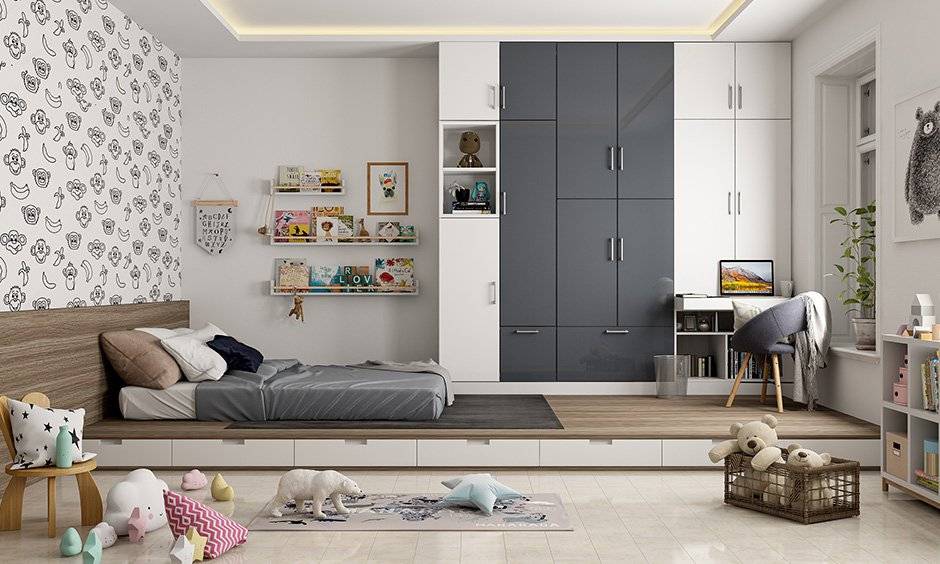
Most parents are going about bedroom clutter the completely wrong way. They’re buying more storage, another shelf, another box, another unit… and the room is getting smaller. The actual problem isn’t a lack of storage. It’s the furniture not suiting how kids use the room anymore.
A kids bedroom in 2025 is a sleep space, a gaming station, a study area, and a media room. Traditional furniture was never designed for that. A bed does one thing. A TV stand does one thing. A desk does one thing. Put all three in a small room and you’ve already lost before you’ve added a single toy.
Why traditional furniture is failing modern kids’ rooms
The typical small bedroom only offers 80 to 100 square feet of space once the walls come in. A standard TV stand or media console alone occupies 4 to 6 square feet of floor space. Factor in a separate desk, a wardrobe, and a bed frame, and you’ve already eaten up the majority of available floor space.
When usable floor real estate dwindles, your child will directly feel the effects. A cluttered, crowded room is overwhelming: too much to look at, too little space to do the looking around. Children with no open floor space to speak of will transition between tasks less organically, because there’s no place to be.
How integrated furniture changes the equation
Multipurpose furniture combines several items or functions into one physical unit. For example, rather than needing a bed, TV stand, and media cabinet, 3 pieces of furniture occupy 3 areas. A multipurpose unit fulfils all 3 roles.
In terms of running a TV in the bedroom, the most obvious multipurpose piece is the Tv Bed – a design that integrates the screen and media storage into the footboard of the bed frame. There’s no separate entity right up against the wall (or at least there shouldn’t be, some designs do make this mistake).
The floor space a standalone television chest or a wall-mount bracket and media console system would claim is saved. TV chests, in particular, can be deep beasts, but that’s essentially dead area that you get no utility from. All that space behind the TV could just as well be an empty wall for all the function it serves.
Second, flat screens are notorious cable cluster generators. Most modern stands are pretty good for cable management, with at least holes at the back through which you can fish your cables. But if you’re really serious about making a neat and tidy look, start from tech that has cable routing built in. The cables have to go from the TV to the wall to the underside of the bed if they’re not just going to sprawl across the floor, and dedicated routes in the design let you do that.
Using vertical space and hidden storage
Once you’ve dealt with the media footprint, the next biggest win is storage. Most kids’ rooms waste the vertical space above the floor entirely. Beds with ottoman-style bases – gas-lift mechanisms that turn the entire mattress platform into accessible storage – recover a significant amount of room without adding any footprint at all.
The logic is simple: the space under a standard bed frame is usually dead space, either empty or filled with things that don’t belong there. An integrated storage base turns that same cubic footage into a usable, hidden compartment. Sports kit, spare bedding, off-season items – all of it goes under the bed and out of sight.
This approach fits into a broader minimalist design philosophy that genuinely works well in children’s rooms. Less visual noise means less distraction at sleep time and better mental separation between different activities.
Zoning without walls
A benefit of integrated furniture that is not so obvious is that it forms natural areas in the small room. For instance, if the entertainment system is inside the bed frame, it serves as a reference point for the “media zone.” The desk is used for studying. The bed is for sleeping and relaxation. Even when there’s an overlap of these zones in a confined space, the boundaries are more distinct.
This separation is crucial for a child’s sleep. For example, the TV on a stand on the other side of the room can turn the entire room into a media space. If it’s part of the bed and can be easily hidden, the room becomes a very different environment at bedtime.
Buying once instead of buying often
There’s also a financial advantage to this argument. Parents usually need to buy multiple sets of furniture as their children grow up. What works for a 6-year-old doesn’t work for a 12-year-old, and the same goes for a 12-year-old and a teenager. Integrated furniture that is designed to be adjustable and last a long time helps you avoid this cycle.
Rather than constantly replacing cheap, standalone furniture, it’s more cost-effective to make a one-time investment in a well-made integrated frame. This way, the room will still be functional throughout your child’s different stages of childhood.
A messy kid’s bedroom is a problem with its furniture, not an issue with being tidy. Just replace the add-on strategy with furniture that combines what the room needs, and the room will begin to work for you and not against you.