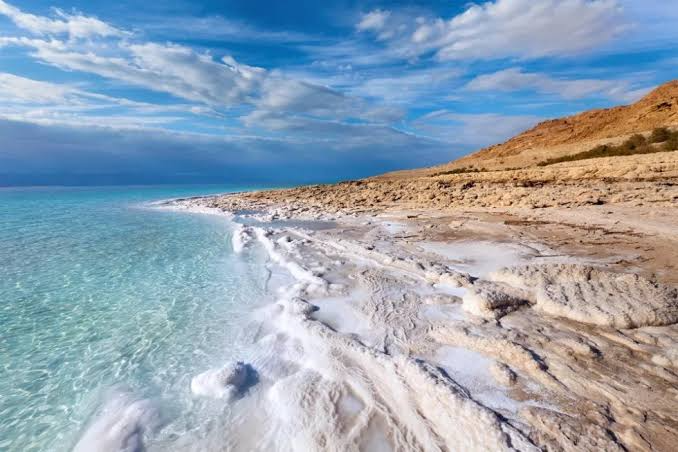
On July 26, 2026, environmental agencies released critical data showing the Dead Sea’s surface has dropped to 440 meters below sea level, a record low that has accelerated regional water conservation initiatives across Israel, Jordan, and the Palestinian territories. The announcement, backed by satellite measurements and ground monitoring stations, underscores a decades long trend of decline driven by reduced inflow from the Jordan River, industrial mineral extraction, and the region’s naturally high evaporation rates.
[globaltimes](https://www.globaltimes.cn/page/202607/1366797.shtml)
A Landscape in Retreat
Standing on the shores of the Dead Sea today, you can see the retreat in plain sight. Abandoned piers jut into empty air, their ends stranded far from the waterline. Tourist resorts that once lined the coast now sit surrounded by cracked mud and salt flats, relics of a shoreline that has moved hundreds of meters farther out. Sinkholes dot the landscape where the ground has collapsed, swallowing roads, fences, and in some cases, entire buildings.
[youtube](https://www.youtube.com/watch?v=FZm9eNkIq2E)
The numbers tell the same story in stark terms. The Dead Sea has been falling by more than one meter each year on average, a pace that has accelerated since the 1960s when large scale diversion of the Jordan River began. What was once cited as 430 meters below sea level is now 440 meters, making the Dead Sea not only the lowest exposed land point on Earth but also one of the fastest shrinking bodies of water on the planet.
[en.wikipedia](https://en.wikipedia.org/wiki/Dead_Sea)
Why the Water Is Disappearing
The drivers are well understood and largely human made. The Jordan River, which once fed the Dead Sea with a steady flow of fresh water, has been heavily diverted for agriculture and domestic use in Israel, Jordan, and Syria. Industrial operations on both sides of the sea pump water into evaporation ponds to harvest minerals such as potash and magnesium, further reducing the inflow.
[bbc](https://www.bbc.com/news/world-middle-east-36477284)
Climate adds pressure. The region’s extreme heat and aridity mean that what little water does reach the sea evaporates quickly, leaving behind salt and minerals that concentrate over time. As the water level drops, the surface area shrinks, which in turn accelerates evaporation and deepens the cycle of decline.
[globaltimes](https://www.globaltimes.cn/page/202607/1366797.shtml)
Environmental and Economic Consequences
The ecological toll is visible in the collapsing shoreline. As the water recedes, underground salt deposits dissolve, creating voids that cause the ground above to cave in. These sinkholes have damaged infrastructure, closed beaches, and made large stretches of the coast unsafe for visitors and residents alike.
[facebook](https://www.facebook.com/groups/physicsisfun109/posts/956649750347203/)
Tourism, a major economic pillar for communities on both the Israeli and Jordanian sides, has suffered. Hotels and spas that once drew visitors from around the world now struggle to stay open as the water moves farther away and the landscape becomes more hazardous. The reputation of the Dead Sea as a health and wellness destination is at risk, with travelers increasingly wary of the visible signs of environmental stress.
[bbc](https://www.bbc.com/news/world-middle-east-36477284)
There are also cross border implications. The Dead Sea is a shared resource, and its decline affects water security, land use planning, and regional cooperation. As the crisis deepens, the need for coordinated action becomes more urgent, not less.
[britannica](https://www.britannica.com/place/Dead-Sea)
Regional Conservation Initiatives Gain Momentum
The latest data release has acted as a catalyst for policy action. Environmental agencies in Israel and Jordan have announced expanded monitoring programs, stricter limits on water extraction from the Jordan River, and new investments in water recycling and desalination to reduce pressure on natural sources. Public awareness campaigns are also being rolled out, urging residents and tourists to conserve water and support sustainable practices.
[globaltimes](https://www.globaltimes.cn/page/202607/1366797.shtml)
One of the most discussed proposals remains the Red Sea to Dead Sea conduit, a large scale engineering project designed to transfer seawater from the Red Sea to stabilize the Dead Sea’s level. The plan includes desalination plants to provide fresh water for Jordan and the Palestinian territories, with the byproduct brine channeled to replenish the Dead Sea. While the project has faced criticism over environmental risks and cost, the accelerating decline has renewed political will to move forward with pilot phases and feasibility studies.
[youtube](https://www.youtube.com/watch?v=FZm9eNkIq2E)
At the same time, there is growing emphasis on restoring the Jordan River itself. Advocacy groups and government bodies are pushing for increased winter flow allocations, improved wastewater treatment, and stricter enforcement of diversion limits. The goal is to bring more fresh water back into the system, slowing the rate of decline and giving the ecosystem a chance to recover.
[britannica](https://www.britannica.com/place/Dead-Sea)
What Travelers Should Know
If you are planning to visit the Dead Sea, the advice is straightforward. Check current access conditions before you go, as some beaches and resorts have been closed due to sinkhole risk and shoreline instability. Follow posted warnings and stay on marked paths, especially in areas where the ground may be undermined by underground cavities.
[facebook](https://www.facebook.com/groups/physicsisfun109/posts/956649750347203/)
Be prepared for a different experience than in past decades. The waterline has moved, and many historic sites are now far from the shore. Some facilities have relocated or adapted, while others have closed entirely. Travelers who understand the context and respect the environment can still enjoy the unique buoyancy and mineral rich waters, but with greater awareness of the fragility of the landscape.
[youtube](https://www.youtube.com/watch?v=FZm9eNkIq2E)
For those who want to support conservation efforts, choosing operators that follow sustainable practices and contribute to local environmental initiatives can make a difference. Small actions, such as reducing water use in hotels and avoiding littering, add up when multiplied across thousands of visitors each year.
[bbc](https://www.bbc.com/news/world-middle-east-36477284)
Looking Ahead: A Test of Regional Resolve
The Dead Sea’s record low is not just a number, it is a signal. It tells us that the current trajectory is unsustainable and that meaningful change is needed to protect one of the most iconic natural landmarks on Earth. The data released on July 26, 2026 has sharpened that message, pushing governments, businesses, and communities to act with greater urgency.
[en.wikipedia](https://en.wikipedia.org/wiki/Dead_Sea)
Restoring the Dead Sea will require more than engineering fixes. It will demand a shift in how water is valued and managed across the region. It will call for cooperation between neighbors who have often been divided, and for a recognition that the health of the Dead Sea is tied to the health of the Jordan River basin as a whole.
[britannica](https://www.britannica.com/place/Dead-Sea)
For those who have floated in its waters or walked its shores, the stakes are personal. The Dead Sea is a place of wonder, a marvel of nature that has drawn visitors for millennia. Saving it will not be easy, but the alternative, watching it vanish into a salt scarred depression, is unthinkable.
[en.wikipedia](https://en.wikipedia.org/wiki/Dead_Sea)
Reliable information on water levels, environmental conditions, and travel advisories can be found through Britannica for background context and through regional environmental agencies that post live monitoring data and safety updates.
[britannica](https://www.britannica.com/place/Dead-Sea)