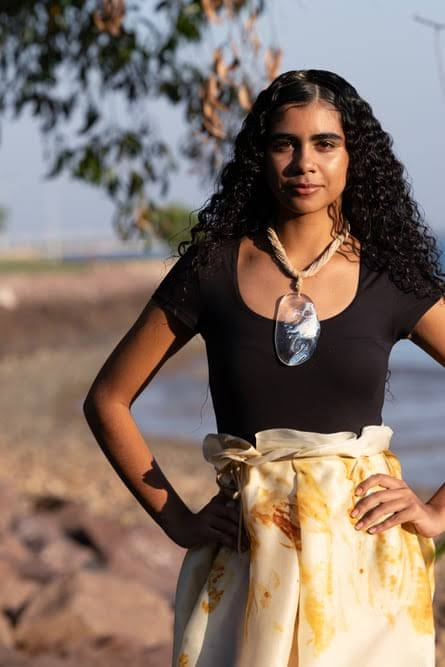
Delvene Cockatoo Collins has been named the 2026 Fashion Designer Award winner at the National Indigenous Fashion Awards, receiving the top honor for a contemporary body of work rooted in Quandamooka culture, locally sourced materials and a deep relationship with Country. The announcement on August 5 places one of Australia’s distinctive First Nations artists at the center of a national conversation about fashion, cultural memory and responsible design.
A major honor for a Quandamooka artist
Cockatoo Collins, who works from Goompi, also known as Dunwich, on Quandamooka Country in Queensland, was recognized at the seventh annual National Indigenous Fashion Awards. Her work includes clothing, accessories and homewares made with handcrafted textiles and materials gathered with care from the places that inform her practice.
The award recognizes more than visual appeal. It acknowledges a design language that carries stories about family, land, history and belonging. When a garment is made from materials connected to Country, its meaning can extend well beyond the fabric itself. The texture, color and pattern may hold memories of shoreline, plant life, community and the people who have cared for that place across generations.
[theguardian](https://www.theguardian.com/fashion/2026/aug/06/delvene-cockatoo-collins-wins-national-indigenous-fashion-award-for-textiles-harvested-on-country)
Cockatoo Collins described herself as overwhelmed by the recognition. That response reflects the weight of an award that honors both creative achievement and cultural responsibility. For many Indigenous designers, fashion is not an isolated commercial product. It can be a living record of identity, a way to keep knowledge visible and a means of allowing audiences to encounter culture through form, touch and movement.
Design rooted in Country
The phrase “designing on Country” carries practical and cultural meaning. It can refer to where an artist lives and works, but it also describes a process shaped by local knowledge, seasonal materials and relationships with community. Cockatoo Collins’s practice reflects that connection through textiles harvested locally and turned into contemporary objects that remain tied to their origin.
Her work shows how Indigenous fashion can move between art, design and everyday use without losing its cultural foundation. A dress may be worn on a runway, a textile may be displayed in a home and an accessory may travel far from its place of origin. Yet each object can still point back to the stories and responsibilities that gave it meaning.
That balance is central to the importance of the National Indigenous Fashion Awards. The program gives public attention to designers whose work may not fit neatly into traditional fashion categories. It also makes space for practices that combine weaving, adornment, print, sculpture, natural materials and contemporary apparel.
[ifp.org](https://www.ifp.org.au/nifa-2026-winners/)
Country Road partnership adds a practical benefit
The Fashion Designer Award is supported by Country Road, which has presented the category since 2020. Along with a prize of $5,000, the award offers the recipient a choice of financial support or a 12 month industry mentorship with Country Road. That opportunity can be especially valuable for an independent designer managing the many demands of a growing creative business.
A mentorship may include guidance on production planning, wholesale relationships, pricing, retail strategy, brand development and the practical demands of presenting collections to larger audiences. For an artist whose work is built around cultural knowledge, the right professional support can help increase visibility while keeping creative control and community obligations at the center.
[ifp.org](https://www.ifp.org.au/nifa-2026-winners/)
The partnership also signals that Indigenous fashion deserves sustained investment rather than occasional attention. Awards can bring a brief moment in the spotlight, but mentorship, fair payment, respectful licensing and long term relationships are what help designers build durable careers.
A national platform for First Nations fashion
The National Indigenous Fashion Awards are presented by Indigenous Fashion Projects alongside Country to Couture. The awards form part of a wider program that celebrates First Nations design from urban centers, regional communities and remote areas across Australia. This year’s ceremony recognized seven recipients across fashion, textile design, traditional adornment, wearable art and emerging talent.
[theguardian](https://www.theguardian.com/fashion/2026/aug/06/delvene-cockatoo-collins-wins-national-indigenous-fashion-award-for-textiles-harvested-on-country)
Other 2026 recipients include Lillardia Briggs Houston, who received the Textile Design Award, Michelle Pulwayu, who won the Traditional Adornment Award, and Lucy Simpson, who received the Wearable Art Award. Jake Powers was named the recipient of the Cecilia Cubillo Young Achiever Award. Together, the winners show the range of creative practices represented by the program, from clothing and surface design to objects that sit between art, ceremony and personal expression.
[abc.net](https://www.abc.net.au/news/2026-08-05/national-indigenous-fashion-awards-nifa-art-designs-darwin-nt/106995770)
- Fashion Designer Award: Delvene Cockatoo Collins from Goompi and Dunwich, Quandamooka Country.
- Textile Design Award: Lillardia Briggs Houston from North Albury, New South Wales.
- Traditional Adornment Award: Michelle Pulwayu from Minnamurra, Wiranku and Tiwi Country.
- Wearable Art Award: Lucy Simpson from Tempe, New South Wales.
- Cecilia Cubillo Young Achiever Award: Jake Powers from Walmany and Cable Beach, Western Australia.
Why representation in fashion matters
Fashion is often discussed through the language of seasonal trends, retail sales and celebrity appearances. Indigenous fashion asks us to consider a longer view. It can connect the body to place, make cultural knowledge visible and challenge the idea that design begins only when a product reaches a studio or showroom.
For audiences, that connection may be felt in small details. A rough natural fiber can recall the surface of bark or dry grass. A muted earth tone can suggest sand after rain. A repeated mark can carry a story that is not immediately available to someone outside the artist’s community. The point is not to reduce those details to decoration, but to recognize that their meaning depends on relationship, context and respect.
We should also be careful not to treat Indigenous creativity as a single style. First Nations designers represent many communities, languages, histories and artistic traditions. Their work cannot be separated from the specific Country and cultural authority that shape it. Responsible coverage therefore requires naming the designer’s community accurately, avoiding vague claims and recognizing the difference between inspiration and permission.
A milestone with wider consequences
Cockatoo Collins’s win arrives during a significant year for Indigenous arts in Australia. The 2026 program coincides with the 20th anniversary of the Darwin Aboriginal Art Fair, giving the awards additional visibility within a broader celebration of First Nations creativity. The connection between art, fashion and commerce is clear, but so is the need for those relationships to be handled on terms that respect artists and communities.
[vogue.com](https://www.vogue.com.au/fashion/news/national-indigenous-fashion-awards-winners-2026/image-gallery/830c42e4d030ada08c0d96d39736452c)
The award may lead to greater public interest in Cockatoo Collins’s collections, but its most lasting value could be the attention it directs toward the processes behind them. Locally harvested materials require knowledge of place. Handcrafted textiles require time. Cultural storytelling requires accountability. When those elements are recognized as part of the work rather than treated as background details, the fashion industry gains a more honest understanding of what the designer is contributing.
Readers who want to follow the work of Indigenous designers can explore current award information through Indigenous Fashion Projects and learn more about Country Road’s continuing support for First Nations fashion through Country Road’s official website. Purchasing directly from authorized artists and labels, checking how designs are licensed and learning the names of the communities connected to a collection are simple ways for audiences to show respect.
What comes next for Delvene Cockatoo Collins
The next stage of Cockatoo Collins’s career will likely bring new opportunities to present her work to wider audiences while continuing to develop ideas grounded in Quandamooka Country. Whether through the award’s financial prize, its industry mentorship or new exhibition and retail opportunities, the recognition gives her practice a stronger national platform.
For us as viewers, the significance of this win lies in the meeting of beauty and responsibility. Delvene Cockatoo Collins has been honored not simply for making striking contemporary fashion, but for showing how clothing and textiles can carry place, memory and cultural continuity. Her achievement gives the 2026 National Indigenous Fashion Awards a clear message: Australian fashion is strongest when it makes room for the stories that have always been here.