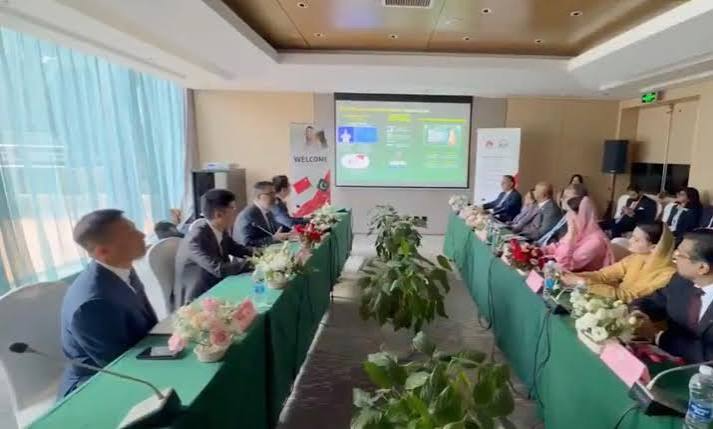
Punjab is moving to build a larger artificial intelligence workforce through a new cooperation initiative with Chinese technology company Huawei, with plans to train 1,000 young people as Huawei master trainers and provide specialized AI training to 300 women trainers. Announced following Punjab Chief Minister Maryam Nawaz Sharif’s meeting with Huawei officials in China, the initiative also includes discussions on an artificial intelligence delivery unit, six data centres and wider cooperation in cloud computing, education, health care, agriculture and smart public services.
A Major Push to Put AI Skills Into More Classrooms
The agreement arrives as governments and technology companies compete to prepare workers for an economy increasingly shaped by artificial intelligence. For Punjab, the challenge is particularly significant because of its large young population and the rapidly changing requirements of technology employers.
Under the reported arrangement, 1,000 young people from Punjab will receive training to become Huawei master trainers. Another 300 women trainers will receive AI focused training. The approach matters because training a relatively small group of instructors can create a much wider educational network. Once qualified, those trainers can potentially pass technical knowledge to students, teachers, professionals and other learners across educational institutions.
That multiplier effect could prove more valuable than a conventional short term training program. Instead of teaching a fixed number of students once, a trained instructor can continue teaching new groups for years, provided that the curriculum and certification standards are regularly updated.
The initiative also comes as Pakistan is pursuing several parallel efforts to expand digital skills. The federal government recently announced a partnership with Google that includes 150,000 Google Career Certificates for Pakistani youth during 2026. :contentReference[oaicite:0]{index=0}
Why the 1,000 Trainer Target Matters
The idea behind a master trainer model is straightforward. A technology company can directly train a limited number of instructors who then become a local source of expertise for much larger groups of learners.
For Punjab, this could help address one of the biggest barriers to AI education: the shortage of teachers who are comfortable working with modern AI tools, cloud platforms, data systems and machine learning concepts.
A student may have access to a computer laboratory and an internet connection, but those resources have limited value if there is nobody available to explain how AI systems work or how those skills translate into real employment.
Well trained instructors can bridge that gap. They can teach students how to move beyond basic AI tool usage toward more technical areas such as cloud computing, data processing, model development, automation and responsible AI deployment.
Women Trainers Receive a Dedicated Role
The decision to train 300 women separately is another important part of the initiative. Women remain underrepresented in many technical fields, and access to instructors who can provide relevant training in educational and professional settings can help broaden participation.
The initiative does not simply frame women as recipients of technology training. By focusing on women trainers, it creates the possibility of building a larger network of women who can teach AI skills to other students and professionals.
That distinction matters. A student who sees qualified women teaching artificial intelligence, cloud technologies and software development is more likely to view those fields as realistic career options rather than distant specialties reserved for a small group of technology professionals.
The broader national training environment is already moving in this direction. A recent Huawei certification program supported through Pakistan’s National Vocational and Technical Training Commission included a 30 percent quota for women and offered training in artificial intelligence and cloud computing. :contentReference[oaicite:1]{index=1}
Punjab Is Also Planning New AI Infrastructure
The education initiative is only one part of the wider cooperation discussed between Punjab and Huawei. Officials also reviewed a proposal to establish an Artificial Intelligence Delivery Unit and discussed six data centres at the Nawaz Sharif IT City, including a sovereign data centre.
That combination of people and infrastructure is important. AI education cannot scale indefinitely on training programs alone. Students and researchers need computing resources, cloud platforms, reliable connectivity and places where they can develop and test applications.
Data centres could provide the infrastructure required for government services, enterprise applications and locally developed AI systems. A sovereign data centre could also support greater control over sensitive government information, although the precise architecture, ownership arrangements and operational safeguards have not yet been publicly detailed.
According to the Punjab government’s reported roadmap, the province wants to build capabilities in cloud computing, digital infrastructure and locally developed AI models. The discussions with Huawei therefore extend beyond classroom training into the technical foundation required to operate AI systems at larger scale.
From Education to Employment
For young Pakistanis, the most important test of the initiative will not be how many certificates are issued. It will be whether those certificates lead to practical skills and meaningful employment.
AI education can become valuable when learners understand how to use their knowledge to solve actual problems. A student who learns cloud computing, for example, could move toward cloud administration, application deployment or infrastructure support. Someone studying AI could eventually work in data analysis, machine learning, automation or AI application development.
The same principle applies to freelancing. Pakistan has a large freelance workforce, and AI skills could give independent professionals access to new categories of international work. However, a certificate alone does not guarantee clients or income. Learners still need communication skills, portfolios, practical experience and an understanding of how to deliver projects reliably.
That is why the quality of the training program will matter as much as its size. Students should ideally leave programs with practical projects they can demonstrate to employers rather than simply a certificate that confirms attendance.
AI Is Already Moving Into Punjab’s Public Services
The proposed workforce expansion is also connected to Punjab’s growing use of artificial intelligence in government operations. Officials have said AI is being introduced across areas including health care, education, infrastructure, agriculture, traffic management and public safety.
Punjab has also established an AI office, according to officials involved in the initiative. The government has described its goal as building an AI integrated and interconnected provincial system by 2029.
That ambition creates a need for people who can maintain these systems after they are deployed. Artificial intelligence is not a one time installation. Models need monitoring, data needs management, software requires updates and automated systems need human oversight.
A larger local workforce could reduce dependence on outside specialists and make it easier for provincial departments to maintain technology projects over the long term.
Healthcare, Agriculture and Manufacturing Could Become Major AI Use Cases
The cooperation discussions include several sectors where AI could have practical consequences for ordinary people. Health care, agriculture and manufacturing all generate large quantities of data and involve decisions that can benefit from automation and analytical tools.
In agriculture, AI systems can help analyze crop conditions, weather patterns and irrigation requirements. In manufacturing, computer vision and predictive maintenance can help identify defects or equipment problems. In health care, machine learning can assist with image analysis, administrative processes and certain forms of clinical decision support.
But these applications also require caution. AI systems used in high consequence settings must be tested carefully, and human professionals need to remain responsible for important decisions. A technically impressive system is not automatically a safe system.
What Huawei Brings to the Partnership
Huawei has extensive experience in telecommunications, cloud computing, data centre infrastructure and enterprise technology. Its involvement gives Punjab access to a company with a large international technology ecosystem and established training and certification programs.
Huawei certification pathways already cover areas such as artificial intelligence, cloud technologies and solution architecture. A recent training program hosted through HITEC University and a Huawei authorized training partner offered HCCDA artificial intelligence, HCCDA technology essentials and HCCDP solution architecture certifications. :contentReference[oaicite:2]{index=2}
For Punjab, working with an established technology company could help create more standardized training pathways. The real benefit, however, will depend on how effectively those programs are adapted to local educational institutions and employment needs.
The Nawaz Sharif IT City Could Become a Central Hub
Punjab has also invited Huawei to invest in the Nawaz Sharif IT City. The proposed technology hub could become an important part of the province’s broader digital infrastructure strategy if the planned investments materialize.
The discussions around six data centres, including a sovereign facility, suggest that officials are thinking about the IT city as more than a collection of office buildings. The objective appears to be creating a location where computing infrastructure, technology companies, skilled workers and public sector digital projects can operate within a connected ecosystem.
Such an ecosystem could create opportunities for universities and private companies to work together. Students could gain access to internships, companies could recruit trained graduates and researchers could work on locally relevant AI applications.
The Biggest Challenge Will Be Turning Announcements Into Skills
Large technology agreements often attract attention when they are announced, but their long term value is determined by implementation. Training 1,000 master trainers is an ambitious target. Ensuring that those trainers remain active, receive updated material and reach students across Punjab will require sustained coordination.
AI itself is also changing quickly. A curriculum that is useful today can become outdated within a short period. Training programs therefore need regular updates covering new AI tools, cloud services, cybersecurity risks, data privacy and responsible AI practices.
There is also a need to ensure that opportunities extend beyond major urban centres. Punjab contains a vast network of educational institutions and communities with very different levels of access to technology. If training remains concentrated in Lahore and a handful of large cities, its economic impact will be narrower than the headline numbers suggest.
What Students Should Look For in the New AI Economy
For students and early career professionals, the announcement offers a useful signal about where technology skills may be heading. Artificial intelligence is increasingly being connected with cloud computing, cybersecurity, data engineering and software development rather than treated as a completely separate field.
Students preparing for these opportunities should therefore focus on practical foundations. Strong programming skills, databases, mathematics, problem solving and communication remain valuable even as AI tools become more capable.
Students can also benefit from building projects rather than collecting certificates alone. A working application, automation project, data analysis dashboard or AI powered prototype can demonstrate skills in a way that a certificate cannot always do.
A Potential New Chapter for Punjab’s Technology Workforce
The Punjab and Huawei initiative arrives at a time when Pakistan is trying to turn its young population into a larger technology workforce. The agreement’s combination of AI instructor training, women’s participation, cloud computing, data centres and public sector applications gives it a broader scope than a conventional skills program.
We should judge the initiative by what happens after the announcement. If the 1,000 master trainers receive high quality instruction and go on to train thousands more students, the impact could extend far beyond the original group. If the planned data centres and AI delivery infrastructure are developed alongside that workforce, Punjab could also gain the technical capacity needed to support locally developed digital services.
The opportunity is substantial, but so is the responsibility. AI skills must be paired with ethical standards, cybersecurity awareness, privacy protections and practical employment pathways. Young people need opportunities to build, experiment and earn rather than simply collect credentials.
Punjab’s partnership with Huawei could become an important piece of that effort. The province is betting that the combination of trained people and modern infrastructure can help it compete for a larger share of the global digital economy. The next measure of success will be whether that ambition reaches classrooms, laboratories, workplaces and ultimately the lives of the young people expected to carry Pakistan’s AI economy forward.