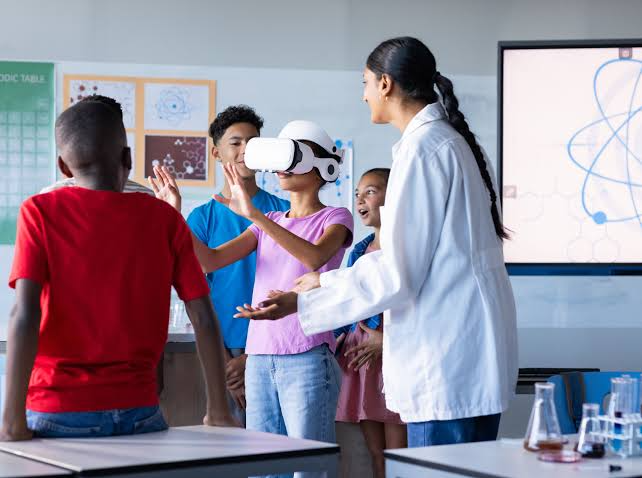
UNESCO is pressing education authorities and international partners toward stronger ethical standards for the use of artificial intelligence in classrooms, as generative AI becomes increasingly common in secondary schools and universities. The September 14 development comes at a moment when teachers are confronting a difficult question: how can students benefit from powerful AI tools without allowing those tools to weaken independent thinking, privacy, academic integrity or the human relationship at the center of education?
Why Global AI Rules Are Becoming Urgent for Education
A student sitting in front of a laptop can now ask an AI system to explain a difficult mathematical concept, summarize a historical event, translate a paragraph, generate programming ideas or provide feedback on an essay within seconds. For a teacher, the same technology can assist with lesson planning, classroom materials and administrative work.
Those possibilities are changing the classroom faster than many education systems can rewrite their policies. UNESCO has already developed global guidance and competency frameworks designed to help countries respond to the opportunities and risks created by artificial intelligence in education. Its wider education program places human agency, critical thinking, ethics and equitable access at the center of AI adoption. UNESCO has also identified the need for international cooperation because education systems face many of the same questions even when their resources and cultural settings are very different.
The latest push for stronger classroom standards reflects a practical reality. Schools cannot simply tell students to avoid AI while the technology becomes part of university study, professional work and everyday communication. At the same time, unrestricted use can create serious problems when students submit machine generated work without understanding it or when confidential information is entered into external systems.
UNESCO’s Approach Puts Human Judgment Before Automation
UNESCO’s existing AI competency framework for students provides a useful foundation for the global discussion. The framework identifies four broad areas: a human centered mindset, ethics of AI, AI techniques and applications, and AI system design. It also organizes learning into three stages known as Understand, Apply and Create. :contentReference[oaicite:0]{index=0}
That structure matters because it moves the conversation beyond the simple question of whether students should be allowed to use ChatGPT or other generative AI systems. Students first need to understand how AI works and what its limitations are. They then need to learn how to use it responsibly. At a more advanced level, they should be able to examine how AI systems are designed and consider their effects on society.
We should see this as a shift from banning technology to teaching judgment. A calculator did not eliminate the need to understand mathematics, and access to a search engine did not eliminate the need to evaluate information. Generative AI creates a similar challenge, although its ability to produce convincing language, images, code and other material makes the stakes considerably higher.
What Ethical AI Could Look Like Inside a Classroom
A global framework would not necessarily mean that every school uses identical rules. A secondary school in a rural community may have very different infrastructure from a major university in a technology rich city. Students may also speak different languages and encounter different social, cultural and economic conditions.
Instead, ethical standards can establish common principles while allowing individual education systems to determine how those principles are implemented.
- Students should know when and how AI assistance is permitted in assignments.
- Teachers should be able to distinguish legitimate AI supported learning from academic misconduct.
- Schools should protect student information and avoid unnecessary collection of personal data.
- AI generated information should be checked rather than automatically treated as accurate.
- Students should learn how bias and discrimination can appear in automated systems.
- Human teachers should remain responsible for important educational decisions.
These safeguards would give students a clearer path. Instead of quietly experimenting with AI and wondering whether they are breaking school rules, learners could understand exactly where assistance is acceptable and where independent work is required.
Teachers Are Central to the AI Debate
The future of classroom AI cannot be separated from the future of teachers. UNESCO’s AI competency framework for teachers identifies competencies covering human centered thinking, AI ethics, AI foundations and applications, AI pedagogy and professional development. The framework is intended to guide teacher training and national education strategies. :contentReference[oaicite:1]{index=1}
This is significant because many teachers are being asked to manage a technology they were never formally trained to use. A teacher may be expected to recognize AI generated essays, understand privacy risks, evaluate educational software and redesign assignments, all while maintaining ordinary classroom responsibilities.
We should not place the entire burden on individual educators. Schools and governments need to provide professional training, clear policies and appropriate tools. Teachers should also have a meaningful voice in deciding how AI is introduced because they understand the classroom context better than technology providers alone.
AI Should Support Teachers Rather Than Replace Them
UNESCO’s guidance takes a human centered position in which AI is intended to support educational work rather than remove the teacher from it. The teacher remains responsible for pedagogy, relationships, judgment and the development of students as people. :contentReference[oaicite:2]{index=2}
That distinction is especially important for younger learners. A computer can generate an explanation, but it cannot fully replace the trust built between a student and a teacher who recognizes confusion, frustration or a lack of confidence. Education is not simply the delivery of information. It also involves encouragement, discipline, curiosity, social development and the experience of learning alongside other people.
Academic Integrity Faces a Major Test
Generative AI has already complicated the traditional meaning of homework. If a student asks an AI system to write an essay, solves an assignment with automated assistance and submits the result as personal work, the teacher may have difficulty determining how much learning actually occurred.
The answer cannot simply be to search for AI generated text and punish students whenever a detection system raises a suspicion. AI detection tools can make mistakes, and an education system that relies heavily on surveillance could create a different set of problems.
A stronger approach is to redesign some assessments. Teachers can ask students to explain their reasoning, discuss drafts, complete supervised exercises, defend conclusions orally or document how they developed a project. These methods make learning more visible and reduce the value of submitting a fully generated answer without understanding it.
AI literacy should therefore become part of academic integrity. Students need to understand that using a tool responsibly is different from outsourcing their intellectual work to that tool.
Privacy and Student Data Are Major Concerns
Privacy is another central issue. AI platforms may process information entered by users, and students may not always understand where their information goes or how it may be handled.
For schools, the risk becomes greater when AI systems are connected to student records, learning platforms or assessment systems. Information about academic performance, disabilities, family circumstances or behavioral patterns can be extremely sensitive.
Any global education framework therefore needs clear expectations around data protection, transparency and accountability. Students and parents should be able to understand what information an educational AI system collects and why it needs that information.
The AI Divide Could Become an Education Divide
There is another problem that deserves equal attention: access. A wealthy university may be able to provide students with modern computers, high speed internet and carefully selected AI tools. A school with limited connectivity may struggle to provide basic digital resources.
UNESCO has identified the risk that the existing digital divide could become an AI divide. Its current strategy also highlights safety and ethics, teacher support, localization and international cooperation as major priorities for AI in education. :contentReference[oaicite:3]{index=3}
If AI becomes an important part of schoolwork but access remains unequal, students with greater financial resources could receive substantially more opportunities to practice and develop AI skills. A global framework will therefore need to address infrastructure as well as ethics.
Higher Education Faces Its Own Difficult Questions
Universities face a particularly complicated transition because AI is becoming part of the professional environments students are preparing to enter. Future lawyers, engineers, journalists, programmers, researchers and business professionals are likely to encounter AI throughout their careers.
Universities therefore have a responsibility to teach students how to work with AI without surrendering professional judgment. A computer science student should understand generated code well enough to identify security problems. A journalism student should be able to verify machine generated claims. A medical student should understand that an automated recommendation does not remove the need for qualified professional judgment.
This means AI education should not be restricted to computer science departments. Ethical AI literacy can be integrated into literature, economics, law, medicine, business, engineering and the social sciences.
UNESCO’s Student Framework Offers a Roadmap
The student framework provides a particularly useful model because it does not treat AI education as a single technical subject. Its competencies cover human agency, accountability, responsible use, AI foundations, practical applications and the design of AI systems. :contentReference[oaicite:4]{index=4}
The framework also stresses inclusion, sustainability and lifelong learning. That approach recognizes that AI systems will continue changing. Teaching students how to use one particular application may become outdated quickly, while teaching them how to question AI output, protect privacy, identify bias and make responsible decisions can remain useful even as new systems appear.
What Schools and Universities Can Do Now
Education authorities do not have to wait for every international discussion to conclude before improving classroom practices. Schools and universities can begin with straightforward measures that make AI use clearer and safer.
First, institutions can establish transparent AI policies that distinguish permitted assistance from prohibited academic substitution. Second, teachers can receive practical training rather than being handed technology without guidance. Third, schools can review the privacy terms of AI products before recommending them to students. Fourth, assessment methods can place greater value on reasoning, discussion, research skills and original analysis.
Finally, students should be treated as participants in the policy conversation. They are already experimenting with these tools, and their experiences can reveal problems that formal policies may overlook.
A Global Standard Should Protect the Human Purpose of Education
The debate over classroom AI is ultimately larger than the question of which software students should use. It concerns what education is supposed to accomplish.
If the purpose of education is only to produce answers quickly, AI can appear to be an obvious solution. But if education is meant to develop judgment, curiosity, creativity, responsibility and the ability to participate thoughtfully in society, then technology must remain subordinate to those goals.
UNESCO’s existing frameworks point toward that balance. They call for students and teachers to develop practical AI skills while maintaining human agency, ethical awareness and critical thinking. :contentReference[oaicite:5]{index=5}
We should expect the debate to continue as education authorities determine how these principles can work across different countries, languages and school systems. The strongest framework will not be the one that places the most restrictions on technology. It will be the one that gives students enough knowledge to question it, enough skill to use it responsibly and enough independence to know when they should work without it.
For classrooms preparing a new generation of students, that distinction could define whether artificial intelligence becomes a shortcut around learning or a carefully governed tool that helps people learn more deeply. The choice will ultimately depend less on the technology itself than on the educational values that guide its use.