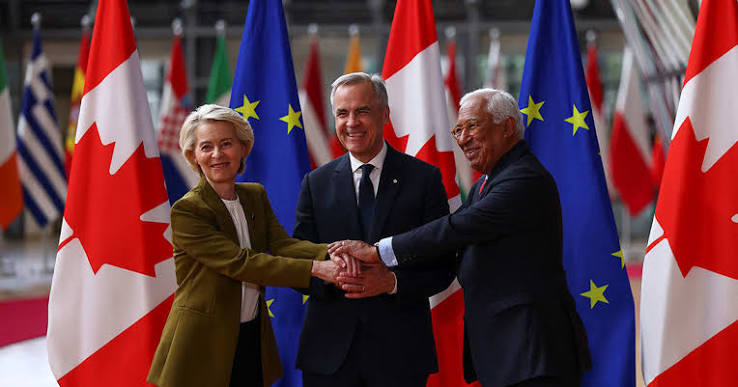
Canada is signaling that its economic future may no longer be built primarily around the United States. On September 15, 2026, Prime Minister Mark Carney outlined plans for what he called a “unique security and economic alliance” with the European Union, while unveiling major measures designed to attract investment from Canada and abroad. The strategy combines deeper European cooperation with sweeping tax changes, new private investment opportunities at major airports, and a broader effort to make Canada less dependent on its southern neighbor.
Canada Looks Beyond Its Traditional Economic Dependence
For generations, the United States has been at the center of Canada’s trade and investment relationships. That reality has not disappeared, and Canadian officials continue to describe the American relationship as highly significant. But growing trade tensions and uncertainty over the future of cross border commerce have encouraged Ottawa to broaden its economic options.
At the first Canada Investment Summit in Toronto, Carney presented Canada as a country capable of attracting capital from a much wider group of partners. Investors from nearly 30 countries attended the summit, representing institutions managing more than $100 trillion in assets. The Canadian government says its broader investment strategy is intended to catalyze as much as C$1 trillion in new investment over five years. :contentReference[oaicite:0]{index=0}
The European Union is central to that diversification effort. Canada already has a major commercial relationship with the 27 member bloc through the Comprehensive Economic and Trade Agreement, commonly known as CETA. Canadian government data shows that two way trade in goods and services between Canada and the EU reached C$178.6 billion in 2025, while the EU remained Canada’s second largest global trading partner after the United States. :contentReference[oaicite:1]{index=1}
A Deeper Canada EU Partnership Is Taking Shape
Carney’s proposed alliance goes beyond traditional trade policy. Canada and the EU have already been expanding cooperation in defense, critical minerals, energy and technology, giving the proposed relationship a broader strategic dimension.
In June, the European Union formally concluded an agreement allowing Canadian companies and Canadian products to participate in procurement under the Security Action for Europe program. Canada became the first non European country to participate in the EU’s SAFE instrument, strengthening the connection between Canadian industry and European defense procurement. :contentReference[oaicite:2]{index=2}
The development matters because economic security and national security are increasingly connected. Critical minerals, energy infrastructure, advanced technology, transportation networks and defense manufacturing all depend on reliable investment and supply chains. A stronger Canada EU relationship could therefore create opportunities that extend well beyond conventional exports.
European Commission President Ursula von der Leyen has since proposed that Canada become the European Union’s first associate member, an idea that would create a new form of cooperation without making Canada a full EU member. The proposal includes deeper collaboration in areas such as defense, energy and technology. :contentReference[oaicite:3]{index=3}
Canada’s Investment Strategy Comes With a Major Tax Change
The European strategy is being reinforced by a substantial domestic investment policy. The Canadian government announced the Productivity Mega Deduction, a permanent expansion of immediate expensing for a much broader range of capital investments.
Under the proposed rules, eligible businesses would be able to deduct the cost of qualifying investments in the year those assets become available for use rather than spreading deductions over several years. The expanded program covers a wide range of assets, including software, computer equipment, research and development, mining property, pipelines, aircraft, vehicles, patents, rail infrastructure, bridges and roads. :contentReference[oaicite:4]{index=4}
The government says the measure will reduce Canada’s marginal effective tax rate on new business investment from roughly 13 percent to 6.4 percent. Ottawa argues that the change will make Canada more competitive for investment at a time when companies are reassessing where to build factories, infrastructure, technology operations and resource projects. :contentReference[oaicite:5]{index=5}
For businesses, the practical effect is significant. A company considering a major equipment purchase or technology project can recover eligible investment costs more quickly for tax purposes. That can improve cash flow and potentially make large projects easier to finance.
Four Major Airports Open the Door to Private Capital
Canada is also turning to private investment to finance infrastructure. The government announced plans to seek long term private concessions to operate the country’s four largest airports: Toronto Pearson, Montreal, Calgary and Vancouver.
The proposal does not amount to a straightforward sale of the airports. Ottawa says the government will retain ownership of the underlying land and assets while private investors provide capital and expertise through long term operating arrangements. The government expects the arrangements could raise tens of billions of dollars for additional infrastructure investment. :contentReference[oaicite:6]{index=6}
The proceeds are intended to support regional airports, local transportation projects and national infrastructure, including a proposed broadband backbone designed to connect communities across Canada and strengthen links with Europe and Asia.
For travelers, however, the policy could raise practical questions about airport fees, passenger costs and service standards. Canadian labor groups have already raised concerns about how private participation could affect travelers. The government maintains that the model can improve infrastructure and passenger experience while preserving public ownership of the assets. :contentReference[oaicite:7]{index=7}
The U.S. Relationship Remains Too Important to Ignore
Canada’s push toward Europe should not be interpreted as an immediate replacement for the United States. American markets remain deeply integrated with the Canadian economy, and Carney has continued to describe the relationship as important even as trade tensions intensify.
That makes the current strategy more accurately described as diversification rather than separation. Canada is attempting to build additional economic channels so that its businesses have more options when political disputes or trade restrictions affect one major market.
The challenge is that replacing a deeply integrated trading relationship is considerably more complicated than announcing new partnerships. Supply chains, transportation networks, investment patterns and business relationships have developed over decades. European markets can offer Canada new opportunities, but expanding those opportunities will require companies to adapt to different regulations, consumer markets and logistics systems.
CETA Still Has Unfinished Business
Canada and Europe already have the framework for expanded commerce, but the relationship has not reached its full potential. CETA has been provisionally applied since 2017, yet several EU member states have still not completed the ratification process required for the agreement to take full effect across the bloc. :contentReference[oaicite:8]{index=8}
That unfinished process illustrates one of the central realities facing Canada’s European strategy. Strong political statements can create momentum, but businesses ultimately need predictable rules, market access and regulatory certainty.
There are also limits to how quickly Canada can redirect trade. European demand, investment decisions and industrial capacity cannot be expanded overnight. Canada will need to demonstrate that its new tax incentives, infrastructure policies and regulatory reforms can produce tangible results rather than simply promising them.
What the Shift Could Mean for Canadian Businesses
For Canadian companies, the emerging strategy could create opportunities across several sectors. Resource producers may benefit from stronger European demand for critical minerals and energy. Technology companies could gain from deeper cooperation in digital infrastructure and research. Defense manufacturers may find new procurement opportunities through Canada’s growing participation in European security initiatives.
Infrastructure could become another major area of activity. The government’s airport initiative, broadband plans and transportation proposals are designed to bring more institutional and private capital into large projects.
The tax changes could also influence investment decisions by making the initial cost of capital easier to recover. Ottawa’s stated goal is to encourage businesses to build, purchase equipment, expand operations and invest in productivity inside Canada rather than postponing those decisions during a period of trade uncertainty. :contentReference[oaicite:9]{index=9}
A New Economic Direction Is Emerging
What we are seeing in Canada is not simply a new trade agreement or a single investment incentive. The announcements of September 15 point toward a broader economic strategy built around diversification, domestic investment and stronger partnerships with countries outside the United States.
The European Union is particularly important because Canada already has established commercial ties with the bloc and is now adding defense and strategic cooperation to that foundation. At the same time, Ottawa is attempting to make the Canadian economy more attractive to global capital through tax reform and infrastructure investment.
The approach carries both opportunity and uncertainty. Canada must still manage its enormous economic relationship with the United States while building new markets in Europe and elsewhere. It must also ensure that private investment in infrastructure benefits communities and travelers, while maintaining the public oversight Canadians expect.
For businesses and households, the significance of this shift will ultimately be measured less by diplomatic language and more by what happens on the ground: new factories, expanded mines, better transportation connections, stronger technology infrastructure, new export markets and jobs created by investment.
Canada’s economic relationship with the United States remains deeply rooted. But the direction announced in Toronto suggests Ottawa wants the country’s next chapter to have more than one economic center of gravity. The proposed partnership with Europe, combined with new incentives for investment at home, represents an effort to give Canada more room to maneuver as global trade relationships become less predictable.