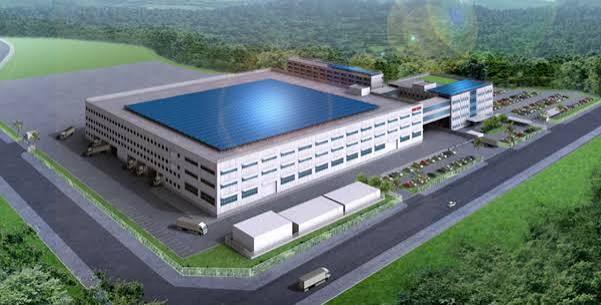
Ricoh is preparing to build a new manufacturing facility in Japan that could significantly expand the production of high quality inkjet heads used across industrial and functional printing. Announced on September 18, 2026, the project brings together automation, robotics, artificial intelligence and digital manufacturing at Ricoh’s Atsugi Manufacturing Site in Kanagawa Prefecture. For industries ranging from wall coverings and furniture to building materials, packaging and advanced functional surfaces, the investment points to a broader shift from conventional analog production toward flexible digital printing.
Ricoh Announces a New Four Story Manufacturing Facility
Ricoh said the new facility will be constructed at its Atsugi Manufacturing Site, an important production center for its inkjet business. Construction is scheduled to begin in November 2026, with completion planned for the first half of fiscal 2028. The building will have four floors and approximately 39,000 square meters of gross floor space, equivalent to roughly 420,000 square feet. :contentReference[oaicite:0]{index=0}
The company expects the new production base to eventually provide more than twice its current inkjet head production capacity. That increase is significant because inkjet heads are a core component of industrial printing systems. Their ability to deposit ink and other liquids with high precision determines how effectively printers can produce detailed images, patterns and functional layers on different materials.
Ricoh describes the project as a next generation manufacturing platform that combines its experience in ultra precision manufacturing with automated production, robotics, artificial intelligence and digital manufacturing. The company also plans to consolidate manufacturing functions that are currently spread across multiple buildings at the Atsugi site.
Why Industrial Inkjet Printing Is Expanding
Industrial inkjet printing is moving well beyond the traditional idea of printing documents on paper. Manufacturers can now use digital inkjet technology to apply images, colors, coatings and other materials directly onto a wide variety of surfaces.
Ricoh identifies applications including building materials, furniture, wall coverings, signs and display graphics and textiles. These industries are increasingly dealing with demand for greater product variety, shorter production runs and faster turnaround times. Digital printing can address those requirements because designs can be changed through digital files without requiring the same type of fixed production setup associated with many conventional printing processes. :contentReference[oaicite:1]{index=1}
For a wall covering manufacturer, for example, digital inkjet technology can make it easier to produce different patterns for different customers or markets. A furniture producer can potentially print decorative finishes onto selected surfaces without relying entirely on large standardized production batches. The same principle can apply to building materials where architects and designers want more customized visual treatments.
Building Materials Are Becoming a New Printing Surface
One of the most interesting parts of the development is the connection between inkjet technology and building materials. Walls, furniture panels, decorative boards and other architectural surfaces can serve as printable substrates, opening possibilities that were once difficult to achieve economically.
Digital surface decoration can allow manufacturers to reproduce detailed textures, patterns and visual effects across materials used inside homes, offices, hotels and commercial buildings. Instead of treating printing as a separate activity associated mainly with paper, manufacturers can integrate digital decoration into industrial production lines.
This matters for designers because the visual appearance of a material can influence the character of an entire space. A printed surface can imitate natural materials, introduce geometric patterns or provide customized artwork while remaining part of a manufactured panel or finished product.
We are also seeing the practical reason behind this transition. Consumers and businesses increasingly expect variety, while manufacturers need production systems that can respond without creating excessive waste or requiring large inventories of every possible design.
Automation Will Be Central to Ricoh’s New Factory
The new Atsugi facility is designed around automated production lines and robotics capable of manufacturing a range of inkjet head products. Ricoh says the approach is intended to provide both high productivity and flexibility, allowing production capacity to respond more effectively to changes in demand. :contentReference[oaicite:2]{index=2}
Automation is particularly relevant in precision manufacturing because inkjet heads require extremely accurate production. Ricoh says manufacturing these components involves micron level precision, while the experience of skilled technicians remains important for maintaining and improving product quality.
The company therefore is not presenting automation as a simple replacement for human expertise. Instead, Ricoh plans to capture the knowledge of experienced technicians as data and combine it with artificial intelligence for production and quality decisions.
AI Will Help Preserve Manufacturing Expertise
One of the less visible challenges facing advanced manufacturing is the loss of specialized knowledge when experienced workers retire or move away from production roles. Some manufacturing skills are difficult to communicate through written instructions because they depend on years of observation and practical experience.
Ricoh plans to digitize this expertise so that artificial intelligence can help apply it during manufacturing and quality management. The approach could allow production teams to retain valuable knowledge while reducing dependence on individual workers having to make every decision manually.
The company also expects employees to focus more heavily on activities that require human judgment and specialized expertise. In that model, AI becomes part of the manufacturing environment rather than a separate software system operating outside the factory.
Production, Quality and Logistics Will Be Connected
The planned facility is also designed around digital connections between manufacturing equipment, quality management systems and logistics operations. Ricoh intends to use automated material handling to improve the movement of physical components while connecting the associated information flows digitally.
That combination can be important in a high precision manufacturing environment. A production system is only as efficient as its slowest connected process. If manufacturing equipment is automated but materials still move slowly through disconnected workflows, overall productivity can remain limited.
By linking equipment, quality information and logistics, Ricoh aims to create a more coordinated production environment. The objective is to improve supply reliability while allowing the factory to respond to changes in customer demand.
Functional Printing Opens a Much Larger Opportunity
The factory investment is not limited to decorative printing. Ricoh also identifies functional printing as an expanding area for inkjet technology. Functional printing involves using inkjet systems to deposit functional materials with high precision rather than simply producing a visual image.
Potential applications include printed electronics, batteries and automotive coatings. These uses require very different materials and production requirements from conventional graphic printing, but the underlying principle is similar: a system must place a liquid or functional material precisely where it is required.
This could broaden the role of inkjet technology from an imaging tool into a manufacturing technology. Instead of simply putting color onto a surface, advanced inkjet systems can potentially help create layers and structures that perform a specific technical function.
The Shift From Analog to Digital Production
Ricoh’s investment comes as manufacturers across several industries reassess the economics of analog and digital production. Traditional printing methods remain important, especially for large standardized production volumes, but digital systems offer different advantages when customers demand customization and shorter production runs.
Ricoh specifically points to demand for greater product variety, smaller production lots, shorter delivery times and lower environmental impact as factors supporting the transition toward digital industrial printing. :contentReference[oaicite:3]{index=3}
For manufacturers, flexibility can be as important as raw production speed. A factory capable of switching between designs without extensive preparation can respond more easily to changing customer preferences. That can be particularly valuable in industries such as interior design, where trends and project requirements can change rapidly.
What the New Factory Could Mean for Wall Coverings and Home Decor
The implications for home decoration are easy to overlook because the technology operates behind the finished product. Consumers may simply see a patterned wall covering, decorative furniture panel or printed architectural surface. Behind that product could be a highly automated digital manufacturing process.
More capable inkjet production could support a wider selection of decorative finishes while helping manufacturers produce smaller quantities economically. That could benefit designers working on hotels, restaurants, retail spaces and residential projects where visual differentiation is important.
It could also support faster responses to changing design preferences. Instead of committing production capacity to a small number of standardized patterns, manufacturers can use digital files to manage a broader design library.
Japan Remains a Major Center for Precision Manufacturing
The decision to expand the Atsugi site also highlights Japan’s continuing role in precision engineering and advanced manufacturing. Ricoh has spent decades developing inkjet heads using materials science and ultra precision manufacturing techniques, and the new building is designed to combine that established expertise with newer digital technologies.
The company expects technologies developed at the new facility to be shared across the wider Ricoh Group. That means the project could influence manufacturing practices beyond the immediate production of inkjet heads.
Ricoh has also been pursuing automation and artificial intelligence in other areas. Earlier in 2026, the company announced work with Thread AI to investigate AI based automation for facility management operations in Japan, showing that the company’s broader strategy includes applying AI to physical operations as well as products and services. :contentReference[oaicite:4]{index=4}
Construction Begins in November 2026
The timetable gives Ricoh a clear sequence for the project. Construction is scheduled to begin in November 2026, followed by completion during the first half of fiscal 2028. The company intends for the facility to become a central production base for its inkjet head business.
The planned increase to more than twice the current production capacity is particularly significant because demand for industrial inkjet technology is expanding across several unrelated industries. Building materials and furniture require decorative printing, while electronics, batteries and automotive applications can require functional material deposition.
A Factory Designed for the Next Stage of Digital Manufacturing
Ricoh’s new facility reflects a broader change in how manufacturers think about printing. The factory of the future is not necessarily focused only on producing documents or images. Printing technologies can become part of the manufacturing process itself, placing decorative and functional materials onto surfaces with increasing precision.
For building materials, that could mean more choices in appearance and greater customization. For industrial manufacturers, it could mean more flexible production. For advanced technology companies, it could create opportunities to use inkjet systems in applications that were previously handled by different manufacturing techniques.
We should therefore view Ricoh’s September 18 announcement as more than a factory expansion. It is a bet on the growing convergence of precision engineering, industrial inkjet printing, automation, artificial intelligence and digital manufacturing. The four story Atsugi facility will take time to build, but its planned capabilities point toward a manufacturing model in which human expertise, robotics and AI work together to produce increasingly sophisticated surfaces and materials.
If the company achieves its planned production expansion, the impact could extend from the factory floor to the products people encounter every day, from the walls around them and furniture they use to advanced components found inside future technologies.