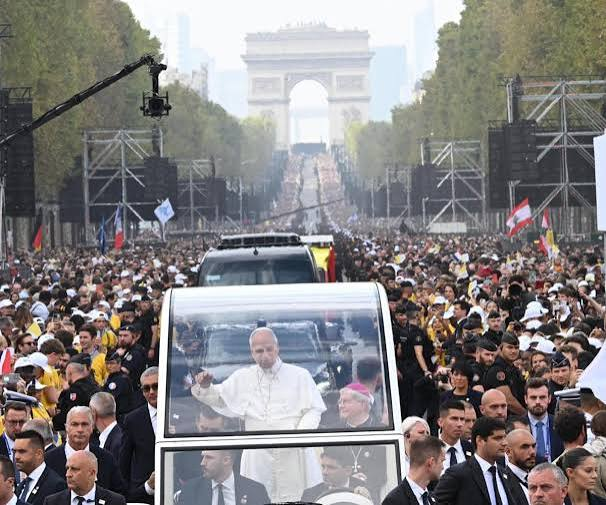
Pope Leo XIV brought the Paris chapter of his historic visit to France to a close before traveling to Lourdes, where he celebrated Mass at one of Catholicism’s most revered pilgrimage sites on Sunday. The American pope’s four day journey has drawn enormous crowds, placed questions of faith and human dignity at the center of public discussion, and marked the first official papal visit to France in nearly two decades.
The most striking moment came Saturday, when an estimated 800,000 people gathered around Place de la Concorde and the Champs Élysées for an open air Mass. The vast crowd stretched through one of Paris’s most recognizable public spaces as Pope Leo traveled through the city in the popemobile. The Vatican described the attendance as roughly 800,000 people, while French organizers had prepared for hundreds of thousands of worshippers. :contentReference[oaicite:0]{index=0}
For us, the images from Paris and Lourdes carry significance beyond their scale. In a country where Catholic practice has declined sharply over generations and where the state maintains a strong tradition of secularism, the sight of hundreds of thousands gathering publicly for a papal Mass offered a vivid reminder that religious identity remains part of France’s social and cultural story.
A Historic Papal Journey Through France
Pope Leo XIV arrived in France on September 25 for a four day apostolic journey scheduled to include Paris, Lourdes and Metz. The Vatican itinerary included meetings with French political and religious leaders, a visit to UNESCO, an encounter with young people, a major public Mass and a pilgrimage to Lourdes. :contentReference[oaicite:1]{index=1}
The Paris portion of the journey combined traditional Catholic ceremony with discussions about some of the most difficult questions facing modern societies. Pope Leo visited Notre Dame, met people involved in social support and integration work, spoke with catechumens and newly baptized Catholics, and addressed young people before the enormous outdoor celebration at Place de la Concorde.
The restored Notre Dame Cathedral provided one of the journey’s most symbolic settings. The cathedral, damaged by the devastating 2019 fire and subsequently restored, became a powerful backdrop for the pope’s message about renewal. Vatican coverage described the building as filled with light during the celebration of Vespers, connecting the physical restoration of the cathedral with themes of spiritual renewal within the French Church. :contentReference[oaicite:2]{index=2}
Hundreds of Thousands Fill the Heart of Paris
On Saturday afternoon, the scale of the gathering became unmistakable. Worshippers filled Place de la Concorde and surrounding sections of the Champs Élysées, many carrying flags, religious images and banners as they waited for the pope.
Pope Leo traveled through central Paris in the popemobile before reaching the site of the Mass. The journey gave people along the route an opportunity to see the pope at close range, while the enormous congregation waited for the liturgy to begin.
The Vatican estimated that about 800,000 people attended. That figure placed the event among the largest public gatherings of Pope Leo’s young pontificate and gave his French visit an unmistakably public character. :contentReference[oaicite:3]{index=3}
Yet the size of the crowd was only part of the story. Pope Leo spoke about the human search for meaning and the need for people to share their faith openly in a society where religious belief is not always publicly visible. His message addressed both committed Catholics and those who may feel distant from organized religion.
A Message About Human Dignity
The pope’s remarks in France have repeatedly returned to the dignity of the human person. That theme has become an important part of his early pontificate, particularly as he speaks about war, poverty, technology, family life and the responsibilities of institutions.
His visit also comes at a sensitive moment for the Catholic Church in France. The country has confronted a devastating legacy of clerical sexual abuse, with an independent 2021 investigation estimating that approximately 330,000 children were abused within Catholic institutions or by members of the clergy over a period of seven decades. :contentReference[oaicite:4]{index=4}
That history has made any papal visit to France more complicated than a celebration of Catholic heritage. For survivors and their advocates, the journey has also been an opportunity to ask whether the Church can respond to past wrongdoing with lasting accountability and institutional change.
From Paris to Lourdes
After the Paris Mass, Pope Leo flew south to Lourdes, arriving Saturday evening. His first major act there was not a large public speech but a quiet prayer at the Grotto of Massabielle, where Catholic tradition holds that the Virgin Mary appeared to Bernadette Soubirous in 1858.
The atmosphere was markedly different from the enormous gathering in Paris. Instead of the noise and movement of a packed avenue, the pope entered one of the most intimate spaces of Catholic pilgrimage and knelt in prayer. Thousands of people were present, but the moment itself was characterized by silence and devotion. :contentReference[oaicite:5]{index=5}
Pope Leo entrusted France to the Virgin Mary and prayed for peace, families, people who are sick or suffering and those facing poverty. He also asked for harmony within French society and called for leaders who would serve the common good.
His visit to the grotto carried particular emotional weight because Lourdes is associated with people who come seeking spiritual comfort and healing. Every year, millions of pilgrims travel to the shrine, including people living with serious illnesses and disabilities. :contentReference[oaicite:6]{index=6}
The Lourdes Mass Brings the Journey Into a More Personal Setting
On Sunday, September 27, Pope Leo celebrated Mass on the Prairie of the Shrine of Our Lady of Lourdes. The service formed one of the central moments of the French pilgrimage and placed the pope among pilgrims who had traveled to the shrine for prayer and reflection.
The Vatican schedule also included a meeting with the French bishops, time with staff and sick members of the Accueil Notre Dame community, a private meeting with contemplative religious sisters and an evening Rosary and torchlight procession. :contentReference[oaicite:7]{index=7}
The contrast between Paris and Lourdes is revealing. Paris presented Pope Leo before one of the largest public audiences of his pontificate. Lourdes placed him among people whose reasons for coming were often intensely personal: illness, grief, prayer, family concerns and the search for hope.
That contrast has given the trip a broader emotional range. The pope has been addressing national and international questions in one moment and standing silently before a shrine in another.
Clergy Abuse Remains a Difficult Part of the Visit
The Lourdes portion of the journey also brought the Church’s abuse crisis directly into focus. Pope Leo was scheduled to meet privately with survivors of clerical sexual abuse, an encounter that has received considerable attention from survivor groups and advocates.
Before that meeting, the pope told French bishops that the Church must continue confronting the painful reality of abuse and recognized steps taken by French bishops in responding to the crisis. :contentReference[oaicite:8]{index=8}
For survivors, however, the question extends beyond words. Some advocates have called for deeper institutional reforms and stronger independent mechanisms for handling allegations and compensation. Reuters reported that survivors hope the pope’s engagement will lead to more consistent action across the Church. :contentReference[oaicite:9]{index=9}
The significance of the Lourdes meeting therefore rests partly in what follows it. A private conversation can provide recognition and human connection, but survivors and advocates have continued to call for structural measures that can prevent abuse and improve accountability.
France Offers a Complex Setting for Pope Leo
France presents a distinctive environment for a modern pope. Catholicism has deep historical roots in the country, yet France is also firmly secular and public religious practice has declined over generations.
That tension was visible throughout the journey. Massive crowds attended the papal events, while the broader country remains shaped by secular public institutions and debates over questions where Catholic teaching differs sharply from prevailing political and social positions.
The visit therefore cannot be measured simply by crowd size. The more difficult question is what the pope’s presence means for French Catholics, younger generations, people who have left religious practice and those who remain deeply affected by the Church’s failures.
The French Church has also seen signs of renewed interest among some adults, including an increase in adult baptisms, even as regular religious participation remains a challenge. Pope Leo’s meetings with catechumens and newly baptized Catholics placed those individuals directly within the public story of his visit.
The Vatican Schedule Points Beyond Lourdes
Although the Paris portion of the trip has concluded, Pope Leo’s French journey continues beyond Lourdes. On Monday, September 28, he is scheduled to travel to Metz before returning to Rome.
His Metz program includes an interreligious meeting, a gathering focused on Europe, peace and unity, and a Mass at Saint Stephen’s Cathedral. The Vatican has presented the wider journey as an opportunity to address questions of peace, human dignity and Europe’s future. :contentReference[oaicite:10]{index=10}
The journey has therefore moved through several different settings, from the political and cultural center of Paris to the deeply spiritual atmosphere of Lourdes and finally to Metz, a city with strong historical connections to European identity.
Why the France Visit Matters for Pope Leo XIV
Pope Leo XIV is still early in his pontificate, making every major international journey an opportunity to define the themes he wants his leadership to represent. France has allowed him to address a remarkably broad range of subjects in a short period.
He has spoken about the dignity of human life, the responsibilities of political leaders, peace, technology, migration, young people, religious belief and the need for the Catholic Church to confront its own failures.
The scale of the Paris Mass demonstrated that the Catholic Church can still mobilize enormous public gatherings in France. The pilgrimage to Lourdes showed another side of the Church, one centered on silence, suffering and personal prayer.
For observers, the most revealing part of the journey may be the combination of both experiences. Pope Leo has stood before a crowd large enough to fill some of Paris’s most famous avenues and then knelt quietly at a grotto where generations of pilgrims have brought their private hopes and fears.
The official Vatican website provides the full program and official record of the pope’s apostolic journey, while major international reporting has documented the public response and the issues surrounding the visit.
A Journey Defined by Faith, Memory and Responsibility
Pope Leo XIV’s visit to France has produced scenes that will remain among the defining images of his early pontificate. The streets of Paris filled with hundreds of thousands of people. Notre Dame welcomed the pope beneath its restored roof. Lourdes received him in the quiet of the grotto. Survivors of abuse prepared to tell their stories. Young Catholics gathered to hear a pope speak about faith in a secular society.
Those moments do not tell a single simple story about the Catholic Church in France. They reveal a country where religious tradition remains powerful for many people while secularism, institutional distrust and painful memories have reshaped the relationship between society and the Church.
As Pope Leo leaves Lourdes and continues toward Metz, the immediate crowds will eventually disappear from the streets. What remains will be the harder work of translating messages about dignity, peace, accountability and hope into lasting action.
For the people who gathered in Paris and Lourdes, the journey has already provided something deeply human: a moment to stand together, pray, listen and remember that behind the largest public events are individual lives carrying their own questions, wounds and hopes.