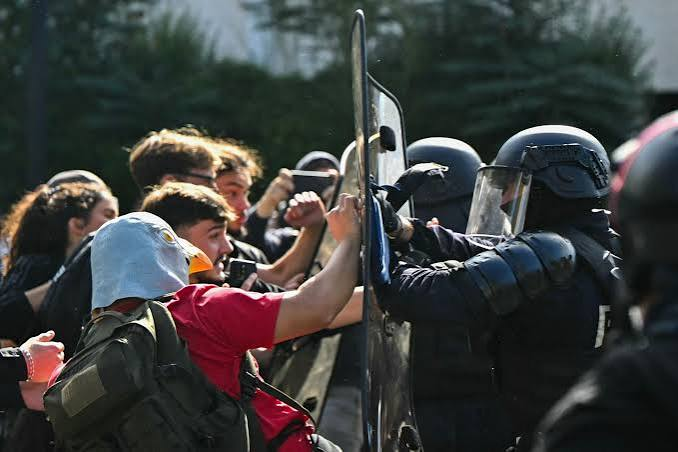
France is facing a rapidly expanding student protest movement that has disrupted more than 1,200 high schools, injured at least 170 students, and resulted in thousands of arrests as teenagers demonstrate over teacher shortages, overcrowded classrooms, long school schedules, and deteriorating school facilities. What began as a series of blockades around schools in the Paris region has spread across the country, producing confrontations with police, fires, property damage, and growing concern among families and educators.
Student Protests Spread From Paris to Schools Across France
The movement began in the Paris region in September and gathered momentum during the final days of the month. By October 1, more than 1,000 high schools had been affected by strikes, demonstrations, or blockades, according to figures reported by French authorities and media outlets. The number of affected schools later rose beyond 1,200 during the week.
The scale of the disruption is significant in a country with roughly 3,700 high schools. At one point, hundreds of schools were closed entirely, while others remained open but experienced demonstrations or blocked entrances. On October 3, authorities reported that hundreds of establishments were still being affected, although the number was lower than during the peak of the previous day.
We can see from the pattern of events that the movement is not limited to one city or one type of school. Demonstrations have appeared in Paris and its surrounding suburbs as well as cities including Lyon, Lille, Marseille, Toulouse, Nantes, Strasbourg, Rennes, Nice, and other communities.
What Students Are Demanding From the Education System
The central complaints concern conditions inside French secondary schools. Students have described classrooms that are too crowded, shortages of teachers and substitute teachers, inadequate buildings, long schedules, and difficulties obtaining the basic resources needed for a productive school day.
One student interviewed by Reuters described classrooms with around 35 students and insufficient seating. Other students have complained about lengthy school days and limited lunch periods that make ordinary routines difficult. These concerns have been echoed by students in different parts of France, although the intensity and specific demands vary between schools.
The issue of teacher shortages has become particularly important. Figures cited by reporting from the French Education Ministry indicate that a substantial number of teaching hours were not provided during the 2024 to 2025 academic year, with a significant share connected to difficulties finding replacement teachers.
For teenagers preparing for examinations and decisions about higher education, a missed lesson is not simply an empty period on a timetable. Repeated absences can mean missed explanations, unfinished coursework, additional pressure at home, and greater anxiety about examinations that determine important next steps.
Why the Blockades Have Become So Disruptive
School blockades are among the most visible forms of protest. Students gather outside entrances, place objects across access points, display signs, and sometimes prevent other students and staff from entering buildings.
Some demonstrations have remained peaceful, while others have escalated into confrontations with police. Burning rubbish bins, thrown objects, damaged entrances, and fires have been reported in several cities. Firefighters have been called to schools where flames threatened buildings, while police have used crowd control measures including tear gas in some locations.
French authorities said more than 100 high schools had suffered severe damage during the unrest. The reported damage has added another layer to the dispute because school administrators now have to consider not only whether classes can safely continue, but also whether buildings require repairs before students can return.
At Least 170 Students and Dozens of School Staff Have Been Injured
Education Minister Édouard Geffray said at least 170 students had been injured since the movement began. He also reported injuries among school staff, including dozens of principals. Police officers and gendarmes have also suffered injuries during clashes.
The circumstances surrounding injuries vary. Reports describe students being affected by police crowd control measures as well as injuries occurring during confrontations between protesters and law enforcement. In one serious case reported in Tours, a young man suffered a severe eye injury during clashes.
Rights organizations have raised concerns about the treatment of young demonstrators, many of whom are minors. At the same time, French authorities have stressed that officers, teachers, school leaders, journalists, and members of the public have also been exposed to violence during some demonstrations.
That distinction matters when assessing the events. Claims about excessive police force and claims about violence by protesters require examination on an incident by incident basis. French authorities have said internal investigations have been opened following allegations of police misconduct.
Thousands Have Been Arrested
The number of arrests has increased rapidly as the protests have spread. Interior Minister Laurent Nuñez said more than 5,000 people had been arrested since Monday, with many of those detained being minors. Earlier figures released during the week were considerably lower, illustrating how quickly police operations expanded as demonstrations intensified.
Justice Minister Gérald Darmanin previously said that around 2,000 people had been taken into custody during an earlier stage of the unrest and that the overwhelming majority were children. The figures subsequently reported by the Interior Ministry were higher as additional demonstrations took place.
Arrest figures should not automatically be interpreted as convictions or proof that every person detained committed a crime. Police custody can occur while authorities investigate suspected offenses, and individual cases must proceed through the French legal system.
Police and Protesters Describe Very Different Experiences
The protests have produced sharply different accounts of what is happening on the streets. Students and student organizations have accused police of using excessive force, while government officials have condemned attacks on officers and school personnel.
Reuters reported scenes in which police used tear gas and other crowd control measures as protesters threw objects. Other reports have documented fires, damaged school entrances, and attacks involving police officers. The French government has said that the original educational grievances have been overshadowed in some locations by violent activity.
At the same time, students continue to insist that their underlying complaints remain unresolved. Student representatives have called for concrete measures addressing teacher replacements, school buildings, class sizes, and schedules.
The Government Is Trying to Reopen Dialogue
Education Minister Édouard Geffray has met with student representatives, education unions, and parent organizations as officials attempt to reduce tensions. The government has indicated that it intends to work on faster replacement of absent teachers and has discussed creating channels through which students can communicate their concerns directly to policymakers.
The ministry has also been under pressure to address school infrastructure and classroom conditions. These issues cannot be solved simply by reopening blocked entrances. Recruiting teachers takes time, repairing buildings requires funding and planning, and reducing class sizes can require additional staff and facilities.
The French Education Ministry provides official information about schools, education policy, and government measures through its national education information portal.
Families Face an Uncertain School Week
For parents, the unrest has created a difficult practical problem. A school that is technically open may still be difficult to reach if entrances are blocked or demonstrations are taking place nearby. Parents are also having to weigh the normal importance of attendance against concerns about safety.
Students face their own uncertainty. Missing several days of lessons can affect coursework, examinations, and preparation for higher education. At the same time, teenagers who believe their concerns are being ignored may see demonstrations as one of the few ways they can make themselves heard.
The situation has therefore created a difficult balance between the right to protest, the right of other students to attend school, and the responsibility of authorities to protect minors and staff.
The Movement Is Larger Than a Single Education Complaint
The school demonstrations are also unfolding alongside wider social and political tensions in France, including public sector opposition to government budget measures. That broader environment has created additional opportunities for different groups to demonstrate at the same time.
Government officials have accused political actors on the hard left of attempting to exploit or influence the student movement. Representatives of France Unbowed have rejected those accusations. The competing claims remain part of the political debate surrounding the protests and should be distinguished from the documented educational grievances raised by students themselves.
The protests also demonstrate how quickly a local school dispute can become a national movement. Social media has allowed images of fires, clashes, blocked entrances, and police operations to spread rapidly, helping students in distant cities recognize similar problems and coordinate demonstrations.
What Happens Next Could Depend on Whether Dialogue Produces Results
Student organizations and unions have called for additional demonstrations in the coming days, meaning the situation may remain unsettled. Government officials are seeking to restore normal school operations while promising discussions over teacher shortages and learning conditions.
The immediate priority is the safety of students and staff. Beyond that, the government faces the more difficult task of addressing the conditions that helped generate the protests in the first place. Faster teacher replacement, adequate classroom space, functioning school buildings, reasonable schedules, and meaningful communication with students are practical issues that can be measured and addressed through policy.
For France, the significance of the current protests will ultimately depend not only on how many schools reopen, but also on whether students believe their concerns have been heard and whether authorities can deliver concrete improvements without allowing further violence to become part of the dispute.
The Agence France Presse coverage has documented the spread of the demonstrations, the injuries reported among students and school staff, the police response, and the government’s efforts to restore dialogue.
As of October 3, the picture remains fluid. More than 1,200 high schools have been affected since the movement began, at least 170 students have been reported injured, thousands of people have been arrested, and numerous schools have suffered serious damage. Behind those numbers are classrooms that cannot operate normally, families worried about their children, teachers trying to continue their work, and teenagers demanding changes to the conditions in which they study. The next stage of the crisis will show whether those competing pressures can move from confrontation toward practical negotiations.