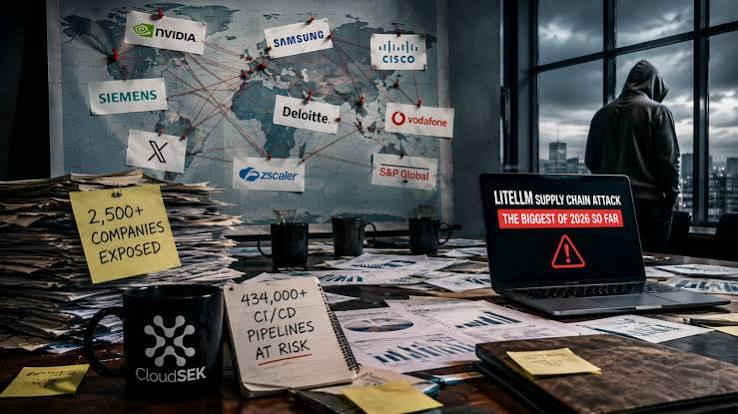
October 21, 2026 — A reported supply chain compromise involving LiteLLM, a widely used open source middleware platform for connecting applications to artificial intelligence models, has drawn attention to a critical weakness in modern software development: even trusted tools can become a security risk when the process used to distribute them is compromised. The reported incident has prompted concern among developers and enterprise security teams, particularly those managing application credentials, cloud access, and sensitive business information through AI powered systems.
For developers, a software update is usually a routine part of maintaining an application. Teams review release notes, install a newer version, and return to building features. A supply chain incident changes that calculation. If an attacker interferes with a release pipeline, the software delivered to users may not be as trustworthy as the project name or version number suggests. In environments where AI middleware connects applications to model providers, databases, and internal services, the potential consequences deserve careful attention.
The reported LiteLLM incident highlights why organizations must examine not only the code they write, but also the packages, build systems, publishing credentials, and automated workflows they rely on. The precise scope of this reported compromise, including affected releases and confirmed exposure, should be established through official incident advisories. Until those details are verified, organizations should avoid assuming that every installation was affected or that a particular credential was necessarily stolen.
Why LiteLLM Matters to AI Developers
AI applications often depend on several services working together. A product may use one model for text generation, another for embeddings, and additional services for monitoring, retrieval, or data storage. Managing these connections separately can increase development work and make applications harder to maintain.
LiteLLM is designed to provide a common interface for working with different large language model providers. Depending on how it is deployed, developers can use it to route requests, manage model connections, handle provider credentials, and integrate AI capabilities into existing applications. This makes middleware an important part of the software architecture rather than a minor convenience installed at the edge of a project.
That central position also creates security implications. Middleware may process requests containing confidential business information, communicate with external model services, or operate in environments where API keys and other secrets are available. If a compromised package runs inside such an environment, its permissions and execution context can influence the extent of possible damage.
Not every deployment has the same level of exposure. A developer testing a local demonstration with temporary credentials faces a different risk from a company running production services with access to customer data and cloud infrastructure. Security teams therefore need to assess the specific package versions, runtime permissions, and credentials associated with their own installations.
How a Software Supply Chain Attack Can Happen
A software supply chain attack targets the processes through which software is developed, built, published, distributed, or installed. Instead of attacking every organization that uses a product individually, an attacker attempts to compromise a trusted point in the distribution process. If malicious code reaches a widely used package, multiple downstream users may receive it through an update or installation.
Modern development pipelines contain many moving parts. Developers submit code, automated systems run tests, build tools assemble packages, and publishing services distribute releases to package repositories. Each stage may rely on accounts, access tokens, signing credentials, or automated permissions. A weakness in any of these areas can create an opportunity for unauthorized changes.
For example, if an attacker gains access to a publishing credential, they may attempt to release a package that appears to come from a legitimate project. If a build workflow is compromised, malicious changes may enter the artifact produced by an otherwise trusted process. In some cases, an attacker may target a dependency rather than the main application itself.
The danger is that the resulting package can appear ordinary. It may carry a familiar name, version number, and installation command. Developers who rely on automated updates or install dependencies without verifying their origin may have limited visibility into what changed. This is why software provenance, release integrity, and controlled publishing permissions are essential elements of modern application security.
Why AI Middleware Can Increase the Impact of a Breach
AI middleware often sits between an application and several external services. This position can make it a valuable target because the software may handle authentication details, model requests, configuration settings, and operational logs. The risk depends on the permissions granted to the application and the way credentials are stored, but a compromised component can potentially reach resources beyond the immediate AI feature.
Consider a company using an AI assistant to summarize customer support conversations. The application might send selected messages to a model provider while using a service account to access internal records. If a compromised dependency executes within the same environment, investigators would need to determine whether it could access those records, read environment variables, communicate with external destinations, or obtain credentials used by other services.
These are possible investigation scenarios, not confirmation that each occurred in the reported LiteLLM incident. The distinction matters. Responsible incident reporting separates the capabilities of a compromised component from evidence of what an attacker actually accessed or changed. Organizations should base their response on verified indicators, affected versions, and the privileges available to the software in their environment.
The broader lesson is that AI security cannot focus exclusively on model behavior. Prompt safety, output filtering, and protection against malicious instructions are important, but they do not replace ordinary software security. A secure AI application also needs trustworthy dependencies, protected credentials, controlled network access, and reliable methods for verifying what code is being executed.
What Developers and Businesses Should Do Immediately
Organizations using LiteLLM should first establish whether their applications include an affected release. They should consult the project’s official security announcements and repository for the confirmed package versions, indicators of compromise, and recommended remediation steps. A general warning alone is not enough to identify which installations require replacement.
Where an affected version is confirmed, teams should follow the project’s remediation guidance, upgrade to a verified safe release when one is available, and rebuild or redeploy affected environments as appropriate. Simply changing a version number in a configuration file may not be sufficient if the compromised package remains inside a container image, build artifact, or cached dependency.
Credential review is particularly important when a potentially compromised package was executed in an environment containing secrets. Security teams should identify which credentials were accessible to that environment and assess whether any could have been exposed. Depending on the evidence and official guidance, the response may include revoking and rotating model provider keys, cloud credentials, database passwords, and relevant service tokens.
Credential rotation should be handled carefully. Teams need to update dependent services, verify that new credentials work, and monitor for suspicious activity after the change. Where possible, old credentials should be invalidated rather than merely replaced in application configuration. If logs indicate unauthorized use, the incident may require a broader investigation into affected accounts and connected systems.
A practical response checklist
- Inventory dependencies: Identify every application, container, virtual environment, and build pipeline that installs or uses LiteLLM.
- Verify affected versions: Compare installed versions and package hashes with official security guidance rather than relying on package names alone.
- Inspect credentials: Determine which secrets were accessible to affected processes and rotate exposed or potentially compromised credentials according to the risk assessment.
- Review logs: Examine package installation activity, authentication records, outbound network connections, and unusual API usage for suspicious behavior.
- Rebuild trusted environments: Where compromise is plausible, rebuild from verified sources instead of assuming that an in place update has removed every trace.
- Monitor after recovery: Watch for unexpected model requests, unfamiliar access patterns, unexplained usage charges, and attempts to reuse revoked credentials.
Organizations should preserve relevant logs and investigation evidence before making changes that could erase useful information. For serious incidents, security teams may need support from incident response specialists, cloud providers, or the organizations responsible for affected services.
How to Reduce Future Supply Chain Risk
The most effective long term response is to make software distribution easier to verify and harder to compromise. Development teams should restrict publishing permissions, protect release credentials, require strong authentication for privileged accounts, and separate routine code development from the authority to publish official packages.
Automated release systems should use narrowly scoped credentials and avoid granting broad access to every workflow. Changes to publishing configurations deserve careful review because a pipeline can become a route into the software supply chain even when the source code itself appears unchanged. Where practical, projects should use protected release processes, signed artifacts, and independent checks that help establish where a package came from and whether it has been altered.
Organizations can also maintain a software bill of materials, commonly called an SBOM, that records the components included in an application. An SBOM does not prevent an attack, and it cannot guarantee that every component is safe. However, it can help security teams identify which applications contain a vulnerable or compromised dependency when an incident becomes public.
The Cybersecurity and Infrastructure Security Agency’s guidance on software bills of materials provides useful background on software component transparency. Teams can use this approach alongside vulnerability scanning, dependency pinning, artifact verification, and routine review of third party packages. Pinning a version improves reproducibility, but it should not become an excuse to ignore security updates or continue using a version known to be compromised.
Enterprise AI Security Requires More Than Patching
Installing a corrected package is an important step, but it does not answer every question raised by a supply chain incident. Organizations must determine whether the affected software ran with access to sensitive data, whether credentials were available to it, and whether any suspicious activity occurred while the package was present.
Teams should also assess how much authority their AI middleware actually needs. Production services should not automatically inherit broad administrative access because it makes integration easier. Separate credentials for development, testing, and production can limit the consequences of a compromise. Restricting outbound network access may also help prevent unauthorized communication from a service that does not need unrestricted internet connectivity.
Monitoring should cover both security events and unusual business activity. A sudden rise in model requests, unexpected changes in cloud usage, or access to records unrelated to an application’s purpose may warrant investigation. Logs should capture enough detail to support a review without unnecessarily collecting sensitive customer information.
Organizations that use several AI providers or middleware components should apply the same discipline across the entire stack. Replacing one dependency does not remove the risks associated with other packages, build systems, developer accounts, or service credentials. A documented process for evaluating vendors and responding to software advisories can make future incidents easier to manage.
Open Source Security Is a Shared Responsibility
Open source software plays an important role in AI development because it allows developers to inspect code, report problems, contribute improvements, and build on existing work. However, public access to source code does not automatically make a project secure. Maintainers still need resources to review changes, protect release infrastructure, respond to vulnerabilities, and communicate clearly with users.
Users also have responsibilities. Companies that depend on open source packages should not assume that maintainers alone can manage every operational risk. Organizations can contribute by reporting vulnerabilities responsibly, supporting projects they rely on, maintaining internal dependency inventories, and avoiding deployment practices that grant unnecessary privileges to third party code.
Security expectations should remain proportionate to the role of the software. A small experimental project may not have the same resources as a widely deployed enterprise dependency, but software used in sensitive production environments requires a careful assessment regardless of its license or popularity. Trust should be based on evidence, controls, and ongoing maintenance rather than reputation alone.
What the Reported LiteLLM Incident Means for the AI Industry
The reported LiteLLM supply chain compromise is a reminder that the rapid growth of AI applications depends on infrastructure that can be attacked in familiar ways. Middleware can simplify development, but it can also become a point of concentration for credentials, service access, and sensitive requests. That makes release integrity and dependency management central parts of AI risk management.
Developers and enterprise security teams should avoid both complacency and unsupported assumptions. Not every user will necessarily have been affected, and the extent of any exposure must be established through verified incident information. At the same time, organizations should not wait for proof of direct damage before checking whether they installed an affected package or exposed valuable credentials to it.
The practical response is clear: verify the official advisory, identify affected deployments, apply the recommended remediation, review access and activity logs, and rotate credentials when warranted by the evidence and guidance. For future projects, stronger release controls, limited permissions, dependency inventories, and repeatable incident response procedures can reduce the impact of similar events.
AI applications are only as dependable as the systems that support them. Protecting models and user data requires attention to every layer, from application logic to package repositories and automated release pipelines. By treating software supply chain security as a core part of AI development, organizations can respond to incidents more effectively and build systems that deserve the trust placed in them.