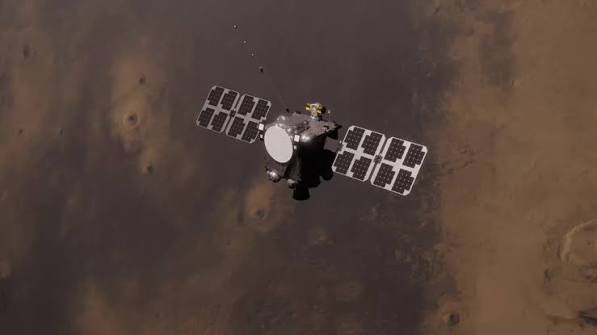
NASA is preparing for an unusual milestone in planetary exploration as its twin ESCAPADE spacecraft, named Blue and Gold, approach Earth for a carefully planned maneuver that will send them toward Mars. Scheduled for November 7 and November 9, 2026, the two flybys will combine the pull of Earth’s gravity with powerful engine burns to increase the spacecraft’s speed and redirect their paths toward the Red Planet. The operation represents an important test of a new approach to interplanetary travel and could help scientists develop more flexible ways to send future missions across the solar system.
Two Spacecraft, Two Carefully Timed Earth Flybys
The ESCAPADE mission, short for Escape and Plasma Acceleration and Dynamics Explorers, involves two nearly identical robotic spacecraft designed to study Mars and its surrounding space environment. NASA plans to send Blue past Earth first, around 5 a.m. Eastern Standard Time on Saturday, November 7. Gold is scheduled to follow approximately two days later, around 6 a.m. Eastern Standard Time on Monday, November 9.
Both spacecraft will pass relatively close to Earth, reaching distances of approximately 600 to 1,100 miles above the planet’s surface. At the closest point of each encounter, the spacecraft will fire their engines for about nine minutes. These burns are known as trans Mars injection maneuvers and will work alongside Earth’s gravity to give each probe the additional energy needed for its journey.
NASA expects the maneuvers to increase each spacecraft’s speed by more than 1,000 miles per hour. Their velocity is expected to rise from approximately 6.3 miles per second to about 6.7 miles per second. Although those numbers may seem abstract, they represent an extraordinary amount of energy being carefully controlled through navigation, timing and propulsion.
As of November 5, the flybys and engine burns remain scheduled events rather than completed milestones. Their success will depend on precise spacecraft operations and confirmation from the mission team after each maneuver.
Why NASA Is Combining Earth’s Gravity With an Engine Burn
A spacecraft traveling between planets does not need to rely entirely on its own engines to change direction or gain speed. Planetary gravity can alter a spacecraft’s trajectory, allowing mission planners to use a planet’s movement and gravitational field as part of a carefully calculated route. This technique is commonly called a gravity assist.
During a conventional gravity assist, a spacecraft approaches a planet, curves around it and leaves on a different trajectory. Depending on the geometry of the encounter, it can gain speed relative to the Sun without using a large amount of onboard fuel. The ESCAPADE operation adds another element: each spacecraft will fire its engine near its closest approach to Earth.
This combination is known as a powered flyby. The engine burn takes advantage of the spacecraft’s high speed near Earth, where a given amount of propulsion can produce a particularly useful change in its orbital energy. The underlying principle is related to the Oberth effect, which describes how a rocket engine can provide greater energy benefits when fired at high velocity.
NASA says this is a pioneering maneuver for a Mars bound spacecraft. Earlier missions have used planetary flybys and carefully timed launch opportunities, but ESCAPADE is attempting a powered Earth encounter as part of its route to Mars. The result could provide valuable experience for planning future interplanetary missions.
Why ESCAPADE Did Not Travel Directly to Mars
The spacecraft launched on November 13, 2025, aboard Blue Origin’s New Glenn rocket from Cape Canaveral, Florida. At that time, Earth and Mars were not positioned for the most suitable direct transfer. Rather than wait on Earth for another launch opportunity, mission planners selected a different route that allowed the spacecraft to begin their journey earlier.
After launch, Blue and Gold entered an extended Earth proximity orbit. Their path took them around the Earth Sun Lagrange point 2, a region approximately one million miles from Earth where gravitational forces allow a spacecraft to maintain a useful position relative to the Earth and Sun. The spacecraft followed a broad, curved trajectory before returning toward Earth for the planned November 2026 encounters.
This approach gave the mission team a way to work around the limited launch opportunities created by the changing positions of Earth and Mars. The planets reach favorable alignments for relatively efficient transfers about every 26 months. ESCAPADE’s unusual route demonstrates how mission designers can use extended orbital paths to create additional options instead of depending entirely on a narrow launch window.
The journey also provided an unexpected scientific opportunity. During its extended passage, ESCAPADE traveled through a distant region of Earth’s magnetotail, the portion of our planet’s magnetic environment that stretches away from the Sun. The mission team reported observations of activity and structure in this region, which had not previously been directly explored by a spacecraft in the same way.
What the Twin Probes Will Investigate at Mars
ESCAPADE is not simply a transportation experiment. Its main scientific purpose is to investigate how the solar wind interacts with Mars and how that interaction contributes to the loss of the planet’s atmosphere.
The solar wind is a continuous stream of charged particles released by the Sun. When these particles reach Mars, they interact with the planet’s upper atmosphere and magnetic environment. Unlike Earth, Mars does not have a strong global magnetic field protecting the entire planet. Instead, it has a more complex magnetic environment influenced by magnetized regions of its crust and its upper atmosphere.
Scientists believe interactions between the solar wind and the Martian environment have played an important role in the planet’s atmospheric history. Mars once had a thicker atmosphere and conditions that allowed liquid water to exist on its surface. Over billions of years, the planet lost much of that atmosphere. Studying the processes that continue to remove atmospheric particles could help researchers understand how Mars changed from a potentially wetter world into the cold, dry planet observed today.
Using two spacecraft rather than one will give researchers an important advantage. Blue and Gold will be able to collect observations from different positions around Mars, helping scientists compare changes across space and time. This coordinated approach can reveal details that might remain hidden if a single spacecraft observed each region separately.
Why Two Spacecraft Can Provide Better Scientific Evidence
Planetary environments are constantly changing. Solar activity can alter the flow of charged particles, while magnetic fields and atmospheric conditions influence how energy moves around a planet. A single spacecraft may detect a change without being able to determine whether it happened over time or because the spacecraft moved into a different region.
Two coordinated orbiters can help address that problem. By comparing measurements collected from separate locations, researchers can distinguish changes in the surrounding environment from changes associated with the spacecraft’s position. This makes it easier to investigate how solar energy enters the Martian magnetic environment and how particles escape into space.
The mission will measure properties of Mars’ upper atmosphere and magnetic environment, including the movement of charged particles and the behavior of magnetic fields. These observations could contribute to a more complete explanation of atmospheric loss and improve scientific models of Mars’ space weather.
When Will Blue and Gold Reach Mars?
Following their scheduled Earth encounters, both spacecraft are expected to begin an approximately ten month cruise toward Mars. NASA currently lists arrival dates of September 7 and September 9, 2027, for the two probes.
The journey will not be entirely passive. Mission controllers will continue monitoring the spacecraft and carrying out trajectory correction maneuvers when necessary. These small adjustments help keep each probe on the correct path and account for differences between the planned trajectory and the spacecraft’s actual movement.
Reaching Mars will also require another demanding operation. Each spacecraft must fire its engines to slow down enough to enter orbit around the planet. The mission team will then work to adjust their orbits and prepare the spacecraft for coordinated scientific observations. The process is expected to continue into 2028 before the main science campaigns begin.
Could Observers See the Spacecraft Passing Earth?
The November flybys may offer a rare opportunity for observers with suitable equipment to track the spacecraft. NASA says the probes could appear as faint points moving against the background stars, although a telescope will most likely be needed. Their small size, roughly comparable to a standard refrigerator, makes them difficult to see without optical assistance.
The closest approaches will take place while the spacecraft are over the Southern Hemisphere, with their engine burns expected above southern Australia. Observers in parts of the western United States may have opportunities to follow their movement during the hours before the encounters. However, the spacecraft will be below the horizon there at the moment of closest approach.
Anyone hoping to observe the event should check NASA’s published viewing information and local sky conditions before making plans. The spacecraft are not expected to appear as bright objects visible to the unaided eye.
What This Mission Could Mean for Future Space Exploration
The ESCAPADE mission offers lessons that extend beyond Mars. Its unusual route tests whether spacecraft can use an extended Earth orbit, a carefully timed return and a powered flyby to reach another planet. If the maneuvers work as planned, the experience could help mission designers consider more flexible launch schedules and alternative interplanetary routes.
For future robotic missions, better trajectory planning could create opportunities to use launch vehicles and spacecraft resources more efficiently. For human exploration, understanding Mars’ space environment is equally important. Solar wind and energetic particles can create radiation risks and affect communications, navigation and equipment. A clearer picture of the planet’s magnetic environment could help engineers design systems that protect astronauts and support reliable operations.
The immediate focus remains on the two scheduled Earth encounters. The mission team must confirm that Blue and Gold complete their engine burns, leave Earth on the intended trajectories and remain on course for their 2027 arrival. These operations involve demanding navigation and propulsion work, with little room for error.
A Major Step on the Road to Mars
Blue and Gold represent a different way of approaching a familiar challenge in space exploration. Rather than following a direct route from launch to Mars, the twin spacecraft have spent roughly a year using Earth’s wider gravitational environment as part of their journey. Their upcoming powered flybys will bring that strategy to its most important stage.
The mission’s success will ultimately be measured by more than the speed gained during two engine burns. Its scientific value will come from the observations collected around Mars and the knowledge gained about how solar activity shapes planetary atmospheres. For now, the November 7 and November 9 encounters are the critical milestones to watch. They will test a new route to the Red Planet and bring NASA one step closer to answering how Mars lost much of the atmosphere it once had.
NASA provides mission details, spacecraft information and updates through its official ESCAPADE mission page.