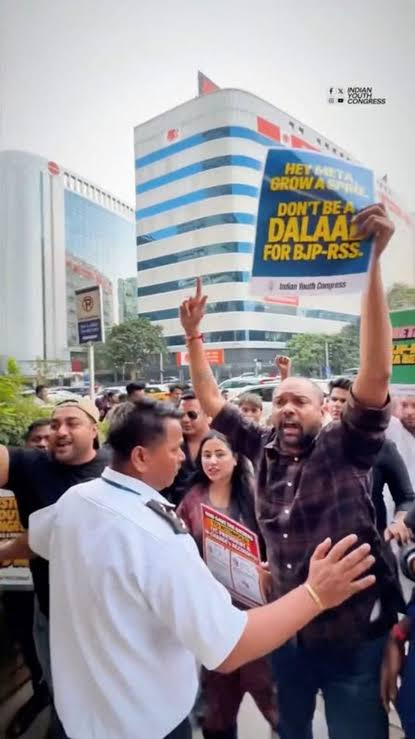
Meta is facing growing political pressure in India after members of the opposition Congress party’s youth wing protested outside the company’s offices, clashed with police and security personnel, and issued a seven day ultimatum over suspended and restricted social media accounts. The demonstrations on November 20, followed by warnings of further action on November 21, have brought fresh attention to the difficult relationship between technology platforms, government content removal orders and freedom of expression in the country. At the centre of the dispute are allegations that accounts belonging to opposition figures were unfairly restricted because of their political views. Meta has said it follows Indian law, but the company has not publicly addressed the specific allegations in the reports surrounding the protests.
Congress Youth Wing Takes Its Protest to Meta Offices
The demonstrations were organised by the Indian Youth Congress, the youth wing of the country’s main opposition Congress party. Protesters gathered outside Meta offices in Hyderabad, Mumbai and Gurugram, near New Delhi, demanding the restoration of Instagram accounts belonging to party officials and an explanation for restrictions affecting political content.
In Hyderabad, members of the Telangana Youth Congress entered the building housing Meta’s offices in the Gachibowli area. Footage shared by the organisation showed protesters carrying placards, raising slogans and moving through parts of the premises. Some flower pots were smashed during the disturbance, and protesters clashed with police and security personnel. Police detained demonstrators, with reports indicating that around 20 people were taken into custody during the Hyderabad action.
In Mumbai, demonstrators gathered outside Meta’s office and spray painted slogans on walls, while protesters in Gurugram displayed banners calling for the restoration of Youth Congress accounts. The scenes marked an escalation from online complaints to direct action at the offices of one of the world’s largest technology companies.
The protests were not limited to a demand for the return of two accounts. The Youth Congress framed the dispute as a wider question about whether political opposition, journalists and independent content creators can express criticism online without facing unexplained restrictions.
Which Accounts Triggered the Dispute?
The immediate controversy followed restrictions on Instagram accounts associated with Indian Youth Congress national president Uday Bhanu Chib and national in charge Manish Sharma. Party representatives alleged that the accounts were withheld on November 19 and claimed that the action was politically motivated.
The organisation accused Meta of selectively restricting voices critical of Prime Minister Narendra Modi and the ruling Bharatiya Janata Party, commonly known as the BJP. It also raised concerns about posts mentioning Congress leader Rahul Gandhi and content criticising the central government. These are allegations made by the political organisation, and the specific government instructions or platform decisions behind the disputed restrictions have not been independently established in the public reporting.
According to Manu Jain, who oversees social media for the Youth Congress, two accounts were restored after Friday’s demonstrations. However, he said thousands of accounts belonging to journalists, creators and influencers critical of the government remained restricted. That broader claim has become a central part of the organisation’s campaign, although the group has not publicly provided a complete list of the accounts it says were affected.
What the Seven Day Ultimatum Demands
On November 21, the Youth Congress issued a seven day ultimatum, asking Meta to explain its handling of account restrictions and remove what it considers unlawful limitations on opposition voices. The organisation warned that it would continue its campaign through public demonstrations and legal action if the company did not respond.
The group outlined several demands. It wants Meta to disclose how many Indian accounts were restricted following government orders during the previous six months and how many remain blocked. It has also requested an explanation of alleged automated restrictions affecting posts that mention Rahul Gandhi or criticise Modi and the BJP.
Another demand is the removal of restrictions that the Youth Congress considers unjustified, particularly those affecting opposition politicians, journalists and independent creators. The organisation also argues that Meta should respect constitutional protections for free expression and should not act on political instructions that it believes are arbitrary.
The ultimatum puts the company in a difficult position. Meta must operate within Indian law, but it also faces scrutiny over whether its moderation systems are transparent, consistent and open to meaningful review. The seven day deadline gives the dispute a clear immediate focus, although it does not establish that the company is legally required to meet the organisation’s demands within that period.
Meta’s Position and India’s Content Removal Rules
Meta has said that it restricts content in India to comply with local laws. The company declined to comment on the protests when approached by reporters on November 20. Its broader position is important because technology platforms can face legal obligations to remove or restrict material that authorities identify as unlawful, even when the affected users or political groups dispute the reasons for those decisions.
India’s rules governing online content have become a major part of the debate. In February 2026, the government shortened the deadline for platforms to remove content identified as unlawful from 36 hours to three hours after receiving a notice. The shorter period has raised concerns among free speech advocates and digital rights groups, who argue that platforms may have limited time to examine the context of a post, assess whether a removal request is justified and provide users with an effective opportunity to challenge a decision.
For a company operating services such as Instagram and Facebook at enormous scale, the requirements create practical pressure. A platform may need to process large numbers of government requests while distinguishing between illegal material, political criticism, satire, reporting and legitimate public debate. A short compliance window can make careful review more difficult, particularly when decisions involve language, political context or local events.
The scale of restrictions reported in India has added to the controversy. Meta disclosed that it restricted more than 5.4 million posts or accounts in the country under local laws during the first half of 2026. That compared with approximately 70,000 during the whole of 2025. The figures indicate a sharp increase in restrictions, although they do not by themselves establish how many decisions were politically motivated or how many resulted from specific government orders.
BJP Criticism Adds to the Political Tension
The demonstrations also prompted criticism from the ruling party. BJP spokesperson Pradeep Bhandari accused Congress workers of vandalising Meta’s Hyderabad premises and using the incident to publicise their actions. He argued that damaging a private company’s office was unacceptable and criticised the opposition party over the disturbance.
The competing responses have turned the Meta dispute into a wider political confrontation. Congress says restrictions on its leaders’ accounts raise questions about censorship and the ability of opposition figures to reach voters. The BJP has focused on the conduct of the protesters and the damage reported at the company’s premises. Neither position, on its own, resolves the underlying question of whether the disputed account decisions were justified.
That distinction matters. Political parties have a right to challenge decisions they believe are unfair, but protests must also respect the safety of employees and the security of private premises. Equally, technology companies should be able to explain account restrictions clearly, especially when decisions affect public figures, journalists or organisations involved in democratic debate.
Why the Dispute Matters Beyond Congress and Meta
India is Meta’s largest market by users, making the dispute significant for the company’s operations and its relationship with regulators. Millions of people use social media platforms to follow news, discuss public policy, promote businesses and communicate with their communities. For political organisations, these services have also become essential tools for reaching supporters and responding to opponents.
When an account is suspended or a post is removed, the impact can extend beyond the individual user. A political leader may lose a channel for communicating with voters. A journalist may struggle to distribute reporting. A small creator may lose access to an audience built over years. If users are not given clear explanations or a practical appeal process, they may begin to question whether platform rules are being applied fairly.
At the same time, platforms have responsibilities to address content that violates the law or creates genuine safety risks. The challenge is to enforce those rules without treating legitimate political criticism as unlawful simply because it is uncomfortable for powerful institutions. Transparent explanations, consistent standards and independent review can help reduce the risk of arbitrary decisions.
The wider debate is reflected in reporting by The Guardian on the Congress protests and Meta dispute, which details the demonstrations, the allegations of censorship and the pressure created by India’s tighter content removal requirements.
What Happens After the Deadline?
The immediate question is whether Meta will respond to the Youth Congress demands before the seven day period expires. The organisation has threatened further demonstrations and legal action if it considers the company’s response inadequate. Its representatives have also warned that protests could spread to other Meta offices across India.
For Meta, a useful response would need to address the substance of the concerns rather than simply restate its obligation to follow local laws. Explaining the reasons for individual account restrictions, clarifying how government requests are reviewed and providing meaningful appeal channels would help users understand how decisions are made. The company may also face pressure to publish more detailed information about the scale and nature of government requests.
For Indian authorities, the dispute raises questions about how content removal rules can protect public safety while preserving constitutional freedoms. Government requests should be sufficiently clear to allow platforms to assess them, and users should have ways to challenge restrictions they believe are mistaken or excessive.
A Test of Transparency and Digital Rights in India
The confrontation between the Indian Youth Congress and Meta is about more than two suspended Instagram accounts. It has become a public test of how political speech is handled on platforms that play a central role in modern communication. The company faces pressure to demonstrate that its moderation decisions are based on clear rules, while political organisations must make their case without putting employees or private property at risk.
The restoration of two accounts after the protests may ease part of the immediate dispute, but it does not settle the wider allegations concerning journalists, creators and other users. The next steps will depend on whether Meta offers a substantive explanation, whether the Youth Congress pursues its threatened legal and public campaign, and whether Indian authorities address concerns about the speed and transparency of content removal requests.
For millions of people who rely on social media to participate in public life, the principle at stake is straightforward: online rules should be understandable, consistently enforced and open to challenge. As the seven day deadline approaches, the response from Meta and the wider political establishment will help determine whether this dispute leads to greater accountability or another round of confrontation.