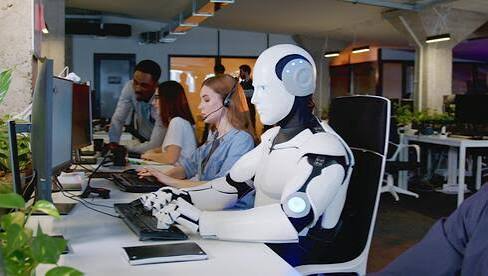
Artificial intelligence is beginning to reshape the structure of employment itself, not simply the tasks people perform at work. A new global study covering 41 countries found that companies adopting AI saw employment in senior positions rise by 6.7% over five years, while junior employment declined by 3%. The findings offer a more complicated picture than the idea that AI simply eliminates jobs. Instead, the technology appears to be changing which workers companies need, how much experience they expect and how young professionals enter their careers.
A New Pattern Is Emerging Inside AI Adopting Companies
The study by Stanford University researcher Bharat Chandar and King’s College London researcher Bouke Klein Teeselink examined employment patterns across companies and countries over several years. Its central finding is striking because overall employment at companies using AI increased, yet the benefits were not distributed evenly across levels of the workforce.
Senior employment increased by 6.7% during the five year period, while junior employment declined by 3%. The share of junior workers within AI adopting companies also fell by 1.9 percentage points. Researchers found evidence of this shift across several countries, including Brazil, Saudi Arabia and the United Kingdom.
That distinction matters. We are not looking at a straightforward story in which businesses adopt AI and immediately begin removing workers. Instead, the workforce can grow while becoming more concentrated around experienced employees who can supervise systems, interpret complex information, make decisions and take responsibility for outcomes.
The researchers describe AI as labor saving for junior workers while expanding demand for senior workers in occupations exposed to the technology. That pattern raises a difficult question for employers and educators: if junior workers traditionally gain experience by performing routine tasks, what happens when software begins performing many of those tasks instead?
Why Entry Level Workers Are Feeling the Pressure
For generations, entry level employment has functioned as the first rung on the career ladder. A new graduate might begin with research, data preparation, customer support, document review or basic analysis. These assignments may not appear glamorous, but they provide something essential: experience.
AI can perform many routine activities quickly. A system can summarize documents, organize information, generate first drafts, analyze large datasets and assist with repetitive administrative work. For employers, that can reduce the amount of human labor required for some foundational assignments.
The consequence is not necessarily that every junior position disappears. Instead, the responsibilities of junior employees can change rapidly. Employers may expect new workers to arrive with stronger analytical abilities, better judgment and greater familiarity with AI tools than previous generations were expected to have.
Research from PwC points in a similar direction. Its 2026 Global AI Jobs Barometer analyzed more than one billion job advertisements across six continents and found that AI exposed entry level positions in the United States were seven times more likely to request traditionally senior skills such as leadership, creativity and judgment. :contentReference[oaicite:0]{index=0}
The Entry Level Job Is Becoming More Demanding
This creates a paradox for young workers. Technology can make them more productive, but employers may simultaneously expect them to be productive from the beginning.
Previously, a graduate could enter an organization with limited practical experience and gradually learn through routine assignments. In an AI supported workplace, some of those routine assignments may already be automated. The employee may therefore be expected to move more quickly toward tasks requiring interpretation, communication and independent decision making.
PwC found that entry level roles requiring more senior style human skills have grown substantially since 2019. Its research found that these roles increased by 35%, while other entry level roles declined by 10%. :contentReference[oaicite:1]{index=1}
That does not mean every graduate needs to become a manager immediately. It means the definition of useful early career experience is changing. The ability to ask the right questions, verify AI generated information, communicate findings and understand the consequences of decisions can become as important as completing a task quickly.
Universities Face a Similar Challenge
The changes taking place inside companies are also reaching higher education. Universities have become major testing grounds for generative AI, with students and faculty using these systems for research, writing assistance, coding, tutoring and administrative work.
That creates a difficult responsibility for academic institutions. Universities have traditionally prepared students by combining theoretical knowledge with practical assignments. If employers increasingly expect graduates to perform higher level work immediately, academic programs may need to place greater attention on applied problem solving, judgment and responsible technology use.
The challenge is particularly significant because AI can make it easier to complete some assignments without necessarily developing the underlying skill. A student who uses an AI system to produce an answer may finish the task quickly, but the educational value depends on whether the student can evaluate the response, identify mistakes and explain the reasoning behind it.
Universities therefore face a choice between treating AI primarily as a threat to academic standards or incorporating it into learning while preserving rigorous assessment. The long term question is not simply whether students use AI. It is whether they leave university capable of working effectively with it without becoming dependent on it.
Companies May Need to Rethink How Young Workers Learn
The employment findings also create a problem for businesses themselves. If companies reduce junior hiring while increasing demand for experienced professionals, they may weaken their future talent pipeline.
Senior employees do not appear fully formed. They usually developed their judgment through years of increasingly difficult assignments. If organizations automate too many of the basic tasks that once provided early career learning, they may eventually have fewer workers who possess the experience required for senior positions.
McKinsey has highlighted this issue in its research on talent development, noting that organizations are increasingly seeking employees who can interpret AI generated information and work alongside AI agents. The firm has also pointed to concerns that some foundational tasks traditionally used to develop junior workers are already being reduced by AI. :contentReference[oaicite:2]{index=2}
This creates an incentive for companies to rethink training rather than simply reducing entry level opportunities. Apprenticeships, structured mentoring, supervised AI use and carefully designed rotational programs could become more important as traditional learning tasks become automated.
AI Skills Are Becoming Part of the Hiring Equation
Another major change is the growing value of AI literacy. Employers increasingly want workers who understand how to use AI tools while also knowing when those tools should not be trusted.
PwC’s research found that jobs requiring specific AI skills are growing much faster than the overall jobs market. The analysis also found a substantial wage premium associated with AI skills. :contentReference[oaicite:3]{index=3}
For job seekers, this suggests that learning AI should not be treated as a replacement for professional expertise. A marketing graduate, for example, still needs to understand audiences, campaigns and communication. A software developer still needs programming fundamentals. An accountant still needs financial principles. AI becomes another layer of capability rather than a substitute for the underlying profession.
Skills that may matter increasingly for early career workers include:
- Critical thinking and independent judgment
- Practical AI literacy and responsible AI use
- Data interpretation and verification
- Clear written and verbal communication
- Problem solving in unfamiliar situations
- Collaboration with experienced professionals and AI systems
The Numbers Do Not Mean Every Entry Level Job Is Disappearing
The global findings should also be interpreted carefully. A 3% decline in junior employment among AI adopting companies does not establish that AI alone caused every reduction. Hiring decisions are affected by economic conditions, industry cycles, interest rates, restructuring, outsourcing and changing business strategies.
Other research also shows that the relationship between AI and entry level employment is not uniform. A 2026 Strada Education Foundation survey of nearly 1,500 executives and senior talent leaders found that employers were more likely to expect AI to increase entry level hiring than decrease it. The survey therefore presents a more mixed outlook, with some businesses using AI to make junior employees more productive rather than eliminating their positions. :contentReference[oaicite:4]{index=4}
That difference is important. AI adoption does not produce one universal employment outcome. Its effect depends on the industry, the type of work being automated, how aggressively a company invests in technology and whether management uses AI primarily for cost reduction or to expand what employees can accomplish.
A New Career Ladder May Be Taking Shape
The deeper issue may be the structure of the career ladder itself. For decades, workers commonly moved from routine responsibilities toward more complex work as they gained experience. AI is beginning to automate portions of that progression.
We may therefore see a workplace where fewer people are needed for repetitive junior tasks, while more employees are expected to contribute analytical and strategic value earlier in their careers. That could create opportunities for ambitious workers who develop strong technical and human skills, but it could also make the first step into professional employment more difficult.
The challenge for employers will be creating enough meaningful early career opportunities to develop the people they will need later. For universities, the task will be preparing students for workplaces where AI is present without allowing technology to replace the learning process itself.
What the Shift Means for Workers and Employers
For workers, the message is not simply to fear automation. The stronger lesson is to develop capabilities that remain useful when routine work becomes easier to automate. AI proficiency can matter, but so can judgment, communication, creativity, accountability and the ability to understand a real business problem.
For employers, the numbers should raise a separate question. A workforce with more senior employees and fewer juniors may deliver short term productivity gains, but organizations still need mechanisms for developing future experts and leaders.
The evidence emerging in 2026 suggests that AI is not producing a simple division between people who have jobs and people who do not. It is helping create a more complicated division between different types of work, different levels of experience and different combinations of human expertise and technology.
As companies and universities continue integrating artificial intelligence, the most consequential change may ultimately be the redesign of the career path itself. The challenge ahead is ensuring that AI makes experienced workers more capable while still giving newcomers enough opportunities to learn, contribute and build the experience needed for the next generation of professional work.