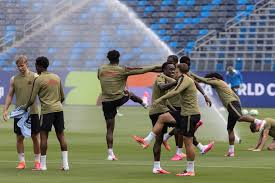
For the first time in FIFA World Cup history, all three host nations have moved beyond the group stage together. The United States, Mexico, and Canada have each secured a place in the Round of 32 at the 2026 tournament, turning a shared hosting duty into a shared sporting milestone that will resonate far beyond the final whistle.
A rare moment for North American football
This is the kind of tournament storyline that makes a World Cup feel larger than a competition. Host nations often arrive with hope, heavy expectations, and the pressure of performing in front of their own supporters. What has happened in 2026 is different. Rather than one host carrying the region, all three have found a way through the group stage, giving North America a collective celebration that feels both improbable and earned.
The achievement matters because host nation pressure is not sentimental. It is loud, immediate, and deeply visible in every stadium. Crowds expect effort, identity, and results. When three countries are sharing venues, travel demands, media attention, and public hopes, advancing together becomes a test not only of football quality but also of resilience and organization. That all three passed it makes this World Cup feel historic in a very real sense.
What the advance means
Reaching the knockout rounds changes the emotional temperature of a tournament. Group stage matches are about survival and rhythm. The Round of 32 brings sharper stakes, greater tension, and the knowledge that one mistake can send a team home. For the United States, Mexico, and Canada, progression means their World Cup stories are no longer about participation. They are now about possibility.
For the hosts, this moment also strengthens the atmosphere around the tournament. Fans in each country now have a reason to believe that their national side can shape the event rather than simply decorate it. That matters in stadiums, in local bars, in public viewing areas, and in homes where people have been following every touch and tackle. A successful host nation can give a World Cup a pulse, and three successful hosts can give it an entire heartbeat.
The United States on home soil
The United States’ progression carries special weight because of the scale of the American sports market and the intense scrutiny that always follows the national team. A host nation is expected to look comfortable, organized, and competitive, but that expectation can quickly become burdened by nerves. Surviving the group stage gives the Americans a chance to settle into the tournament with confidence and a louder connection to home supporters.
There is also a broader symbolic value. Soccer in the United States has often had to compete for attention in a crowded sports culture. A deep run in a home World Cup can shift conversation in ways that no marketing campaign can match. It can inspire young players, sharpen public interest, and give the sport a stronger cultural foothold. Even before the knockout rounds begin, the tone around the team has changed from cautious hope to real anticipation.
Mexico’s enduring World Cup identity
Mexico has long carried one of the most passionate football cultures in the world, and World Cup tournaments often become national events in the truest sense. Advancing at home or near home is more than a sporting result. It is a communal experience felt in streets, markets, stadiums, and family gatherings. When Mexico progresses, the noise is not limited to the stands. It spreads through the country with extraordinary force.
For Mexico, moving into the knockout stage reinforces a familiar truth. The national team is rarely just another participant. It is a source of pride, debate, and constant expectation. A place in the Round of 32 gives supporters a reason to believe that the tournament could yet deliver a defining chapter. It also adds to the pressure, because the next phase is where legends are made and disappointments become harder to forget.
Canada’s growing football moment
Canada’s advancement may be the most meaningful in terms of long term football development. The country has spent years building toward a stronger global presence in the sport, and a home World Cup provided a rare chance to convert that work into a defining public moment. Advancing out of the group stage gives Canadian football something powerful: proof.
That proof matters for youth participation, infrastructure, media attention, and the broader belief that the sport belongs at the center of Canadian athletic life. When a national team advances on home soil, it creates memory. Children watching in living rooms remember the night. Parents remember the noise. Coaches remember the players who showed composure under pressure. Those are the kinds of moments that ripple through a sporting culture for years.
Why this World Cup feels different
The 2026 World Cup is already unusual because it is shared by three countries, each with its own football identity and fan culture. The fact that all three have advanced from the group stage gives the tournament a rare narrative cohesion. Instead of one host country carrying the weight of the event, the success is spread across a continent. That makes the entire competition feel more connected, more participatory, and more emotionally layered.
There is also the simple joy of seeing a tournament reward its hosts. Hosting a World Cup requires immense logistical work, financial investment, and public coordination. When the teams wearing the host badge also keep winning, the event feels more alive. The stadiums become louder. The television images become more vivid. The sense of shared purpose grows stronger with every match.
What comes next
The knockout stage changes everything. Group results can build belief, but the next round demands precision. There is no room for drift, and the margins become thinner with every minute. The three host nations now face the challenge that defines every great tournament team: turning momentum into survival.
That challenge will not be the same for each side. The United States will be judged by expectations at scale. Mexico will carry the weight of a footballing culture that always believes more is possible. Canada will carry the energy of a nation that has waited for a statement on the world stage. Their paths may differ, but the stakes are shared. Each now has a chance to write another chapter in a tournament already rich with meaning.
A shared legacy in the making
History at the World Cup is often remembered through one image, one goal, or one team. Yet some moments are larger than any single highlight. The advancement of all three host nations is one of those moments. It speaks to the growth of football across North America, to the power of home support, and to the idea that a major tournament can bring different countries together without erasing their identities.
As the Round of 32 begins, the story is no longer just about hosts welcoming the world. It is about hosts joining the fight. That shift gives this World Cup a stronger emotional charge and a richer competitive edge. Whatever happens next, the 2026 tournament has already delivered a first that football fans will remember for a long time.
For official tournament context, readers can follow the FIFA World Cup 2026 tournament hub and broader coverage from the FIFA main site.