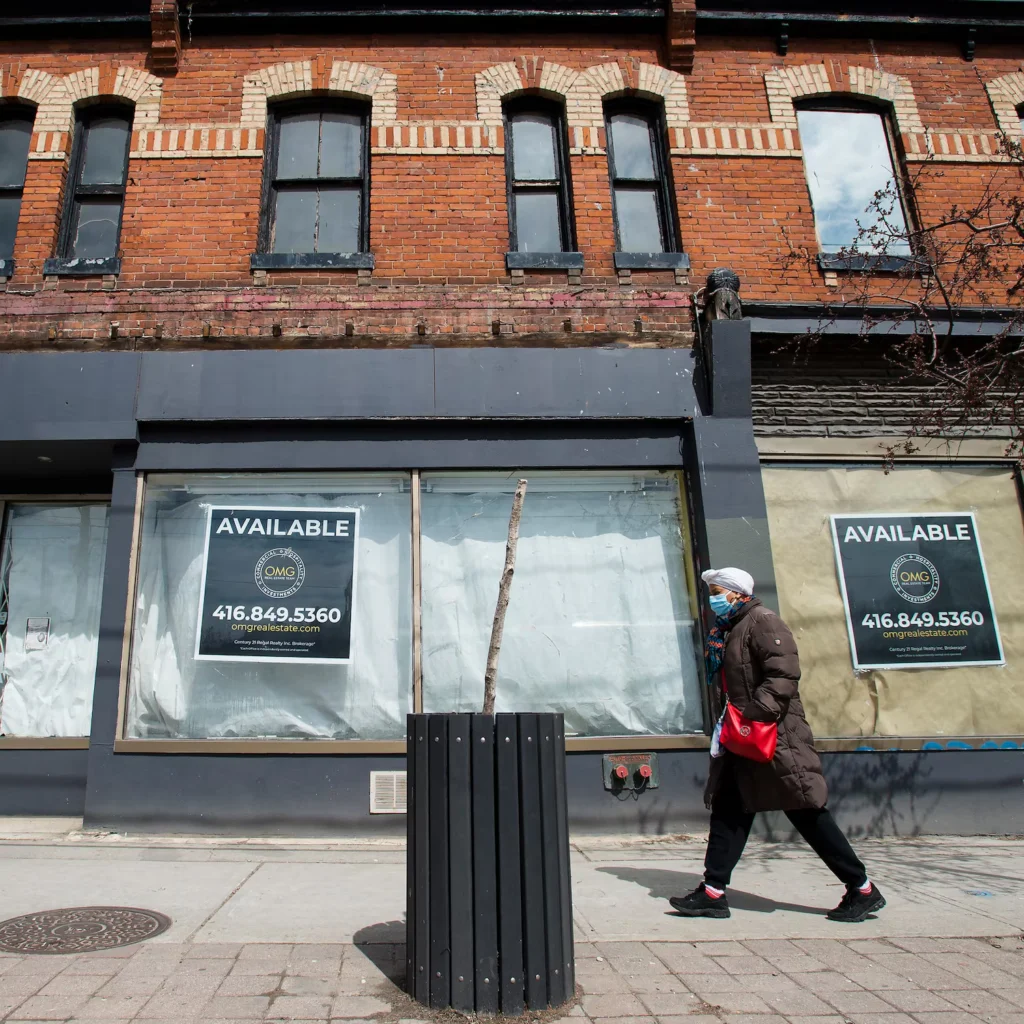
A quiet but meaningful shift is unfolding across Canada’s commercial property landscape. On April 21, 2026, new market data shows that for the first time since 2020, both national office and industrial vacancy rates have declined at the same time, signaling a decisive change in momentum. After years defined by uncertainty, hybrid work adjustments, and uneven demand, the country’s commercial real estate sector is beginning to show signs of coordinated recovery across key asset classes.
A Rare Dual Decline Signals Market Rebalancing
We are observing a moment that industry analysts describe as a structural turning point rather than a temporary fluctuation. According to national market data, office vacancy fell to 13.6 percent, marking a year over year decline of 100 basis points, while industrial space also recorded tightening conditions driven by strong absorption and limited new supply.
This simultaneous improvement across both sectors has not been seen since the early pandemic period, when commercial real estate first entered a prolonged phase of disruption. The latest figures suggest that market forces are now moving in a more coordinated direction, shaped by return to office policies, constrained development pipelines, and stabilizing demand patterns.
From Fragmentation to Alignment in Demand Trends
In the years following 2020, office and industrial markets moved on very different trajectories. Office space struggled with hybrid work adoption and fluctuating occupancy, while industrial assets benefited from e commerce expansion and logistics demand. What we are seeing now is a convergence where both segments are responding to renewed economic normalization.
Industrial space remains historically tight in many urban hubs, while office leasing activity is stabilizing as employers refine workplace strategies and encourage higher in office attendance. This alignment is creating a more balanced commercial real estate environment than at any point in the past several years.
Return to Office Momentum Reshapes Urban Demand
A key driver behind the office market recovery is the gradual return to office policies implemented by both private companies and public institutions. These policies are not uniform, but they are increasingly consistent across major Canadian cities, contributing to renewed demand for centrally located office space.
Leasing activity has strengthened in premium downtown buildings, particularly Class A properties that offer modern amenities and improved energy efficiency. Employers are prioritizing these spaces as they seek to attract workers back into physical offices while maintaining hybrid flexibility.
Recent market analysis shows that tightening conditions are especially visible in major hubs such as Toronto and Vancouver, where competition for high quality office inventory is intensifying.
Scarcity of New Supply Intensifies Competition
One of the most important structural factors shaping the current market is the limited pipeline of new office development. Construction activity has slowed significantly compared to pre pandemic levels, meaning that most demand is being absorbed by existing inventory rather than new supply.
This scarcity is changing negotiation dynamics between landlords and tenants. In many cases, tenants are renewing leases earlier than before to secure preferred locations, while incentives are becoming less common in top tier buildings.
Industrial Market Strength Continues but Begins to Normalize
The industrial real estate sector, which experienced extraordinary growth during the height of e commerce expansion, is now entering a phase of stabilization. While demand remains strong, especially in logistics and distribution corridors, the pace of tightening has moderated compared to earlier post pandemic years.
National absorption levels have exceeded new supply in recent quarters, signaling a gradual return to balance after a period of rapid expansion and speculative development. This shift suggests that while industrial real estate remains one of the strongest performing asset classes, it is no longer operating under extreme scarcity conditions in every market.
Regional Variation Defines Industrial Outlook
The industrial landscape across Canada is far from uniform. Markets such as Toronto and Vancouver continue to experience some of the lowest vacancy rates, driven by population density and supply chain proximity. Meanwhile, emerging logistics hubs are seeing increased construction activity aimed at meeting long term distribution needs.
This regional variation is becoming a defining feature of Canada’s industrial real estate cycle, requiring investors and occupiers to take a more localized approach to planning and expansion.
Downtown Cores Regain Strategic Importance
We are also seeing renewed confidence in downtown office cores, where high quality buildings are once again attracting tenant interest. The shift away from remote work dominance is not a reversal of hybrid work entirely, but rather a recalibration toward more structured in office presence.
Major employers are increasingly prioritizing access to transportation, amenities, and collaborative workspace environments. This has led to a renewed focus on central business districts as essential anchors for workforce engagement.
Workplace Strategy Becomes a Competitive Advantage
Companies are no longer treating office space as a simple cost center. Instead, workplace design and location are becoming strategic tools for talent retention and productivity. The quality of office environments is playing a larger role in recruitment decisions, particularly in knowledge based industries.
Investment Sentiment Shows Cautious Optimism
Investor confidence in Canadian commercial real estate is gradually improving, supported by stabilizing fundamentals and clearer interest rate expectations. While caution remains due to broader economic uncertainty, the dual decline in vacancy rates is being interpreted as a positive signal of market resilience.
According to industry outlooks from major property research firms, a growing share of market participants expect office demand to stabilize or improve through 2026 as return to office strategies mature.
Capital Follows Stability
We consistently see that capital flows toward predictability. As vacancy rates tighten and leasing activity strengthens, investors are beginning to reassess previously cautious positions, particularly in high quality office and logistics assets.
This does not signal a return to pre pandemic conditions, but rather a redefined market where efficiency, location quality, and tenant stability are more important than ever.
What This Turning Point Means for Canada’s Urban Economy
The implications of this shift extend beyond real estate metrics. Commercial property performance is closely tied to employment patterns, urban transportation, and downtown economic activity. As office occupancy increases, surrounding businesses such as retail, hospitality, and transit systems also experience secondary benefits.
This creates a reinforcing cycle where higher workplace density supports broader urban recovery, particularly in city centers that were most affected by remote work transitions.
A Gradual Return to Urban Density
The recovery is not abrupt, but incremental. Employees are returning in phased patterns, companies are refining hybrid models, and landlords are adapting to evolving tenant expectations. Together, these shifts are slowly rebuilding the density that once defined Canada’s major metropolitan cores.
A Market Moving Into Its Next Phase
The simultaneous decline in office and industrial vacancy rates marks more than a statistical milestone. It reflects a broader transition in how Canada uses its built environment after years of disruption and adaptation.
We are now entering a phase defined by stabilization rather than volatility, where supply constraints, evolving work patterns, and renewed economic confidence are shaping a more balanced commercial real estate ecosystem. While challenges remain, particularly around affordability and development costs, the direction of movement is clearer than it has been in years.
Canada’s commercial real estate market is not returning to its past form. Instead, it is forming a new one, shaped by hybrid work realities, disciplined development, and a renewed focus on quality over quantity.