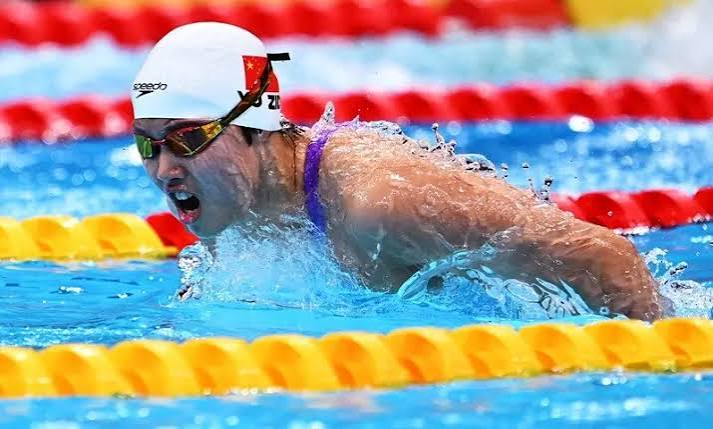
The 2026 Asian Games have ended, but the strength of Asia’s aquatic powers is still being measured in numbers, records and moments that will remain in the sporting memory of the Aichi Nagoya Games. China finished with a remarkable 169 gold medals overall, while its swimmers and divers produced some of the most commanding performances of the competition. In diving alone, China completed a clean sweep of every gold medal and reached a milestone that was almost difficult to imagine when the country first entered the Asian Games diving competition decades ago.
China Reaches a Remarkable Diving Milestone
The clearest symbol of China’s dominance came at the Tokyo Aquatic Centre, where the diving competition produced a historic achievement. Lian Junjie won the men’s 10 metre platform title on September 30, giving China its 100th consecutive Asian Games diving gold medal since the nation’s debut in the sport at the continental Games in 1974. The achievement was confirmed by the Olympic Council of Asia, which described the result as the continuation of one of the most extraordinary streaks in Asian sport. The Olympic Council of Asia provides the official record of the Asian Games and its participating sports.
Lian finished with 501.25 points, narrowly ahead of Japan’s Rikuto Tamai, who scored 497.20. China’s 15 year old Zhao Renjie completed the podium with 427.50 points. The result was especially striking because the Chinese team did not simply win another gold medal. It closed the entire diving program without surrendering a single title.
For athletes watching from the pool deck, such consistency can be difficult to comprehend. A diving final can turn on a fraction of a rotation, a small change in body position or an entry into the water that is just slightly less clean than expected. Yet China repeatedly produced performances capable of surviving that pressure. The final dives at the Tokyo Aquatic Centre therefore carried more than the weight of individual medals. They represented decades of technical development, coaching and competition experience.
A Century of Asian Games Diving Gold
The significance of China’s 100th consecutive diving gold becomes clearer when viewed across generations. The streak stretches from 1974 through the Aichi Nagoya Games, covering multiple eras of Asian sport. Athletes have changed, coaching methods have developed and competition has become increasingly sophisticated, yet the result has remained remarkably consistent.
China’s success has also involved different diving disciplines rather than one isolated event. Synchronised platform events have demanded extraordinary coordination between partners, while individual springboard and platform competitions have required athletes to combine power, flexibility, balance and mental control.
At the 2026 Games, Wang Zongyuan successfully defended his men’s 1 metre springboard title. Chen Yuxi also secured the women’s 10 metre platform crown, adding another individual gold to a collection that has made her one of the most recognizable young figures in international diving.
Chen’s victory carried its own lesson about elite competition. She acknowledged that she had experienced emotional fluctuations during the preliminary stage before finding greater calm in the final. Her ability to adjust quickly helped her produce the strongest dives of the competition. That kind of recovery is easy to overlook when a medal table records only gold, silver and bronze, yet it is often what separates champions from talented competitors.
Japan and Other Rivals Still Created Memorable Moments
China’s dominance did not make the aquatic competition predictable. Japan provided some of the strongest challenges, including Rikuto Tamai’s silver medal in the men’s 10 metre platform. The narrow difference between Tamai and Lian showed that even within China’s historic streak, rival nations remain capable of pushing the leading athletes toward their limits.
Japan also collected a bronze medal in the women’s 3 metre springboard through Sayaka Mikami, while China’s Chen Yiwen and Chen Jia occupied the top two positions. The podium illustrated a familiar pattern in Asian diving, with China setting the standard while Japan and other nations continue to close portions of the gap.
For emerging divers, those performances matter. A silver or bronze medal against the strongest diving program in Asia can become evidence that sustained investment and careful development can eventually challenge established dominance.
Swimming Added Another Layer of Chinese Strength
The aquatic story extended far beyond diving. China also controlled much of the swimming competition, finishing the Games with 30 swimming gold medals, 13 silver medals and 11 bronze medals. That gave the country 54 swimming medals in total and demonstrated the breadth of its strength across individual races and relay events.
Chinese swimmers were prominent in freestyle, butterfly, breaststroke, backstroke and relay competition. Zhang Zhanshuo became one of the standout performers of the Games, while the wider Chinese team repeatedly appeared at the center of medal winning races.
The results were not limited to China. Japan, South Korea, Chinese Taipei and several Southeast Asian nations produced strong performances that helped make the swimming program one of the most competitive aquatic sections of the Games. Japan’s Shin Ohashi broke the 200 metre breaststroke world record, creating one of the competition’s most significant individual moments.
Chinese Taipei’s Wang Kuan Hung also captured attention by winning the men’s 200 metre butterfly. South Korea continued to show its depth, while athletes from Singapore, Thailand and other nations reached podium positions in events where the margins between finalists were often extremely small.
The Rise of a New Generation
Perhaps the most encouraging feature of the aquatic competition was the number of young athletes capable of competing at the highest level. China’s 13 year old Yu Zidi became one of the defining stories of the Games after winning three swimming gold medals and receiving the Female Most Valuable Player award.
Her emergence says something important about the future of Asian swimming. Medal tables record national success, but individual teenagers can change how an entire generation views the sport. A young swimmer winning on a continental stage can inspire children sitting beside local pools, watching races on television or beginning their first competitive season.
That human element should not be lost when discussing China’s medal totals or its extraordinary diving streak. Behind every podium is an athlete who has spent years training when there were no cameras, no cheering crowd and no guarantee of a medal. The visible moment lasts seconds. The preparation behind it can consume much of a young athlete’s life.
Why Aquatic Success Matters Beyond the Medal Table
The aquatic results at Aichi Nagoya offer a broader picture of how sporting strength is developed. Diving and swimming require facilities, specialist coaching, sports science, youth development programs and regular international competition. Success at this level rarely comes from one exceptional athlete appearing by chance.
China’s results suggest the value of a system that develops athletes across several age groups and disciplines. At the same time, the performances of Japan, South Korea, Chinese Taipei and other nations show that the competitive environment remains active. Strong rivals create pressure, and pressure creates opportunities for athletes to improve.
For fans, this is one of the most compelling aspects of continental sport. A dominant nation can set an extraordinary standard, but every challenger brings a different story. Japan’s athletes competed in front of home audiences. South Korean swimmers continued a long tradition of technical excellence. Chinese Taipei produced breakthrough performances. Younger competitors entered an environment that could shape the next decade of Asian aquatic sport.
A Games That Will Be Remembered for Aquatic Excellence
The 2026 Asian Games concluded on October 4 after two weeks of competition involving thousands of athletes and hundreds of medal events. China finished at the top of the overall medal table with 169 gold medals, followed by Japan with 83 and South Korea with 39.
The official Asian Games results platform records the performances across swimming, diving, artistic swimming and water polo, offering a detailed picture of how the aquatic disciplines contributed to the wider competition.
For China, the numbers tell an extraordinary story. Thirty swimming gold medals demonstrated breadth, while ten diving gold medals completed a perfect sweep. The 100th consecutive Asian Games diving gold added a historic dimension that may stand for many years before another continental sporting streak approaches it.
Yet perhaps the most lasting image is not a number. It is the athlete standing on the platform, preparing for one final dive while the arena grows quiet. It is the swimmer touching the wall after years of training. It is a teenager discovering what is possible for the first time. The 2026 Asian Games produced plenty of medals, but the aquatic competition also offered something more enduring: a glimpse at how sporting ambition passes from one generation to the next.