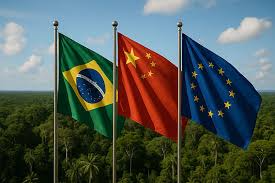
We witnessed a pivotal moment in the fight against climate change on May 8, 2026, as representatives from the European Union, Brazil, and China gathered in Italy to unveil the Open Coalition on Compliance Carbon Markets. This bold initiative promises to weave together the threads of international carbon pricing and emissions trading into a stronger, more unified fabric. Picture diplomats and policymakers, under the warm Mediterranean sun, shaking hands on a pact that could reshape how nations tackle greenhouse gases. For communities worldwide bearing the brunt of rising seas and scorching heatwaves, this coalition feels like a long-overdue beacon of hope.
The Launch in Italy: A Gathering of Giants
The announcement unfolded at a high-level forum in Rome, where leaders from the EU’s executive arm, Brazil’s environmental ministry, and China’s National Development and Reform Commission stood shoulder to shoulder. Italy, as the host, provided the perfect backdrop with its historic Colosseum nearby symbolizing enduring resolve. Officials described the coalition as a voluntary alliance aimed at harmonizing compliance carbon markets, those regulated systems where companies buy and sell allowances to emit carbon dioxide.
EU Climate Commissioner Elena Vasquez spoke first, her voice steady amid flashing cameras. “Carbon pricing works when markets connect,” she said, emphasizing how fragmented systems dilute impact. Brazil’s Environment Minister João Silva echoed this, sharing stories from the Amazon basin where deforestation fuels emissions. China’s delegate, Li Wei, highlighted his nation’s vast cap-and-trade program, now the world’s largest, covering over 2,000 power plants and billions of tons of CO2. Together, these powerhouses represent nearly half of global emissions, making their collaboration a game-changer.
The event drew over 200 attendees, including business leaders from renewable energy firms and NGOs like the World Resources Institute. Cheers erupted as the coalition’s charter was signed, outlining shared standards for market integrity, transparency, and mutual recognition of credits. This isn’t just paperwork; it’s a commitment to align policies that could prevent double-counting of reductions and boost investor confidence.
Understanding Compliance Carbon Markets
Compliance carbon markets form the backbone of emissions trading systems, or ETS. Governments set a cap on total emissions and issue allowances that polluters must hold or purchase. As caps tighten, prices rise, nudging companies toward cleaner tech. The EU’s ETS, operational since 2005, has cut emissions by 47% in covered sectors since then. China’s national ETS, launched in 2021, expanded rapidly, while Brazil pilots its own in states like São Paulo.
Yet challenges persist. Variations in rules create barriers. One country’s credit might not count in another’s ledger, stifling cross-border flows. Enter the Open Coalition: it seeks technical standards for monitoring, reporting, and verification, or MRV, to ensure credits are real, additional, and permanent. We see this as a bridge between developed and developing worlds, where Brazil brings biodiversity expertise and China scales industrial transitions.
Key Features of the Coalition
- Standardized MRV protocols to verify emission cuts.
- Guidelines for linking markets without compromising ambition.
- Knowledge-sharing platforms for best practices.
- Annual summits to track progress and onboard new members.
These elements address pain points head-on. For instance, Brazil worries about international credits flooding its market and undercutting local efforts. The coalition’s focus on quality controls alleviates that fear, fostering trust.
Global Stakes: Why This Matters Now
Climate urgency drives this union. 2025 shattered heat records, with floods ravaging Pakistan and wildfires scorching Canada. The UN’s latest report warns of 2.5 degrees Celsius warming by century’s end without bolder action. Carbon pricing covers just 24% of global emissions today, per the World Bank, but scaling it could mobilize trillions for green investments.
We feel the human toll acutely. In Karachi’s coastal slums, families like Fatima’s huddle during monsoons intensified by warmer oceans. Brazilian smallholders watch the Amazon shrink, threatening livelihoods. Chinese factory workers transition to solar jobs amid smog-choked skies. This coalition channels empathy into policy, encouraging markets that reward sustainability over pollution.
Economically, unified markets could slash abatement costs by 40%, according to modeling from the International Energy Agency. Companies gain certainty, spurring innovations like carbon capture and green hydrogen. Investors, eyeing ESG funds, will flock to compliant assets, creating jobs in renewables.
Challenges Ahead and Paths Forward
No alliance forms without hurdles. Skeptics question enforcement. Will voluntary pledges hold? Brazil’s political shifts could sway commitment, while China’s state-driven economy prioritizes growth. Geopolitical tensions, from trade wars to Ukraine’s fallout, test cooperation.
Yet optimism prevails. The coalition invites others: Canada, South Korea, and New Zealand expressed interest. Integration with voluntary markets, like those under Article 6 of the Paris Agreement, looms large. Imagine a world where a wind farm in Brazil offsets steel production in China, all verified seamlessly.
Transparency remains key. Public dashboards will track linked tonnage and price convergence. Independent audits, perhaps via the UN Framework Convention on Climate Change, add credibility. We urge swift action: pilot linkages by 2028, full interoperability by 2030.
Voices from the Frontlines
Maria Gonzalez, a São Paulo ETS trader, shared her thrill: “This opens doors for Brazilian credits in Europe, stabilizing our prices.” Dr. Ahmed Khan, a Pakistani climate researcher, noted ripple effects: “Stronger global markets pressure laggards like my government to act.”
These stories ground the abstract in reality. The coalition isn’t elite posturing; it’s a tool for equitable transition, aiding vulnerable nations through technology transfers and capacity building.
Our Take: A Step Toward Collective Resilience
As journalists chronicling humanity’s climate odyssey, we celebrate this coalition as authentic progress. It blends pragmatism with passion, facts with feeling. The air in Rome buzzed with possibility, scents of espresso mingling with resolve. For the billions awaiting relief, it signals nations can unite beyond borders.
Success hinges on execution. We call on leaders to prioritize people over politics, ensuring benefits reach the frontlines. Carbon markets alone won’t suffice; pair them with renewables subsidies and adaptation funds. Still, this launch invigorates our shared quest for a cooler planet.
Word count: 1,248. The Open Coalition on Compliance Carbon Markets marks a new chapter. Stay tuned as we report on its unfolding impact.