The European Union has imposed new human rights sanctions on four Haitian armed groups accused of grave abuses, including killings, sexual violence and the recruitment of children. Announced on November 16, 2026, the decision adds 5 Segond, Gran Ravine, 400 Mawozo and Krazé Baryè to the EU Global Human Rights Sanctions Regime. The move brings additional international pressure on armed groups operating in Haiti, where widespread gang violence has contributed to civilian deaths, displacement and the breakdown of essential services.
Four Haitian Groups Added to the EU Sanctions List
The Council of the European Union said the four entities were listed because of their involvement in serious human rights violations. The allegations include attacks on civilians, sexual and gender based violence, crimes against children and actions that have disrupted access to healthcare and humanitarian assistance.
The groups named in the decision are 5 Segond, Gran Ravine, 400 Mawozo and Krazé Baryè. Their inclusion reflects the Council’s focus on armed groups whose activities have exposed children and other civilians to severe and continuing harm.
5 Segond and Gran Ravine
The Council identified 5 Segond as responsible for killings, rape and other forms of sexual and gender based violence, including violence against children. The group has also been linked to attacks affecting health infrastructure and humanitarian services. Such attacks can have consequences far beyond the immediate location. When medical facilities or aid operations are disrupted, families may lose access to treatment, food assistance and other services that are essential to survival.
Gran Ravine was also listed over a pattern of serious crimes. Under the leadership of Renel Destina, known as Ti Lapli, the armed group has carried out attacks that have resulted in civilian deaths, displacement and interruptions to essential services. The Council also cited murder, rape, kidnapping and other serious offences among the group’s activities.
400 Mawozo and Krazé Baryè
The EU named 400 Mawozo and Krazé Baryè for the recruitment of children into armed groups and exposing them to armed violence. The Council also cited killings and forms of sexual and gender based violence. The recruitment of children is particularly damaging because it places young people in situations of extreme danger while disrupting their education, family relationships and prospects for a safe future.
Children affected by armed groups may face coercion, threats and pressure that make it difficult to leave. Girls can face additional risks of sexual exploitation and abuse, while boys may be forced into combat or other roles that expose them to violence. These experiences can leave lasting physical and psychological harm, even after immediate fighting has ended.
What the EU Sanctions Mean
The new listings carry practical financial and legal consequences across the European Union. Under the Global Human Rights Sanctions Regime, listed entities are subject to an asset freeze. EU citizens and companies are also prohibited from making funds or economic resources available to them, either directly or indirectly. Individuals listed under the same framework face travel bans that prevent them from entering or transiting through EU member states.
These restrictions are intended to limit the ability of sanctioned groups and individuals to access financial resources or use European territory. They can also create compliance obligations for banks, businesses and other organisations operating within the EU. Companies must take care not to provide funds or economic resources to designated entities, including through indirect arrangements.
The measures do not amount to a military intervention or a direct law enforcement operation inside Haiti. Their purpose is to impose targeted consequences on those identified as responsible for serious abuses. Humanitarian exceptions and authorisations can also apply under the EU framework, helping ensure that sanctions do not prevent legitimate humanitarian assistance from reaching people in need.
Following the November 16 decision, the Council said the Global Human Rights Sanctions Regime covered a total of 152 individuals and 49 entities. The legal acts implementing the new listings were published in the Official Journal of the European Union, giving the measures their formal legal basis.
Why the Global Human Rights Framework Matters
The EU established its Global Human Rights Sanctions Regime in December 2020. It allows the bloc to target individuals, organisations and other entities responsible for, involved in or associated with serious human rights violations and abuses, regardless of where those acts take place. The framework can cover state and non state actors and is not limited to one country or a single type of conflict.
Its scope includes genocide, crimes against humanity, torture, slavery, extrajudicial killings, enforced disappearances and arbitrary detention. Other abuses, including trafficking, sexual violence and gender based violence, may also fall within the framework when they meet the required seriousness and policy criteria.
The decision concerning the four Haitian groups was specifically linked to grave violations affecting children in armed conflict. The Council referred to the EU Guidelines on Children and Armed Conflict, which identify six grave violations: killing and maiming children, recruiting or using children as soldiers, sexual violence against children, abducting children, attacking schools or hospitals, and denying humanitarian access to children.
The year 2026 marks the thirtieth anniversary of the United Nations mandate on children and armed conflict. By making the new listings on that anniversary, the EU connected its action to a wider international effort to protect children caught in armed violence. The Council’s announcement reinforces the principle that children must not be treated as participants or instruments in conflicts created by adults.
Haiti’s Wider Security and Humanitarian Crisis
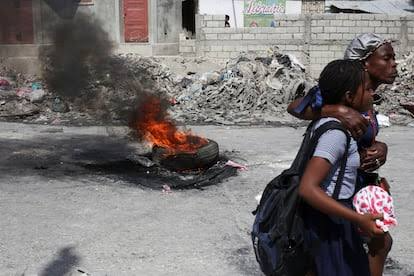
The sanctions arrive as Haiti continues to face a profound security and humanitarian emergency. Armed groups have expanded their influence in parts of the country, particularly around the capital, Port au Prince. Violence, intimidation, kidnapping and attacks on communities have forced people from their homes and made ordinary activities increasingly dangerous. For many families, the consequences are measured not in political statements but in missed school days, interrupted medical care, lost livelihoods and uncertainty about whether it is safe to travel across their neighbourhood.
Displacement places further pressure on communities already struggling with limited resources. Families forced to leave their homes may need emergency shelter, food, clean water, healthcare and protection. Children can lose access to education for extended periods, while women and girls face heightened risks of exploitation and gender based violence. When roads, hospitals and humanitarian facilities become unsafe, assistance becomes harder to deliver precisely where it is most urgently needed.
The EU has described itself as a long standing political and development partner of Haiti. Its response includes support for basic services, institutional capacity, food security, education, disaster preparedness and assistance connected to security and stability. The new sanctions form one part of that broader engagement, rather than a complete solution to the country’s crisis.
How the New Listings Fit With Other Haiti Sanctions
The November decision should be distinguished from the EU’s separate sanctions framework addressing threats to peace, stability and democracy in Haiti. That country specific framework was established in 2022 and expanded in 2023. It allows restrictive measures against people and entities responsible for threatening Haiti’s security or undermining democratic institutions and the rule of law.
In June 2026, the Council extended that separate framework until July 29, 2027, citing persistent gang violence and its destabilising effects. The Global Human Rights Sanctions Regime used for the four new listings has a different legal foundation and a worldwide scope. The two frameworks can complement one another, but they address distinct legal objectives.
This distinction matters because sanctions are not a single blanket measure. Each listing must be supported by the relevant legal framework and grounds for designation. The EU says listings under its global regime are kept under review, and the framework provides routes through which affected parties can seek reconsideration or challenge measures under applicable legal procedures.
What Comes Next for Haiti and International Partners
The immediate effect of the November 16 decision is to place four additional armed groups under EU financial restrictions. Its longer term impact will depend on implementation, cooperation with international partners and whether the measures make it harder for those groups to obtain resources. Sanctions can raise the cost of operating internationally, but they cannot by themselves restore security in communities facing armed control or rebuild damaged public services.
For meaningful progress, targeted restrictions will need to sit alongside effective protection for civilians, support for Haitian institutions, humanitarian access and sustained efforts to prevent the recruitment and exploitation of children. Regional governments and international organisations also have a role in addressing the movement of weapons and illicit financial flows that can help armed groups maintain their operations.
The EU’s decision sends a clear message that serious abuses against civilians, particularly children, can carry consequences beyond national borders. Yet the measure’s real significance will ultimately be judged by whether it contributes to safer conditions for Haitians. Behind every designation are communities seeking the basic security to attend school, receive medical treatment, earn a living and return home without fear.
Official Information
The full announcement and details of the four designations are available through the Council of the European Union’s official press release. Further information about the legal framework, asset freezes, travel restrictions and humanitarian exceptions is provided on the EU’s Global Human Rights Sanctions policy page.