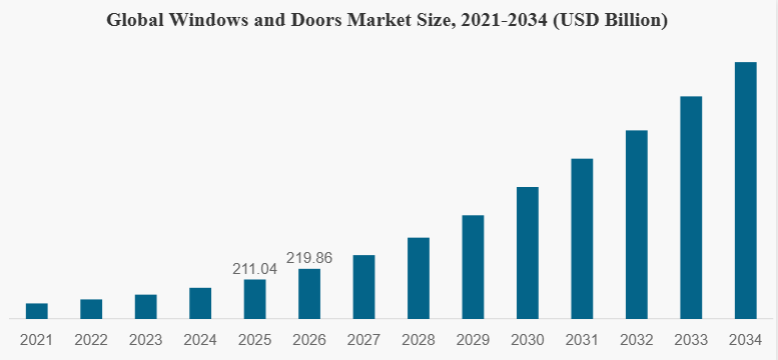
We are witnessing a quiet transformation taking place in homes, offices, and skylines around the world. On April 16, 2026, a new global market report revealed that the windows and doors industry is on track to reach an estimated 278 billion dollars by 2031. What might seem like a routine construction segment is now at the center of a much larger shift driven by energy efficiency, sustainability, and evolving building standards.
A Market Growing With Purpose
The numbers tell a compelling story. The global windows and doors market, valued at over 216 billion dollars in 2025, is expected to steadily expand, crossing 278 billion dollars within the next five years. This growth reflects a compound annual rate of more than 4 percent, signaling consistent demand across residential and commercial sectors.
We often overlook how integral windows and doors are to a building’s performance. They are not just design features. They regulate temperature, manage airflow, and influence energy consumption. As energy costs rise and climate concerns intensify, these components have moved from background details to critical investments.
The Regulatory Push Driving Change
At the core of this growth lies a powerful force. Regulation. Governments across major economies are tightening energy efficiency standards, compelling builders and homeowners to rethink materials and design choices.
In the United States, updated standards such as ENERGY STAR Version 7.0 are setting higher benchmarks for thermal performance. In Europe, the Energy Performance of Buildings Directive is pushing toward near zero emission buildings by the end of the decade.
These policies are not abstract guidelines. They directly influence what gets built, renovated, and replaced. Builders must now select products that meet strict insulation and energy performance criteria, accelerating demand for advanced window and door systems.
Why Energy Efficient Windows and Doors Matter
To understand the scale of this shift, we need to look inside the home. A poorly insulated window can leak heat during winter and allow excess warmth during summer. Multiply that across millions of buildings, and the energy loss becomes enormous.
Modern solutions are addressing this challenge with precision. Double glazed and triple glazed windows, low emissivity coatings, and thermally insulated frames are becoming standard rather than optional. These technologies reduce energy consumption, lower utility bills, and improve indoor comfort.
We are also seeing homeowners take a more active role. Renovation projects increasingly prioritize energy savings, not just aesthetics. Replacing old windows is no longer a cosmetic upgrade. It is a financial and environmental decision.
The Renovation Boom Reshaping Demand
One of the most significant drivers of market growth is the global surge in home renovation. Aging buildings across North America, Europe, and parts of Asia are being upgraded to meet modern energy standards.
This renovation wave is not limited to luxury projects. It spans middle income households, commercial properties, and public infrastructure. Governments are offering incentives, rebates, and tax benefits to encourage energy efficient upgrades.
We can imagine a homeowner standing in front of an old, drafty window, feeling the cold air seep through the edges. Replacing that window is no longer just about comfort. It becomes a step toward lower energy bills and a smaller environmental footprint.
Asia Pacific Leads the Expansion
Geographically, Asia Pacific continues to dominate the market, driven by rapid urbanization and large scale infrastructure development. Cities across China, India, and Southeast Asia are expanding at an unprecedented pace, creating strong demand for construction materials.
At the same time, emerging economies are adopting stricter building codes, aligning with global sustainability goals. This combination of growth and regulation is creating a powerful momentum that positions the region as both the largest and fastest growing market.
We are seeing how urban growth and environmental responsibility are increasingly intertwined. New buildings are expected to meet higher standards from the outset, reducing the need for costly retrofits later.
Technology Redefines the Industry
Beyond regulation and demand, technology is playing a transformative role. Manufacturers are introducing innovative materials and designs that improve performance while maintaining aesthetic appeal.
Some of the key advancements include:
- Low emissivity glass that reflects heat while allowing light
- Smart glass that adjusts transparency based on sunlight
- uPVC and composite frames that offer superior insulation
- Modular designs that simplify installation and reduce waste
These innovations are not just incremental improvements. They represent a fundamental shift in how windows and doors are engineered and perceived.
The Rise of Sustainable Building Practices
The growth of this market is closely tied to a broader movement toward sustainable construction. Green building certifications, carbon reduction goals, and environmental awareness are influencing decisions at every level of the industry.
Developers are now considering the lifecycle impact of materials, from production to installation and long term performance. Windows and doors play a critical role in achieving energy efficiency targets, making them central to sustainable design strategies.
We are also seeing collaboration between governments, manufacturers, and builders to accelerate adoption. Industry standards are evolving rapidly, creating a shared framework for innovation and compliance.
Challenges Beneath the Growth Story
Despite the optimistic outlook, the industry faces several challenges. Rising material costs, particularly for metals like aluminum, continue to impact pricing. Labor shortages in construction and manufacturing add another layer of complexity.
Supply chain disruptions, which have affected multiple industries in recent years, remain a concern. Manufacturers must balance demand with production capacity while maintaining quality and compliance.
We cannot ignore the pressure this places on smaller companies. Larger players with advanced manufacturing capabilities are better positioned to adapt, while smaller firms may struggle to keep pace.
Residential Sector Remains the Core Driver
The residential segment accounts for the majority of demand, driven by both new construction and renovation projects. Homeowners are increasingly aware of the long term benefits of energy efficient upgrades, from cost savings to improved living conditions.
At the same time, commercial and industrial sectors are gaining momentum. Office buildings, retail spaces, and public facilities are adopting high performance systems to meet regulatory requirements and reduce operational costs.
We are seeing a convergence of priorities. What benefits homeowners also benefits businesses and governments, creating a unified push toward efficiency.
A Market Reflecting Changing Priorities
The growth of the windows and doors market reflects a deeper shift in how we think about buildings. Energy efficiency is no longer a niche concern. It is a central requirement shaping design, construction, and renovation.
We are moving toward a future where every component of a building contributes to sustainability. Windows and doors, once considered simple fixtures, are now part of a larger system aimed at reducing energy consumption and environmental impact.
Looking Ahead to 2031
As the market approaches the 278 billion dollar mark, the trajectory appears steady and resilient. Continued regulatory support, technological innovation, and consumer awareness are expected to sustain growth in the years ahead.
For homeowners, builders, and policymakers, the message is clear. Investing in energy efficient solutions is no longer optional. It is a necessary step toward a more sustainable future.
We are not just witnessing the growth of an industry. We are seeing the evolution of how buildings interact with the environment and how people experience the spaces they live and work in. In that transformation, something as simple as a window becomes a powerful symbol of change.