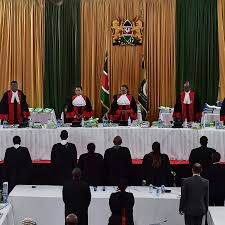
Kenya’s Supreme Court has opened final arguments in a case that reaches far beyond one courtroom and one generation of survivors. At stake is a constitutional question with national and international weight: whether the government bears legal responsibility to protect survivors of post election sexual violence and to provide compensation when it failed to prevent, investigate, or respond to those abuses.
[phr](https://phr.org/news/kenya-supreme-court-hears-post-election-sexual-violence-case/)
A case rooted in memory and accountability
The hearing takes place nearly two decades after the violence that followed Kenya’s disputed 2007 election, a period that left deep scars across communities and families. For survivors of sexual violence, those years were marked not only by physical harm but also by silence, stigma, and the exhausting burden of seeking recognition from institutions that too often turned away.
[hrw](https://www.hrw.org/report/2016/02/15/i-just-sit-and-wait-die/reparations-survivors-kenyas-2007-2008-post-election)
What makes this case so important is that it asks the Supreme Court to define the government’s constitutional duty in plain terms. If state authorities knew, or should have known, that women and girls were at grave risk during the post election crisis, what obligation did they have to prevent the abuse? And when violence occurred, what duty did they have to investigate it, prosecute those responsible, and repair the harm? Those are not abstract questions. They shape whether survivors receive more than sympathy.
From petition to high court victory
The legal path to this moment has already been long. In 2020, a Nairobi court issued a landmark decision in favor of four survivors, finding that the government failed in its duty to investigate and prosecute the sexual violence that followed the election crisis. The court ordered compensation, a step that was widely seen as a major breakthrough because it recognized post election sexual violence as a matter of state accountability, not just private tragedy.
[aljazeera](https://www.aljazeera.com/opinions/2020/12/25/for-kenyas-sexual-violence-survivors-justice-though)
That ruling mattered because it acknowledged the state’s failure in more than symbolic terms. In at least some of the cases, the abuse was linked directly to security forces or to police inaction after complaints were made. The court’s reasoning drew a line between isolated criminal acts and institutional neglect, making clear that justice is not only about punishing offenders after the fact. It is also about whether the system was working when it mattered most.
[aljazeera](https://www.aljazeera.com/opinions/2020/12/25/for-kenyas-sexual-violence-survivors-justice-though)
Yet the road after the judgment has been painfully slow. Survivors and advocates have repeatedly called on the government to implement the award, and delays in payment became part of the story itself. Last year, Kenya did begin compensating four of the survivors, a welcome but partial step that arrived after years of waiting. The current Supreme Court case now asks whether the legal and moral logic behind that award should extend further.
[icj-kenya](https://icj-kenya.org/news/landmark-victory-government-compensates-post-election-sexual-violence-survivors-after-13-years/)
Why the Supreme Court hearing matters now
The new hearing is not simply a replay of old facts. It is the final stage in a constitutional lawsuit that could define the state’s duties to survivors of systemic sexual violence committed by non state actors during times of national crisis. That distinction matters because many survivors were harmed by gangs, militias, or other civilians rather than by uniformed officers, and the legal question is whether the state can still be held liable when it failed to prevent or properly respond to those crimes.
[phr](https://phr.org/news/kenya-supreme-court-hears-post-election-sexual-violence-case/)
This is where the case becomes a test of due diligence. International human rights law has long held that governments do not escape responsibility simply because the direct attacker was not a state official. If authorities knew about a pattern of abuse and failed to act with seriousness, the law may still see that failure as a violation in itself. The Supreme Court is now being asked to decide how far that principle reaches in Kenya’s constitutional order.
For broader context on rights and remedies for sexual violence survivors, the United Nations Human Rights Office provides useful material on state obligations, while the International Commission of Jurists Kenya has tracked the reparations effort and the legal struggle surrounding the 2007 to 2008 post election violence.
What the court is weighing
- Whether the state had a constitutional duty to prevent foreseeable sexual violence during the post election crisis.
- Whether government inaction after attacks amounted to a rights violation.
- Whether compensation should be available where survivors were harmed by non state actors and the state failed to respond.
- How Kenya should define reparations for survivors of conflict related sexual violence going forward.
[phr](https://phr.org/news/kenya-supreme-court-hears-post-election-sexual-violence-case/)
[aljazeera](https://www.aljazeera.com/opinions/2020/12/25/for-kenyas-sexual-violence-survivors-justice-though)
[icj-kenya](https://icj-kenya.org/news/landmark-victory-government-compensates-post-election-sexual-violence-survivors-after-13-years/)
[phr](https://phr.org/news/survivors-of-post-election-sexual-violence-in-kenya-call-on-attorney-general-to-deliver-reparations/)
The human cost behind the legal language
Legal filings can feel cold on the page, but this case is rooted in something intimate and painful. Survivors have described years of medical need, financial hardship, and emotional isolation after attacks that changed the course of their lives. The damage did not end when the violence stopped. It followed them into homes, jobs, relationships, and the quiet moments when the past refused to stay buried.
[hrw](https://www.hrw.org/report/2016/02/15/i-just-sit-and-wait-die/reparations-survivors-kenyas-2007-2008-post-election)
For many survivors, compensation is not only about money. It is about acknowledgment. It is about the state saying, in effect, that what happened was real, wrong, and never should have been ignored. That recognition can matter as much as the award itself, because it helps restore dignity in places where trauma once took it away.
We should also be clear that survivor justice is rarely neat or fast. It often arrives in fragments: one judgment, then a delayed payment, then another appeal, then another hearing. Each step can feel small on its own, but together they build the framework for whether a democracy is willing to confront harm done in its name.
What this means for Kenya and beyond
If the Supreme Court upholds a broad view of state responsibility, the ruling could become a major reference point for future cases involving election related violence, gender based violence, and failures in public protection. It would send a strong message that constitutional rights do not disappear when the violence is carried out by private actors during moments of national breakdown.
[phr](https://phr.org/news/kenya-supreme-court-hears-post-election-sexual-violence-case/)
That would matter not only for Kenya but also for other countries dealing with the legacy of mass violence and delayed reparations. Courts across the world often wrestle with the same question: when does government failure become government liability? A clear ruling in this case could help answer that question in a way that honors survivors rather than forcing them to fight the same battle for decades.
If the court narrows the state’s duty, the decision could leave some survivors without a remedy and reinforce the familiar gap between legal recognition and lived justice. Either way, the ruling will likely shape reparations policy and future constitutional claims for years to come.
A national test of conscience
There is a reason this case carries such weight. It is not just about the past. It is about whether a country can look directly at one of its darkest periods and say that survivors deserve more than remembrance. They deserve redress. They deserve a state that can be held to its obligations. And they deserve a justice system willing to move at the pace of principle, not delay.
As the final arguments begin, the court is hearing more than legal theory. It is hearing the echo of old violence, the patience of survivors, and the question that sits beneath the entire case: if the state failed to protect people when they needed protection most, what must it do now to make that failure right? The answer will matter far beyond the courtroom in Nairobi.