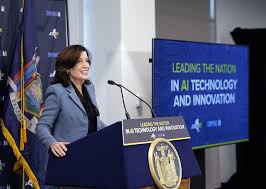
New York is making a bold statement about who should shape the future of artificial intelligence. On August 5, the state officially launched Empire AI Beta, a powerful new supercomputer built to expand academic access to advanced computing, while also backing a 55 million dollar endowment to establish the nation’s first independent university based AI responsibility research center at Binghamton University. Together, the two moves signal that New York wants to lead not only in AI capability, but in the public accountability that should guide it.
[governor.ny](https://www.governor.ny.gov/news/governor-hochul-announces-empire-ai-suny-campus-partnerships-expand-access-artificial)
A supercomputer built for broader access
Empire AI Beta is the next major step in New York’s state supported artificial intelligence infrastructure. Housed at the State University of New York at Buffalo, the system is designed to give researchers across the state access to computing power that would otherwise remain out of reach for most public universities. State officials have described Beta as a dramatic expansion of the original Empire AI system, with performance gains that make complex model training and inference far faster and more available to academic teams.
[suny](https://www.suny.edu/suny-news/press-releases/8-26/8-5-26-2/empire-ai.html)
For researchers, that matters in a practical and human way. Better computing means faster experiments, larger datasets, and a better chance of moving ideas from theory into tools that touch everyday life. That includes work in healthcare, cybersecurity, climate resilience, education and manufacturing, all areas where the pace of research often depends on access to serious computing muscle.
[governor.ny](https://www.governor.ny.gov/news/governor-hochul-announces-empire-ai-suny-campus-partnerships-expand-access-artificial)
Why the Beta launch matters now
In plain terms, Empire AI Beta helps level the playing field. Universities have long produced brilliant ideas while struggling with the cost of the infrastructure needed to test them at scale. The new system gives public institutions more room to compete with private labs and large technology companies, which have spent years building their own compute advantage.
[governor.ny](https://www.governor.ny.gov/news/governor-hochul-announces-empire-ai-suny-campus-partnerships-expand-access-artificial)
New York officials have said the new platform will accelerate Empire AI’s performance to 11 times its former scale, building on the state’s broader effort to make advanced AI research available for public good. The consortium behind the initiative has already supported hundreds of researchers and dozens of projects, and the Beta launch now gives that network a stronger engine.
[governor.ny](https://www.governor.ny.gov/news/governor-hochul-announces-empire-ai-suny-campus-partnerships-expand-access-artificial)
Binghamton gets a landmark center
Alongside the supercomputer launch, New York is helping fund the Center for AI Responsibility and Research at Binghamton University with a 55 million dollar endowment. The center is being described as the first independent artificial intelligence research center at a public university in the United States, a distinction that gives the project unusual national significance.
[binghamton](https://www.binghamton.edu/news/story/6019/binghamton-receives-largest-academic-gift-in-university-history-to-establish-ai-center/)
The funding combines a 30 million dollar philanthropic commitment from alumnus Tom Secunda with a 25 million dollar capital investment from New York State and the Legislature. Binghamton officials say the center will focus on responsible, transparent and trustworthy AI, with research aimed at the public interest rather than narrow commercial gain.
[governor.ny](https://www.governor.ny.gov/news/governor-hochul-announces-empire-ai-suny-campus-partnerships-expand-access-artificial)
The meaning of responsible AI
Responsible AI is one of those phrases that can sound abstract until a real world problem is attached to it. At Binghamton, the work is expected to include issues such as safety, security, transparency and public sector use. That means looking closely at how systems behave, where they fail, and how they affect people who may never know an algorithm was involved in a decision about their life.
[binghamton](https://www.binghamton.edu/news/story/6019/binghamton-receives-largest-academic-gift-in-university-history-to-establish-ai-center)
I find that part especially important because the public conversation around artificial intelligence often gets stuck between hype and fear. A center focused on responsibility offers a more grounded path. It asks whether a system can be trusted, whether it can be explained, and whether it serves people with fairness rather than opacity. That kind of research can shape healthcare tools, hiring systems, civic technology and educational software long before those products reach the mainstream.
[linkedin](https://www.linkedin.com/posts/atul-kelkar-13a8a399_responsibleai-watsoncollege-engineeringforimpact-activity-7420117070350028800-W0Pa)
What the center is likely to study
- AI safety and reliability in public facing systems.
- Transparency and explainability in model outputs.
- Security and misuse risks in deployed AI tools.
- Ethical standards for state and university research projects.
Why universities want their own compute
Empire AI was built around a simple but powerful idea: if only a handful of companies control the computing power needed for major AI research, then the public sector risks falling behind on both innovation and oversight. New York’s approach tries to solve both problems at once by giving academic institutions access to top tier hardware and pairing that with research on how the technology should be used.
[governor.ny](https://www.governor.ny.gov/news/governor-hochul-announces-empire-ai-suny-campus-partnerships-expand-access-artificial)
That model also reflects a growing recognition that AI is not only a technical issue. It is a governance issue, an education issue and a workforce issue. Universities are where many of the next generation of engineers, policy leaders and data scientists are being trained. Giving them access to powerful systems and a mandate to study responsibility could shape the standards that govern AI far beyond New York.
[governor.ny](https://www.governor.ny.gov/news/governor-hochul-announces-empire-ai-suny-campus-partnerships-expand-access-artificial)
Local benefits with national reach
Binghamton’s role in the project is particularly significant because it connects a major research investment to a public university outside the handful of traditional tech hubs. That widens the geography of AI leadership. Instead of concentrating advanced research in a few private campuses or coastal labs, the new center gives upstate New York a direct stake in the debate over how AI should evolve.
[binghamton](https://www.binghamton.edu/news/story/6019/binghamton-receives-largest-academic-gift-in-university-history-to-establish-ai-center/)
The university says it already has projects underway using Empire AI resources, and the new center should deepen that pipeline by creating an independent platform for interdisciplinary work. For students and faculty, the result could be more opportunities to work on urgent problems in healthcare, smart infrastructure, microelectronics, manufacturing and climate related systems.
[binghamton](https://www.binghamton.edu/news/story/6019/binghamton-receives-largest-academic-gift-in-university-history-to-establish-ai-center)
What this says about New York’s strategy
Seen together, Empire AI Beta and the Binghamton center show a state trying to do more than simply chase the latest technology trend. New York is building hardware, funding research, and setting a public interest frame around AI at the same time. That approach gives the state a louder voice in how the next phase of machine learning is developed and judged.
[governor.ny](https://www.governor.ny.gov/news/governor-hochul-announces-empire-ai-suny-campus-partnerships-expand-access-artificial)
It also tells us something about the politics of the moment. States are no longer waiting for federal or corporate leadership to define the AI future. They are building their own institutions, their own compute clusters and their own research centers because the stakes are too high to sit back. In that sense, New York is not just investing money. It is staking out a philosophy: powerful AI should be studied where public accountability is part of the mission from the start.
[governor.ny](https://www.governor.ny.gov/news/governor-hochul-announces-empire-ai-suny-campus-partnerships-expand-access-artificial)
For readers who want to explore the official announcements, the state government’s Empire AI Beta announcement and Binghamton University’s AI center announcement provide the clearest public record of the launch and the funding structure.
[binghamton](https://www.binghamton.edu/news/story/6019/binghamton-receives-largest-academic-gift-in-university-history-to-establish-ai-center/)
The real significance of this moment is not only that New York has a stronger supercomputer or a larger research budget. It is that the state is trying to tie AI power to public purpose. That may prove to be the more lasting innovation.