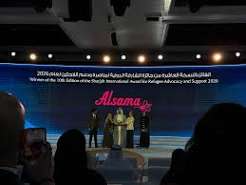
For young people displaced by conflict, losing school can mean losing more than lessons. It can interrupt the route to university, work and a future they once imagined. Lebanon’s Alsama Project, which helps displaced teenagers recover years of missed education, has won the Dh500,000 Sharjah International Award for Refugee Advocacy and Support and plans to use the prize to expand its digital high school qualification to young people around the world.
The award was presented on November 25 at a ceremony in Sharjah marking the prize’s tenth anniversary. Alsama was selected from 736 nominations across 57 countries. Its work offers a practical response to a crisis that often leaves young people with the ability and ambition to study, but few ways to return to a classroom.
A school pathway for students who have missed years
Alsama Project began in 2020 with 40 Syrian refugee girls who had been excluded from formal education in Beirut’s Shatila camp. It has since grown into a programme serving students at five education centres in Beirut and Homs, Syria. The organisation says about 1,200 pupils are currently enrolled, and 3,277 students have benefited from its accelerated learning model.
The programme is designed for young people whose education has been interrupted by displacement. Some arrive unable to read or write. Through a six year accelerated course, students can build foundational literacy and progress toward learning equivalent to Grade 12, giving them a route to apply for university.
For students who have spent years outside school, the challenge is not simply catching up on missed subjects. They may also need to rebuild confidence, adapt to studying again and balance education with family responsibilities. Alsama’s model recognises that returning to learning is a process, not a single admission decision.
Digital qualification aims to cross borders
The award money is intended to support the international expansion of G12++, Alsama’s digital high school equivalent qualification. The programme is designed for displaced students who are out of school, including those who may not live near one of the organisation’s existing centres. Its aim is to help learners demonstrate their academic progress to universities, training providers and employers.
Alsama’s cofounder and chief executive, Meike Ziervogel, told The National that the qualification is intended for displaced students beyond the organisation’s own classrooms. She said that many of the world’s 47 million displaced young people could continue to university, and described G12++ as a way to help them reach higher education and the labour market.
The digital model could widen access for young people who cannot easily attend a physical centre. But reaching students across countries will also require more than putting lessons online. Learners need reliable access to devices and connectivity, academic support, and a qualification that institutions understand and accept. The award provides funding for expansion, while the programme’s longer term reach will depend on how those needs are met.
Accreditation gives students a recognised route forward
Alsama says it is the first organisation worldwide to offer a non formal refugee education programme accredited by the Western Association of Schools and Colleges, known as WASC. Four of its centres hold accreditation, and the Shatila 1 centre is accredited through Grade 12.
That recognition matters because students who have been displaced can face uncertainty about whether their learning will count when they apply to another school or university. A qualification with external accreditation can help make academic progress legible beyond the place where a student studied. It does not remove every barrier to admission, but it can give learners a stronger basis from which to apply.
Alsama aims to reach 5,000 candidates through G12++ by 2030. The prize could help the organisation develop the programme and extend it beyond its current centres. Its stated goal is not only to educate students already connected to Alsama, but to create a pathway that other displaced young people can use.
Graduates show what continued education can make possible
The programme’s outcomes are visible in the journeys of its graduates. At least 16 students progressed to universities in Canada, the United Kingdom, India and Lebanon this summer, according to the Sharjah Government Media Bureau.
One graduate, Louay Alkadro, left school in Syria and worked in clothing and shoe factories to help support his family. He joined Alsama at age 12 and completed the six year programme. He is now studying business management. His story shows how education can become possible again even after years spent working and supporting relatives.
Another graduate, Wessal, had been unable to read when she joined the programme. She is now studying psychology at York University in Canada on a full scholarship. These achievements do not mean every student will follow the same route, but they show what a sustained opportunity to learn can open.
Why the award matters beyond one organisation
The Sharjah International Award for Refugee Advocacy and Support is organised by The Big Heart Foundation in partnership with the United Nations refugee agency, UNHCR. Established in 2017, it recognises organisations working to improve the lives of refugees and displaced people through education, health care, protection, social inclusion and livelihoods. The prize is valued at Dh500,000.
The award’s tenth edition drew nominations from five continents. Its reach reflects the range of organisations responding to displacement, from local initiatives working directly with families to programmes seeking broader institutional change. In Alsama’s case, the recognition highlights education as a form of long term support: it can help young people rebuild a sense of direction while also preparing them for further study and employment.
At the ceremony, Big Heart Foundation advisory board member Mariam Al Hammadi said that people forced from their homes still carry their skills, potential and ambitions. She described the loss to the world when those abilities are left undeveloped. UNHCR Assistant High Commissioner for Operations Anton Leis Garcia also pointed to the role of community organisations in responding to humanitarian needs.
Expansion will depend on access and recognition
For Alsama, the next stage is to make its digital qualification available to displaced students beyond its current centres. That ambition is significant, but the needs of displaced learners differ widely. Some may have limited internet access, interrupted schooling or responsibilities that make regular study difficult. A digital programme must account for those conditions if it is to reach students who are often least served by conventional education systems.
Recognition will matter just as much as access. Students need confidence that the time they invest in learning can support their next step, whether that is university, vocational training or employment. Alsama’s accreditation and its goal of helping students present their academic attainment to institutions and employers are central to that promise.
The award does not resolve the wider education crisis facing displaced young people. It does, however, give Alsama resources and international attention as it attempts to extend a model already used by thousands of students. For a teenager whose schooling was interrupted by conflict, a recognised qualification can be more than a certificate. It can be evidence that the years ahead still hold choices.
Further details about the award are available from The Big Heart Foundation’s Sharjah International Award page. The Sharjah Government Media Bureau has also published an account of the award ceremony and programme.