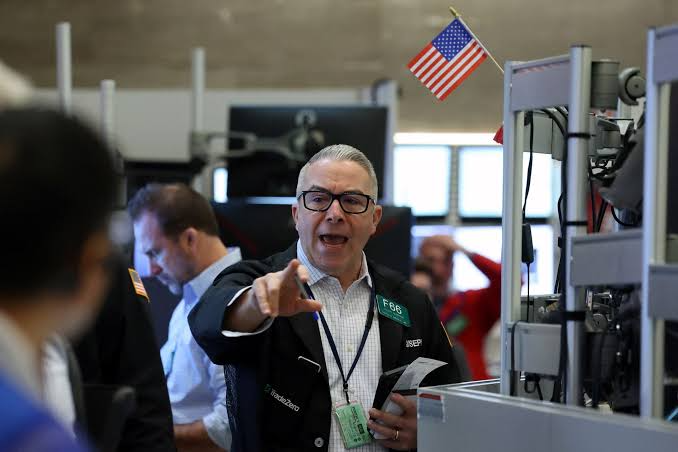
Tech stocks surged across global markets on Thursday, powered by a renewed belief that cloud infrastructure revenue is still growing briskly and that enterprise AI spending, while closely watched, remains intact. The Nasdaq climbed more than 1.5%, and the tone across trading desks shifted from caution back to cautious optimism.
What made the move notable was not just the size of the rebound, but its source. Investors were not chasing a vague rebound in sentiment. They were responding to hard numbers, especially stronger cloud results and evidence that businesses are still funding artificial intelligence projects even after months of debate over valuations and return on investment.
Why the rally found footing
The immediate spark came from a stronger than expected performance by major technology names, led by Microsoft. Its latest earnings report reassured investors that demand for cloud services remains solid and that AI related capital spending is still producing a cash generating business, not just a story. That helped steady a market that had been rattled by a sharp tech selloff in the prior session.
At the same time, chipmakers and memory manufacturers recovered some of their recent losses. That matters because the AI trade is not just about software. It is also about semiconductors, servers, networking gear, and the physical infrastructure required to train and run increasingly complex models. When those names rise together, it usually means investors are seeing a broad based return of confidence in the entire stack.
We are also seeing a familiar market pattern. When concerns about stretched valuations grow too loud, investors step back. When earnings prove that demand is still real, the same money often rushes back in. That is exactly what happened here, with the Nasdaq benefiting most because it is the index most sensitive to technology sentiment.
Cloud is still the anchor
Cloud infrastructure remains the anchor of the current tech cycle. Companies continue to shift workloads from legacy systems into modern platforms, and many are now adding AI capabilities on top of those systems rather than treating cloud migration and AI adoption as separate projects. That makes cloud revenue a useful proxy for broader enterprise digital spending.
Recent data has shown that cloud demand is not simply holding up. It is expanding. That supports the argument that the market may have overreacted to fears that AI spending would stall. Instead, many firms appear to be moving more deliberately, scrutinizing projects more closely while still increasing the overall budget devoted to digital tools, automation, and data infrastructure.
For investors, this is a critical distinction. A slower buying process is not the same thing as a weaker market. It can mean buyers are more disciplined, not less interested. That is why cloud revenue reports have become such powerful market signals.
Enterprise AI is still being funded
Another reason for the rally is that enterprise AI spending has not dried up. Research published this week suggests that many organizations plan to keep increasing their AI budgets in 2026, even as procurement teams demand more proof of value. Businesses are still putting money behind automation, workflow optimization, customer support, and product development tied to AI systems.
That combination of spending and scrutiny is important. It tells us that companies are no longer buying AI simply because they feel they must. They are buying with more selectivity, but they are still buying. In practical terms, that means the market may be entering a healthier phase, one where the strongest platforms and infrastructure providers continue to grow while weaker promises get cut away.
Enterprise technology leaders are also showing a preference for systems that fit into existing workflows rather than stand alone experiments. That favors cloud providers, chip suppliers, and enterprise software firms that can show measurable productivity gains. It also helps explain why the latest rally spread across hardware and cloud related names at the same time.
What investors watched closely
- Cloud revenue growth from major providers, especially Azure and other enterprise infrastructure units.
- Evidence that companies are still funding AI projects despite tighter budget reviews.
- Recovery in semiconductors and hardware stocks after recent valuation driven pullbacks.
- Broader market breadth, which suggested the rally was not limited to one large company.
Hardware joined the rebound
Hardware stocks were part of the rebound because they sit at the center of the AI buildout. Servers, memory, networking equipment, and chips are all required before the software ever reaches customers. When cloud demand is strong, hardware suppliers tend to benefit as well, since the physical infrastructure must keep expanding to handle new workloads.
That is one reason the rally felt more credible than a simple relief bounce. It was not just about one earnings surprise. It was about multiple layers of the technology ecosystem moving in the same direction, from cloud platforms down to component makers. For traders, that breadth can be a sign that the market is re pricing risk more thoughtfully.
It also reflects how deeply the AI economy has become tied to capital formation. Every major step forward in the software layer depends on enormous investments in data centers, power, cooling, and networking. Those realities can be expensive, but they also create long lived demand for the companies that sell the tools needed to build and run the digital infrastructure.
Why this matters beyond Wall Street
Market rallies often sound abstract, but they shape real business behavior. A strong tech tape can affect hiring, capital spending, merger interest, and the pace at which companies move forward on cloud migration or AI deployment. When investors believe the growth story is intact, businesses often find it easier to justify their own technology spending.
That in turn can feed back into the broader economy. Cloud and AI systems do not stay confined to the companies that build them. They reach banks, retailers, manufacturers, hospitals, schools, and public agencies. If the infrastructure providers keep reporting strong demand, the technology choices made in corporate boardrooms will continue to influence everyday work across sectors.
For readers who want a broader view of market structure and enterprise technology trends, the Nasdaq market center offers real time context on index moves, while the Synergy Research Group is a useful source for cloud infrastructure market data and sector growth analysis.
What comes next
The key question now is whether this rally can sustain itself through the next round of earnings and economic data. Investors will want to see whether cloud leaders continue posting resilient growth, whether AI buyers keep spending with discipline, and whether hardware demand stays broad enough to support the current rebound.
There is still plenty of reason for caution. Valuations remain sensitive, interest rates are still a concern, and markets have already shown they can move sharply when the AI trade comes under scrutiny. But Thursday’s surge suggests that investors are not ready to abandon the sector. They are looking for proof, and when they find it, they are willing to buy again.
For now, the mood has shifted. The screens are green, the cloud story remains convincing, and the hardware rebound adds weight to the idea that this is more than a one day bounce. It is a reminder that in technology markets, confidence can return quickly when the underlying revenue story still looks strong.