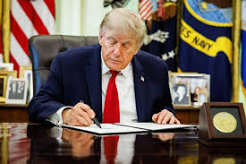
Donald Trump has publicly defended his personal income after official financial disclosures showed he generated at least $2.2 billion, much of it tied to global real estate holdings and investment activity during his return to office. The figure has reignited debate over wealth, disclosure, and the blurred line between public service and private enterprise at the highest levels of American power.
What the disclosure shows
The latest filing presents a striking picture of a president whose financial life remains deeply entwined with property, licensing, and investment assets spread across multiple markets. The reported income of at least $2.2 billion reflects a broad mix of revenue sources, with global real estate holdings standing out as a major driver. For supporters, the number will likely be viewed as evidence of business strength and presidential success. For critics, it will sharpen long standing concerns about conflicts of interest and the influence of private wealth on public office.
The disclosure also matters because it places renewed focus on how a modern president can maintain sprawling business interests while occupying the Oval Office. Real estate income, especially when linked to international assets, tends to raise special questions about valuation, cash flow, and decision making. Those questions do not disappear simply because a disclosure has been filed. They become more urgent when the assets in question are connected to global markets and foreign jurisdictions.
Trump’s defense
Trump responded by defending the scale of his earnings and framing them as proof that his portfolio continues to perform strongly. In his telling, the numbers validate his business instincts and reflect the value of assets he has built over decades. That argument is familiar to anyone who has followed his public career. Trump has long cast financial success as both a personal achievement and a political credential, using wealth as a signal of competence and leverage.
Yet the defense also invites a deeper public conversation. High earnings do not automatically resolve the ethical questions that arise when a sitting president benefits from an expansive commercial network. Even if every transaction is lawful, the appearance of divided loyalties can still unsettle voters who expect the presidency to function above private gain. That tension sits at the center of the reaction to the disclosure.
Why real estate matters here
Real estate has always been central to Trump’s public identity and private wealth. Unlike a passive stock portfolio, property ownership often involves visible branding, management decisions, financing arrangements, and long term strategic positioning in markets that can be affected by regulation, taxes, and international capital flows. When those holdings are global, the complexity rises further.
That complexity is one reason the disclosure has attracted such close attention. Real estate wealth can be both durable and opaque. It often depends on asset appreciation, debt structures, licensing fees, and cross border relationships that do not always translate neatly into a simple annual income line. To many observers, the headline number is less important than what it suggests about the continuing scale and reach of Trump’s business world.
Political and public reaction
The disclosure is likely to deepen partisan divisions rather than soften them. Trump’s supporters may see the financial results as a sign that he remains a formidable businessman despite the demands of public office. His critics are likely to interpret the numbers as yet another example of how wealth and political power remain tightly linked in American life. Both reactions reflect a familiar pattern around Trump, whose finances have long been treated as a proxy for broader arguments about transparency, legitimacy, and accountability.
Public interest in the report also reflects a larger cultural unease. Voters are often asked to trust that office holders can separate personal gain from public duty, but large and complex business holdings make that separation hard to verify in practice. That is especially true when income comes from properties and investments that span multiple countries and markets. The question is not only how much money was made, but whether the structure of that wealth can coexist cleanly with the responsibilities of office.
The disclosure debate
Financial disclosures are meant to provide transparency, but they can also create more questions than they answer. Numbers on a page reveal scale, not necessarily motive or influence. They can show that income was generated, but not always how policy might indirectly affect the underlying assets. In a case like this, the public must interpret the filing through a wider lens that includes ethics, precedent, and the practical realities of presidential power.
That is why disclosure documents often become political documents as much as financial ones. They are read not only by journalists and analysts but by ordinary citizens trying to gauge whether the rules are adequate to the moment. For a president returning to office with a large and active business footprint, the stakes are especially high. The more substantial the private fortune, the more difficult it becomes to reassure the public that governance is being conducted without personal enrichment at the margins.
Broader implications for governance
This latest episode highlights an enduring problem in American democracy: how to reconcile private wealth with public responsibility. The presidency carries enormous symbolic weight, and the person occupying it is expected to act in the national interest, not the interests of a property empire. When that person is also one of the most recognizable real estate figures in the world, every disclosure becomes a test of public confidence.
The practical challenge is not just legal compliance but perceived independence. Even when no rules are broken, the existence of sprawling commercial holdings can make every policy decision look more complicated than it might otherwise be. That is why this disclosure will continue to matter long after the initial headlines fade. It speaks to the continuing struggle to define what clean separation should look like in an era of enormous private wealth and intensely personalized politics.
What comes next
In the days ahead, attention will likely turn to the fine print. Analysts, ethics watchers, and political opponents will study the source of income, the nature of the assets, and any changes in valuation or ownership structure. Supporters will focus on the strength of the financial results and the argument that success in business should not be treated as disqualifying. The public, meanwhile, will be left to weigh a familiar but unresolved question: can a president with a vast global portfolio ever fully separate the private from the public?
For readers who want to review the broader rules surrounding presidential ethics and financial transparency, the U.S. Office of Government Ethics and the Congressional Research Service offer useful background on disclosure standards and executive branch oversight.