The World Health Organization reported on July 25 2026 that the Ebola outbreak in eastern Democratic Republic of the Congo has crossed a grim threshold with more than 1300 deaths as the Bundibugyo strain continues to spread through remote and densely populated areas. The human cost is compounded by funding shortfalls and strikes by healthcare workers who say they are being asked to risk their lives without adequate pay or protection. The combination of a virus with no approved vaccine or specific treatment and a health system under strain has turned what began as a cluster of cases in Ituri Province into one of the largest Ebola epidemics on record.
How the outbreak grew beyond early containment lines
The first confirmed cases appeared in May 2026 in northeastern Ituri around Mongwalu and Rwampara before spreading to Bunia and then into North Kivu and South Kivu. Cross border transmission reached Uganda where two imported cases were detected in Kampala. The World Health Organization declared a Public Health Emergency of International Concern on May 17 2026 as case counts climbed and as clusters of community deaths raised alarms that many infections were going undetected.
By early July the DRC Health Ministry and partners had confirmed more than a thousand laboratory confirmed cases with hundreds more under investigation. The epidemic is now the third largest Ebola outbreak ever recorded. The speed of expansion reflects a difficult context. Insecurity in parts of eastern DRC hampers access. Population mobility along trade routes carries the virus between towns. Informal healthcare facilities and crowded households create conditions where a single case can seed multiple chains of transmission.
Why the Bundibugyo strain is so hard to stop
The Bundibugyo virus is a species of Ebola for which no licensed vaccine or specific therapeutic exists. Response teams must rely on infection prevention and control rigorous contact tracing isolation and supportive clinical care. That approach works when it is implemented quickly and consistently. It becomes far harder when health facilities are understaffed when personal protective equipment is scarce and when community trust has been eroded by previous outbreaks and ongoing conflict.
Laboratory capacity has been expanded with testing kits sent into the field yet delays in sample transport and confirmation mean that some suspected cases die before their status is known. That gap allows the virus to move silently through families and neighborhoods. The absence of a vaccine also means that ring vaccination cannot be used to build a firewall around cases. Every new case must be found through active surveillance and every contact must be monitored for 21 days.
The human toll inside clinics and communities
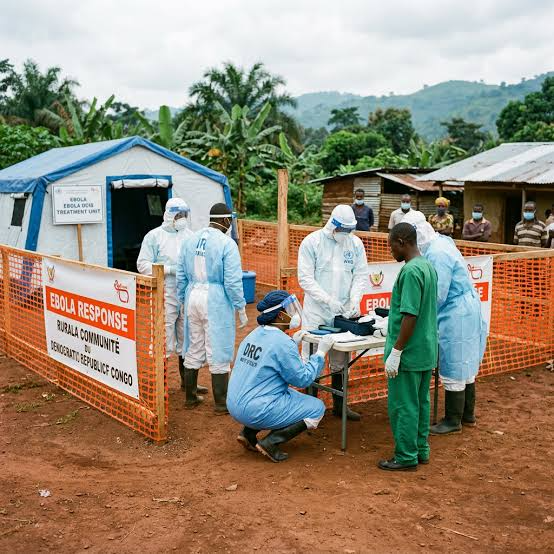
Inside treatment centers the work is relentless. Nurses and doctors in full protective gear move between isolation wards where patients fight high fever severe pain and the risk of hemorrhage. The heat inside the suits is oppressive. Shifts are long. The emotional weight is heavier. Many of the staff have lost colleagues to the virus. Some have buried family members. They return to work because the alternative is to let the virus win.
In communities the outbreak disrupts daily life in ways that are less visible but no less damaging. Funerals are conducted under strict protocols that limit traditional mourning practices. Markets see fewer customers as people avoid crowds. Children miss school when classes are closed as a precaution. The fear is real and it is rational. When a neighbor falls ill and does not return the entire block feels the loss.
Why healthcare workers are striking and what they are asking for
Healthcare workers in affected provinces have staged strikes and work stoppages over unpaid salaries hazard allowances and insufficient protective equipment. They argue that they are being asked to enter isolation wards without the basic tools that keep them safe. They point to the deaths of colleagues as evidence that the system is failing them. Their demands are concrete. Timely pay. Reliable supplies of gloves gowns masks and disinfectants. Clear protocols for exposure and post exposure support.
The strikes are not a rejection of duty. They are a plea for the conditions that make duty possible. When staff do not show up clinics close. When clinics close suspected cases go untreated and contacts go unmonitored. The virus fills the vacuum. The result is a vicious cycle where the very people who are needed to stop transmission are pushed to the brink of burnout and then asked to work without the support they need.
What the World Health Organization and partners are doing now
The WHO and national authorities are scaling up surveillance contact tracing and community engagement across Ituri and the Kivu provinces. Dedicated treatment units have been established near outbreak epicenters to reduce travel time for patients and to concentrate expertise and supplies. Training for infection prevention and control is being delivered to frontline staff with a focus on triage safe patient handling and correct use of protective gear.
International partners are delivering testing kits personal protective equipment and clinical supplies while working to improve the referral pathways that move patients from community clinics to specialized centers. The World Health Organization maintains a situation page for the outbreak that provides regular updates on case counts response activities and guidance for affected countries. The United States Centers for Disease Control and Prevention has also issued a detailed Ebola situation summary that tracks the geographic spread and offers travel guidance for those in or near the region.
How funding gaps are shaping the response
Funding shortfalls have forced hard choices about where to deploy limited resources. Contact tracing teams that should be in every affected health zone are stretched thin. Some community engagement activities that build trust and encourage early reporting have been scaled back. The economics are brutal. Every dollar not spent on prevention is a dollar that will be needed later for treatment and for the social costs of wider transmission.
Donor governments and international financial institutions have been asked to accelerate disbursements to close the gap. The argument from response leaders is straightforward. Early investment reduces the final bill. The longer the outbreak persists the more expensive it becomes to control and the greater the human and economic damage. The global community has seen this lesson before. The question is whether it will be applied quickly enough to change the trajectory.
Practical guidance for residents and travelers
For residents in affected provinces the most effective protection is early recognition and rapid isolation of suspected cases. Avoid contact with bodily fluids of sick individuals. Follow guidance from local health authorities on safe burial practices. Seek care at designated facilities where infection control measures are in place. If you develop symptoms such as sudden fever severe headache muscle pain or unexplained bleeding isolate immediately and contact health workers.
For travelers the risk to the general public outside the region remains low. The US CDC continues to advise avoiding non essential travel to Ituri North Kivu and South Kivu. Anyone returning from the affected areas should monitor their health for 21 days and seek medical care promptly if symptoms develop. Airlines and border authorities are implementing screening measures to detect and isolate suspected cases before they can spread further.
What must happen next to turn the tide
The path to containment runs through three priorities. First stabilize the health workforce by paying salaries on time providing hazard allowances and ensuring reliable access to protective equipment. Second expand active surveillance so that every suspected case is found quickly and every contact is monitored until day 21. Third sustain community engagement so that people understand the risks and support early reporting and safe care practices.
Research into candidate vaccines and therapeutics for Bundibugyo virus must continue with clinical trials that can inform future outbreaks. The current response relies on tools that were designed for other Ebola species. The world needs options that match the virus we are facing now. Until then the fundamentals of outbreak control remain unchanged. Find cases fast. Isolate and care for patients. Protect health workers. Support communities. And fund the effort at a level that matches the stakes.