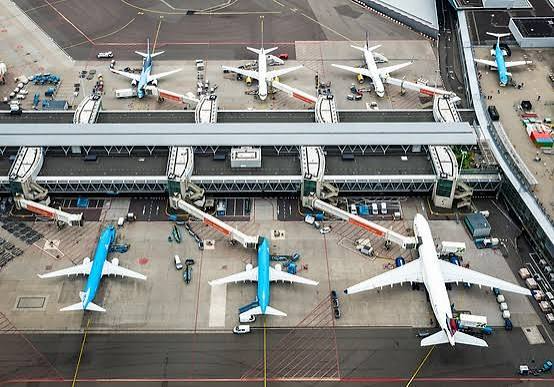
Amsterdam’s Schiphol airport has spent the first half of 2026 navigating a season of disruption, yet the Dutch hub is still standing on firmer ground than many travelers might expect. Royal Schiphol Group reported flat underlying profit for the period, as severe winter weather, conflict driven air corridor changes, and higher fuel costs pressed against a network that remained stubbornly busy.
Schiphol holds steady
The group said underlying net profit for the first half of 2026 came in at €215 million, essentially unchanged from €214 million a year earlier. Revenue rose 5.6 percent to €1.333 billion, while passenger traffic across Schiphol, Eindhoven, and Rotterdam The Hague reached 37.3 million, a modest increase that suggests demand has not vanished even as operating conditions grew more complicated.
What mattered most, though, was not the headline figure alone but the way it was reached. Schiphol said the year began with severe winter weather that forced the cancellation of several thousand flights at Amsterdam Airport Schiphol, followed by air traffic restrictions linked to the war in the Middle East. The group also pointed to a doubling of kerosene prices, a reminder that airline economics can shift sharply when geopolitics and fuel markets pull in the same direction.
Weather and war reshape routing
For airlines, the past six months have been a lesson in how fragile global connectivity can be. When airspace closes, even temporarily, carriers must reroute long haul flights, adjust schedules, and absorb higher operating costs that are difficult to pass along immediately to travelers. A busy airport such as Schiphol feels that pressure quickly, because it sits at the center of a dense European transfer system where missed connections ripple across continents.
Schiphol said it responded by temporarily reducing airport charges to help keep airlines on the network and preserve connectivity for the Netherlands. That relief had a cost, shaving €37 million from first half results, but it appears to have helped stabilize traffic in the second quarter. For passengers, the benefit is more practical than financial: more routings stay open, more seats remain on sale, and more destinations stay reachable when the map changes overnight.
Investment continues
Even with profits under pressure, the airport group kept investing heavily in its future. Schiphol said it spent €801 million on quality improvements in the first half, a record amount for a six month period. That spending underscores a central tension in aviation right now: operators must keep infrastructure modern and reliable while confronting unpredictable weather, security risks, and a market that is still recovering unevenly in different regions.
The company also said quieter aircraft continue to make up a larger share of operations, a sign that airport policy, fleet renewal, and airline incentives are gradually changing the soundscape around one of Europe’s busiest hubs. Travelers may not see that in a boarding pass, but they can feel it in the experience of flying through a major airport that is trying to stay efficient without losing public trust.
China adds a surprising link
While Schiphol dealt with the limits of an exposed European hub, other carriers were busy redrawing the long haul map. Air China announced plans to launch service between Beijing and Reykjavik via Copenhagen, making it the first Asian airline to serve Iceland. The route, set to begin on October 26, will operate three times a week with Airbus A330 300 aircraft and gives the carrier a rare opportunity to sell seats on the Copenhagen to Reykjavik sector as well.
The timing is striking. Iceland has long depended on a web of one stop connections for travelers from Asia, and Air China’s entry adds a new option at a moment when airlines are looking for routes that can perform even as traffic patterns shift. It also reflects a broader appetite among Chinese carriers for Europe bound expansion, especially where demand, visa policy, and network economics line up in their favor.
Aviation adapts to a moving map
The contrast between Schiphol and Air China is instructive. One story is about an established European gateway working hard to protect stability in the face of weather, war, and fuel shock. The other is about an airline using those same shifting conditions to find new openings, including a market as small but strategically interesting as Iceland.
That push and pull is becoming the defining feature of aviation in 2026. Carriers are no longer simply adding routes for growth’s sake; they are choosing corridors that can survive turbulence, regulatory change, and uneven demand. The result is a network that is more adaptive, but also more dependent on quick decisions from airport operators, route planners, and governments.
What travelers should watch
For travelers, the practical takeaway is simple. Expect more route changes, more schedule adjustments, and more flights that exist because airlines are actively reshaping networks rather than merely restoring old ones. In a year when weather can ground hundreds of flights and conflict can redraw airspace in a matter of days, flexibility is becoming as valuable as frequency.
That is why Schiphol’s half year results matter beyond the balance sheet. They show how a major hub can remain commercially resilient while the skies around it stay unsettled, and they offer a clear picture of where aviation is headed: toward networks that are leaner, more selective, and far more responsive to events far outside the airport fence. Travelers can explore the airport’s own reporting at Schiphol Group, while broader industry context remains available through the International Air Transport Association.
In that sense, July 28, 2026, tells a larger story than one airport’s flat profit. It shows an industry trying to keep people moving, even as storms, conflict, and cost spikes force airlines and airports to redraw the routes that connect daily life.