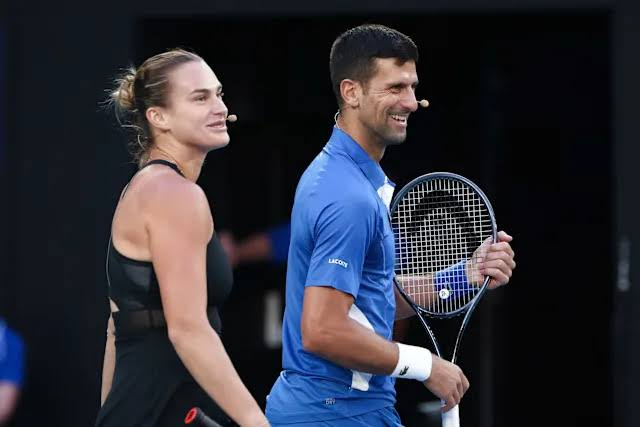
New York is getting the kind of mixed doubles lineup that can make even a casual tennis fan stop and watch. The official entry list for the 2026 US Open Mixed Doubles Championship is led by world No. 1 Aryna Sabalenka and 24 time Grand Slam winner Novak Djokovic, a pairing that immediately gives the event the kind of star power organizers wanted when they reworked the competition last year.
A star pair at the top
The headline alone tells the story. Sabalenka brings the forceful baseline game and competitive edge that have made her the top ranked woman in tennis, while Djokovic arrives with one of the most complete resumes the sport has ever seen. Put together, they create a team that will draw attention far beyond the usual mixed doubles audience, and that matters in a sport where the smallest format can still carry the biggest names.
For the United States Tennis Association, the roster announcement is also a sign that the reimagined mixed doubles championship has found its footing. The event, which was redesigned to draw more top singles players, is now entering its second year with a field that looks less like a sideshow and more like a compact showcase of elite tennis. Fans who have followed the debate over prize money and player commitment will recognize the significance immediately.
Why this roster matters
Mixed doubles has long been one of tennis’s most intimate and tactical events. The court feels smaller, the reactions faster, and the partnerships more revealing. When top singles players enter, the competition changes again, because every serve return, every poach, and every net exchange carries the weight of star expectation as well as strategy.
This year’s entry list reflects that shift clearly. Alongside Sabalenka and Djokovic are other major names such as Iga Świątek with Casper Ruud, Elena Rybakina with Taylor Fritz, Jessica Pegula with Jack Draper, Naomi Osaka with Kei Nishikori, and Taylor Townsend with Alexander Zverev. The field also includes defending champions Sara Errani and Andrea Vavassori, who return with the pedigree and chemistry that made them so difficult to beat a year ago.
The field is wide open
While the spotlight naturally falls on Sabalenka and Djokovic, the draw is packed with combinations that could make a deep run. Mirra Andreeva and Andrey Rublev bring youth and speed. Diana Shnaider and Daniil Medvedev offer a sharp contrast in styles but plenty of tactical depth. Leylah Fernandez and Frances Tiafoe could become crowd favorites on emotion and athleticism alone. In a short format, momentum can flip quickly, and that gives the championship a lively, unpredictable feel.
The official list, announced on July 28, still leaves room for change before the entry window closes on August 17. That matters because the top six teams by combined singles ranking will receive direct acceptance into the main draw, while eight teams will later be chosen by wild card. Two more spots will be decided through a qualifying draw on August 24. The structure gives the event both star power and an open door for surprises.
Teams on the initial list
The first wave of confirmed teams includes:
Aryna Sabalenka and Novak Djokovic, Elena Rybakina and Taylor Fritz, Mirra Andreeva and Andrey Rublev, Iga Świątek and Casper Ruud, Belinda Bencic and Flavio Cobolli, Diana Shnaider and Daniil Medvedev, Amanda Anisimova and Learner Tien, Alexandra Eala and Felix Auger Aliassime, Leylah Fernandez and Frances Tiafoe, Taylor Townsend and Alexander Zverev, Elena Gabriela Ruse and Nuno Borges, Jessica Pegula and Jack Draper, Naomi Osaka and Kei Nishikori, Sara Errani and Andrea Vavassori, Katerina Siniakova and Henry Patten, and Peyton Stearns with Preston Stearns.
What fans can expect in New York
The mixed doubles championship will be played during US Open Fan Week, from August 24 to August 26, at the USTA Billie Jean King National Tennis Center. That schedule gives the event a clear identity of its own, separate from the singles main draw, while still riding the electricity that always builds in New York before the final Grand Slam of the year begins.
That setting matters. Mixed doubles is best understood not as a warmup act but as a concentrated version of tennis at full speed. The returns come hard, the exchanges at net are sudden, and the atmosphere can turn from playful to tense in a heartbeat. In a stadium like Louis Armstrong or the Grandstand, the sounds of the game crowd together quickly: a sharp serve, a half volley, the gasp that follows a perfectly timed lob.
Missing names tell their own story
The list is just as notable for who is not on it. Jannik Sinner, Carlos Alcaraz, and the Williams sisters are absent from the initial roster, and that absence shapes expectations as much as the players who did sign up. Some of those names may still enter before the deadline, but for now the lineup suggests that the event’s next chapter will be built around a different constellation of stars.
That shift is not necessarily a loss. It is a sign that mixed doubles is becoming its own negotiation between prestige, scheduling, and player priorities. When elite singles players commit, they bring attention, television value, and a fresh kind of legitimacy. When they do not, the event must stand on its own merit. This year’s field shows that it can.
What the numbers suggest
From a competitive standpoint, the combination of top ranked singles players and accomplished doubles specialists creates a delicate balance. Djokovic and Sabalenka may have the biggest names, but defending champions Errani and Vavassori bring proven doubles instincts that matter enormously in this format. Katerina Siniakova, meanwhile, arrives with one of the strongest doubles résumés in the sport, and that kind of experience can carry real weight when the margins are thin.
The most interesting part of this roster is that it invites multiple forms of excellence. Some teams are built around firepower, others around court sense, and others around familiarity. That variety should make the event feel brisk and watchable from the first point. For spectators, that is a gift. For players, it is a test of chemistry under pressure.
For readers following the event schedule or planning to attend, the official tournament site at US Open provides ticketing, draw information, and session details. Fans interested in broader tennis rankings and player profiles can also track the current landscape through the ATP Tour and the WTA’s official channels.
In a sport that often treats doubles as an afterthought, this roster feels different. Djokovic and Sabalenka give the US Open a marquee pairing, but the deeper value lies in the full field, where established champions, rising talents, and doubles specialists all have a chance to shape a competition that now feels built for attention. If the final draw holds anywhere near this level of quality, New York will have another compelling August story before the singles tournament even begins.