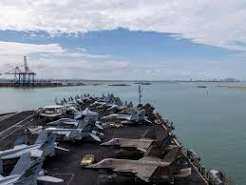
The USS Abraham Lincoln has arrived in Thailand after one of the longest continuous periods at sea in its recent history, giving roughly 5,000 sailors and Marines a chance to step ashore after months of demanding operations. The nuclear powered aircraft carrier reached Laem Chabang on September 2, 2026, as part of a scheduled port visit that brings a major American naval presence into one of Thailand’s busiest maritime and tourism regions. For the people aboard the ship, the arrival represents far more than another stop on a deployment. It is a rare opportunity to walk on solid ground, reconnect with ordinary life and recover after 286 days at sea.
A Long Deployment Finally Brings the Crew Ashore
The Abraham Lincoln Carrier Strike Group arrived in eastern Thailand with the carrier USS Abraham Lincoln accompanied by other ships from the strike group. The carrier entered Laem Chabang, while the guided missile destroyer USS Frank E Petersen Jr arrived in nearby Sriracha and the guided missile cruiser USS Robert Smalls arrived at Map Ta Phut. The United States Navy confirmed that the ships were making scheduled port visits in Thailand. :contentReference[oaicite:0]{index=0}
The length of the deployment has made the Thailand visit particularly significant. Reports indicate that the carrier had spent 286 days at sea, with crew members going more than 260 days without a normal shore visit. The deployment included extensive operations connected with the United States military campaign against Iran and involved prolonged periods in the Middle East. :contentReference[oaicite:1]{index=1}
For sailors accustomed to the constant movement of a carrier, stepping onto land can carry an emotional weight that is difficult to capture in a simple timetable. After months of aircraft operations, watches, maintenance duties and limited personal space, the sight of Thailand’s coastline offers a very different rhythm. Roads, restaurants, hotels, beaches and ordinary city streets suddenly become part of daily life again.
Thailand Provides a Chance to Rest and Recharge
Rear Admiral Robert E Loughran, commander of Carrier Strike Group 3, described the arrival as a well deserved opportunity for sailors and Marines to rest and recharge. He also connected the visit with the long standing relationship between the United States and Thailand. The Navy says the two countries have maintained their partnership for generations, with the relationship dating back to the 1833 Treaty of Amity and Commerce. :contentReference[oaicite:2]{index=2}
The scheduled visit is expected to give personnel time away from the demanding environment of the carrier. Many crew members traveled into Pattaya, the nearby coastal city that has hosted American military personnel for decades. The city is known for beaches, restaurants, shopping, hotels and a large tourism industry, making it a natural destination for thousands of visitors arriving together.
For individual sailors, the experience can be surprisingly simple. A meal at a local restaurant, a walk through a shopping center, a quiet afternoon near the water or a few hours away from the machinery of a warship can provide a sense of normality that has been difficult to find during a prolonged deployment.
Pattaya Sees an Economic Opportunity
The arrival is also significant for businesses across eastern Thailand. Thousands of American military personnel spending several days in the area can generate activity for hotels, restaurants, transportation providers, retail stores and other tourism businesses.
Local authorities and business owners have been watching the visit closely because Pattaya has faced broader challenges affecting international tourism. Higher energy costs and economic uncertainty have affected travel patterns in several markets. A large group of visitors arriving at the same time therefore represents a meaningful short term boost for parts of the local economy.
We should also recognize that the economic effect of a naval port visit extends beyond direct spending. Taxi drivers may receive more fares, restaurants may serve additional customers, hotels can benefit from increased demand and retailers may see stronger sales. Ports themselves gain international visibility when major naval vessels arrive, while nearby destinations receive attention from visitors who may return later as civilian travelers.
A Maritime Hub Meets a Major Naval Transit
Laem Chabang is one of Thailand’s most important maritime gateways, and the presence of a large American aircraft carrier highlights the strategic and commercial importance of the eastern seaboard. The surrounding area connects shipping activity with tourism, industrial development and transportation networks.
The visit therefore has two distinct dimensions. For the United States Navy, it provides an opportunity for personnel recovery and continued engagement with a long standing regional partner. For Thailand, it brings an unusually large number of international visitors into a region already built around ports, logistics and tourism.
The Navy’s official account of the arrival provides further details about the participating ships and the scheduled port activities through its official Navy newsroom.
The Human Cost of an Extended Deployment
The length of the Abraham Lincoln deployment has also attracted attention because of concerns about crew welfare. News reports have described worries about mental health, morale and shortages of some supplies during the prolonged mission. The Navy has disputed or downplayed some of the concerns, while acknowledging the demanding nature of the deployment. :contentReference[oaicite:3]{index=3}
These concerns matter because military readiness is ultimately dependent on people. A carrier can carry advanced aircraft, sophisticated radar systems and enormous quantities of equipment, but every operation still depends on sailors who must maintain machinery, launch aircraft, monitor systems and make decisions under pressure.
Extended deployments can place pressure on families as well. Partners, parents and children may spend months communicating through limited windows of availability while waiting for news from a ship operating far from home. The arrival in Thailand cannot erase that separation, but it provides families with a visible sign that a difficult chapter of the deployment is moving toward its conclusion.
A Visible Symbol of US Thailand Relations
Thailand has been a longstanding American security partner in Southeast Asia, and military cooperation between the two countries includes exercises, training and regular engagement. The Abraham Lincoln visit adds another visible element to that relationship at a time when maritime security remains a major concern across the Indo Pacific.
For regional observers, the arrival also demonstrates how naval forces can operate across enormous distances and move between strategic theaters. The Abraham Lincoln spent much of this deployment supporting American operations in the Middle East before reaching Southeast Asia. Its arrival in Thailand shows the logistical reach required to sustain a modern carrier strike group over many months. :contentReference[oaicite:4]{index=4}
What Happens After the Thailand Visit
The Thailand stop is expected to remain focused on rest and recovery rather than serving as a new combat mission. Reports indicate that the visit is scheduled to last several days, allowing personnel time ashore before the carrier continues its journey. :contentReference[oaicite:5]{index=5}
That distinction is important. After nearly nine months of deployment, the immediate value of the port call is measured not only in strategic terms but also in the condition of the people who have carried out the mission. Maintenance, resupply and personnel recovery are essential parts of sustaining a carrier strike group.
The arrival of the USS Abraham Lincoln in Thailand is therefore a story about both military power and human endurance. A carrier arriving at a busy port may appear to be an imposing symbol of American strength, but behind the enormous flight deck are thousands of people who have spent months working, sleeping and living in a tightly controlled environment far from home.
As sailors and Marines move through Pattaya and the surrounding communities, the scene offers a striking contrast. After months defined by ocean horizons, aircraft launches and military operations, they can once again hear traffic in city streets, taste food prepared on land and watch the sun disappear behind a coastline rather than a carrier deck. For the crew of the Abraham Lincoln, that ordinary experience may be the most meaningful part of this extraordinary port visit.