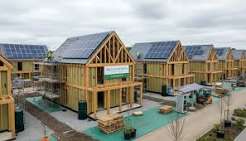
The World Green Building Council is putting residential energy performance firmly in the spotlight as the global building sector looks for practical ways to reduce household energy use and carbon emissions. New international guidance highlighted around September 7, 2026, focuses attention on better insulation, efficient heat pump systems, building renovation, and a broader approach to net zero housing that considers both energy consumption and the carbon impact of construction.
Why Residential Buildings Are Central to the Net Zero Challenge
Homes are among the most familiar parts of the built environment, yet the energy used to heat, cool, light, and operate them represents a major climate challenge. For millions of households, energy consumption is also a direct financial concern. A poorly insulated home can lose warmth rapidly during winter and absorb unwanted heat during summer, forcing heating and cooling systems to work harder.
The World Green Building Council has increasingly promoted a reduction first approach in which buildings should reduce energy demand before relying on renewable energy or other measures to address remaining emissions. Its broader whole life carbon framework considers both emissions from building operations and emissions associated with materials, construction, renovation, and eventual replacement.
That approach changes the conversation around sustainable housing. A home does not become environmentally responsible simply because it contains a modern heating system. The building envelope, windows, ventilation, energy source, materials, and everyday energy demand all contribute to its overall performance.
Better Insulation Can Reduce Energy Waste at the Source
Insulation is one of the simplest concepts in residential energy efficiency, but its importance can be easy to overlook. When walls, roofs, floors, and other parts of a building envelope provide effective thermal protection, indoor temperatures can remain more stable with less mechanical heating or cooling.
For a family living through a cold winter, that difference can be felt in very ordinary ways. A well insulated room can remain comfortable after the heating system switches off, while a poorly insulated room may become cold again within a short time. During a hot summer, effective insulation can help keep outdoor heat from moving rapidly into living spaces.
WorldGBC guidance has previously highlighted insulation, efficient glazing, airtight building envelopes, ventilation, passive heating, passive cooling, and solar design as important elements of comfortable and energy efficient buildings. :contentReference[oaicite:0]{index=0}
Retrofitting Existing Homes Could Matter Most
The challenge is not limited to newly constructed houses. A large share of the world’s residential buildings already exists, meaning that renovation will be essential if governments and communities want to reduce energy consumption at scale.
Retrofitting can include roof insulation, wall insulation, improved windows, better ventilation, air sealing, and upgrades to heating and cooling systems. The correct combination depends on local weather, construction methods, household needs, and the condition of the existing property.
For homeowners, this means that energy efficiency should be viewed as a sequence of decisions rather than a single product purchase. Installing an expensive heating system in a building that loses heat rapidly may produce less benefit than first improving the building envelope.
Heat Pumps Move Further Into the Mainstream
Heat pumps are another major part of the building sector’s shift away from fossil fuel based heating. Unlike conventional combustion systems that generate heat by burning fuel, heat pumps move thermal energy between indoor and outdoor environments using electricity.
The technology can provide heating in colder conditions and cooling during warmer periods, depending on the system and climate. When powered increasingly by low carbon electricity, heat pumps can contribute to lower operational emissions while reducing dependence on fossil fuels.
WorldGBC has described building electrification as a major route toward building decarbonisation and has highlighted the role of efficient electric systems alongside renewable energy. Its 2026 electrification publication also stresses that solutions must reflect local infrastructure, climate, policy, and social conditions rather than assuming that one approach will work everywhere. :contentReference[oaicite:1]{index=1}
Heat Pump Modernization Requires More Than Replacing a Boiler
Replacing an existing heating system with a heat pump can be technically possible, but the best results often require a wider assessment of the home. Insulation, windows, ventilation, electrical capacity, heating distribution, and household behavior can all influence performance.
A home that has historically depended on a high temperature heating system may require changes to radiators or other heat distribution equipment when switching to a system designed to operate differently. Professional assessment is therefore important before major work begins.
For homeowners considering a renovation, practical questions include:
- How much energy does the property currently use for heating and cooling?
- Where is heat being lost through the building envelope?
- Is the electrical system suitable for the planned equipment?
- Would insulation improvements reduce the required heating capacity?
- What maintenance and ventilation changes will the renovation require?
Answering these questions before purchasing equipment can reduce the risk of spending money on a system that does not match the building.
Net Zero Means More Than Lower Utility Bills
Energy savings are important to households, but net zero building guidance looks at a much larger picture. WorldGBC’s whole life carbon framework considers operational emissions as well as emissions associated with construction materials and building renovation. :contentReference[oaicite:2]{index=2}
This is significant because a building can consume relatively little energy during operation while still carrying a substantial carbon footprint from materials and construction. Decisions about concrete, steel, insulation products, windows, finishes, and replacement cycles can influence the total environmental impact of a property.
That does not mean homeowners should attempt to calculate every material themselves. Instead, the broader principle encourages architects, builders, developers, and policymakers to consider the entire life of a building rather than focusing only on monthly energy consumption.
Affordability Will Be Critical for Residential Renovation
One of the biggest challenges facing sustainable housing is cost. A homeowner may understand the long term value of better insulation or a heat pump while still being unable to afford the initial investment.
This is particularly important for lower income households that may already struggle with energy bills. Without financial assistance, energy efficiency programs can unintentionally favor households that have enough savings to pay for renovations upfront.
Effective residential climate policy therefore needs to consider grants, affordable financing, technical assistance, workforce development, and consumer protection. The goal should not simply be to create better buildings for people who can already afford them. It should also help households facing high energy costs gain access to healthier and more efficient homes.
Europe Is Moving Toward Stronger Building Renovation Targets
The European building sector provides an important example of how energy performance policy can shape residential renovation. WorldGBC’s analysis of European building policy identifies targets for reducing average primary energy use across residential building stock and points toward the broader objective of moving buildings toward zero emission performance by 2050. :contentReference[oaicite:3]{index=3}
Such policies can influence decisions made by governments, property owners, developers, financial institutions, and construction companies. They also demonstrate why residential energy efficiency is increasingly being treated as an infrastructure issue rather than simply a matter of individual household choice.
For homeowners, policy changes can eventually affect renovation requirements, property values, available incentives, energy certificates, and access to financing. For builders, they can change expectations around insulation levels, heating equipment, materials, and building design.
World Green Building Week Adds Momentum
The timing of the latest focus is notable because World Green Building Week 2026 begins on September 7 and runs through September 11. The international campaign, organized by the World Green Building Council, is centered on sustainable buildings, climate action, resilience, and wellbeing. :contentReference[oaicite:4]{index=4}
The timing gives the residential discussion a wider platform. Energy efficient homes are not only about emissions. Better insulation can improve comfort, efficient heating can reduce exposure to volatile fuel costs, and well designed ventilation can support healthier indoor conditions.
That human dimension matters. A discussion about building standards can sound abstract when reduced to energy percentages and carbon calculations. For residents, however, building performance is experienced through the temperature of a bedroom in winter, the air inside a crowded apartment during summer, and the size of the monthly utility bill.
What Homeowners and Builders Should Watch
The emerging direction of international building guidance suggests that residential modernization will increasingly combine several measures rather than rely on one technology. Homeowners planning renovations should pay attention to insulation, airtightness, ventilation, efficient heating, renewable electricity, window performance, and the expected life of building materials.
Builders and developers face an even broader responsibility. New housing can be designed from the beginning to require less energy, accommodate efficient electric heating, make better use of natural light and ventilation, and allow future renovation without unnecessary material waste.
WorldGBC’s strategic goals include substantial reductions in building energy intensity and operational emissions by 2030, alongside wider efforts to reduce embodied carbon and move new buildings toward zero emissions. :contentReference[oaicite:5]{index=5}
A Practical Path Toward Lower Energy Homes
The significance of the latest guidance lies in its practical direction. A net zero residential building is not created by adding a single green technology at the end of a construction project. It requires a coordinated approach that begins with reducing energy demand and continues through efficient systems, cleaner energy, responsible materials, and thoughtful renovation.
For households, the transition can begin with a basic energy assessment. Identifying where heat is lost, improving insulation, addressing ventilation problems, and then selecting appropriately sized heating equipment can produce better results than purchasing technology without examining the building itself.
For policymakers, the challenge is making those improvements affordable and accessible. For builders, the task is delivering homes that perform well throughout their full life. For the global building sector, the larger objective is to reduce emissions while creating spaces where people can live comfortably and safely.
The push toward more efficient residential buildings is therefore about much more than climate targets. It is about the quality of the places where people sleep, work, raise families, and spend their lives. If international guidance can turn insulation upgrades, heat pump modernization, efficient design, and responsible materials into practical and affordable standards, the result could be a quieter but meaningful shift in how homes consume energy around the world.