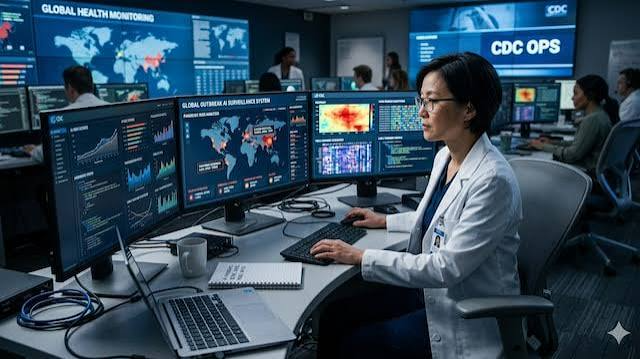
The World Health Organization is strengthening the global systems used to detect emerging infectious disease threats, with artificial intelligence, multi source surveillance and faster information sharing becoming increasingly important to public health preparedness. Although there is no verified WHO announcement on September 16, 2026 confirming the launch of a completely new worldwide AI platform dedicated exclusively to real time vector borne disease outbreaks, the organization is actively expanding AI supported epidemic intelligence and collaborative surveillance. The direction is clear: health authorities are working to identify unusual signals earlier, connect information across countries and give local response teams more time to act.
A New Era of Disease Surveillance Is Taking Shape
For a family living in a neighborhood where mosquitoes gather after heavy rain, an outbreak can begin quietly. A few people develop fever. A clinic notices an unusual increase in patients. A local health worker sees more mosquitoes around standing water. By the time a traditional reporting system identifies a pattern, transmission may already be well underway.
Modern public health surveillance is designed to shorten that gap. WHO describes surveillance as the continuous collection, analysis and interpretation of health information, with the purpose of detecting threats early and supporting rapid action. Its global surveillance system already operates continuously and currently receives thousands of public health threat signals each month.
The organization’s work on Epidemic Intelligence from Open Sources, known as EIOS, is particularly relevant to the growing role of artificial intelligence. WHO describes EIOS as a web based platform that supports national, regional and global public health intelligence. Its newer technology includes AI powered capabilities intended to improve the speed and scale at which information can be processed.
The World Health Organization continues to develop these systems as part of a broader approach to global health security rather than relying on one technology or one source of information.
Why Vector Borne Diseases Need Faster Detection
Vector borne diseases are transmitted through organisms such as mosquitoes, ticks, fleas and other vectors. Malaria, dengue, chikungunya, yellow fever and several other infections can be influenced by environmental conditions, population movement, urban development and changes in vector habitats.
That combination makes surveillance especially difficult. Mosquito populations can expand rapidly after changes in rainfall and temperature. People can travel from one region to another before symptoms become obvious. Cities can contain thousands of potential breeding sites, many of which are difficult to identify through routine inspections alone.
WHO reported that worldwide dengue cases reached a record level in 2024, with more than 14 million cases recorded. That experience illustrates why public health authorities are paying closer attention to mosquito surveillance, environmental information and faster outbreak detection.
WHO has also continued developing practical guidance for vector control. Its 2026 operational manual on larval source management covers surveillance, community participation, environmental management and mosquito control measures targeting both malaria vectors and Aedes mosquitoes associated with diseases such as dengue and chikungunya.
How AI Can Support Early Warning Systems
Artificial intelligence can process enormous quantities of information far more quickly than a human team working manually. That does not mean an algorithm can replace epidemiologists. Instead, AI can help public health specialists identify signals that deserve closer examination.
A modern surveillance system may draw information from several sources, including health reports, laboratory findings, scientific publications, public reports, environmental observations and other openly available information. When these streams are analyzed together, an unusual pattern may become visible earlier than it would through conventional reporting alone.
From Scattered Signals to a Public Health Warning
Imagine several clinics in different districts reporting an unusual increase in patients with fever. At the same time, environmental information shows increased rainfall, while local surveillance teams report larger mosquito populations. None of those observations necessarily proves an outbreak.
Together, however, they may justify immediate investigation.
AI supported public health intelligence can help organize these signals, identify relationships and direct experts toward events that deserve verification. The final decision remains a public health responsibility. Automated detection can identify a possible signal, but trained specialists must determine whether it represents a genuine outbreak, a reporting anomaly or an unrelated event.
WHO Is Building a Wider Surveillance Network
The current WHO approach extends beyond vector borne disease. The organization operates several surveillance and early warning mechanisms covering different infectious disease threats and emergency settings.
Its Early Warning, Alert and Response System is designed particularly for emergencies such as conflict and natural disasters, where routine health systems may be disrupted. WHO also operates global networks for specific diseases, including the Global Influenza Surveillance and Response System.
The organization has increasingly described public health intelligence as a collaborative activity involving technology, people and information from multiple sectors. In September 2026, WHO’s Western Pacific office highlighted regional work involving multi source surveillance and EIOS, with experts working to strengthen national capacity for earlier detection and faster information sharing.
This approach reflects a practical reality. No single surveillance system can see every outbreak immediately. A network that connects national health authorities, laboratories, researchers and international organizations can provide a broader picture.
The One Health Connection
Some infectious disease threats cannot be understood by looking only at human patients. Animals, insects, water systems, land use and weather patterns can all influence transmission.
That is why the One Health approach has become increasingly important in disease surveillance. WHO’s recent work on collaborative surveillance includes connections between human, animal and environmental health information. Earlier identification of risks at the source can provide public health authorities with more time to investigate and intervene.
For mosquito borne diseases, this can mean monitoring vector populations alongside human cases. In other circumstances, it can involve tracking animal illness, environmental changes or unusual events that could signal a developing health threat.
Real Time Surveillance Still Has Important Limits
The phrase real time surveillance can sound more precise than the underlying science actually is. Health data are not produced simultaneously across the world. Some countries have advanced laboratory networks and digital reporting systems, while others still rely heavily on paper records and manual communication.
Connectivity can also become a serious problem during disasters, conflict and infrastructure failures. WHO’s emergency surveillance work recognizes that effective systems must function in difficult environments, including places where internet access and electricity may be unreliable.
Data quality presents another challenge. An AI system can process information rapidly, but inaccurate or incomplete information can still produce misleading signals. The quality of an early warning system therefore depends on the quality of the information entering it and the expertise of the people interpreting its results.
Privacy Must Remain Part of the Conversation
More sophisticated surveillance also means more responsibility for protecting sensitive information. Disease mapping can be valuable for public health authorities, but overly detailed information can expose individuals or stigmatize communities.
WHO guidance on vector borne disease surveillance recommends that publicly available surveillance information be aggregated and de identified as much as possible. This becomes particularly important when digital systems combine health information with location, movement or environmental data.
The objective should be earlier public health action without creating unnecessary exposure for individuals. Trust matters because surveillance depends on cooperation from patients, health workers, communities and governments.
What This Means for Communities
For ordinary people, the value of stronger surveillance is measured in practical outcomes rather than sophisticated software. Earlier detection can mean quicker mosquito control, faster laboratory testing, earlier public warnings and more targeted deployment of medicines and medical teams.
Communities can also contribute to effective surveillance. Reporting unusual clusters of illness, removing standing water where appropriate, following local health guidance and seeking medical care when serious symptoms appear can all support outbreak response.
Health authorities, meanwhile, need to ensure that technological improvements reach the places where surveillance gaps are greatest. A highly advanced system in a central office has limited value if local clinics cannot report information quickly or if field teams lack the resources to investigate warnings.
The Bigger Public Health Shift
The most significant development is not simply the use of artificial intelligence. It is the growing effort to connect information across borders, disciplines and levels of government.
WHO’s existing global surveillance architecture already detects and assesses public health signals around the clock. Its EIOS initiative adds AI supported public health intelligence, while regional programs are strengthening multi source surveillance and national capacity. Vector control programs are also becoming more integrated with environmental monitoring, community participation and disease surveillance.
That combination points toward a model in which disease surveillance becomes more continuous, more connected and more responsive. It does not eliminate outbreaks, and it cannot predict every health emergency. What it can do is reduce the amount of time between the first warning signal and the moment when experts recognize that something unusual is happening.
Early Detection Can Change the Course of an Outbreak
For us, that time difference is the most meaningful part of the story. An outbreak is not just a line on a dashboard. It can mean a parent watching a child struggle with fever, a health worker working through an overcrowded clinic or a community waiting for answers about an illness spreading through its neighborhood.
WHO’s continuing investment in public health intelligence reflects a simple principle: the earlier a credible threat is detected, the more options health authorities have to respond.
The September 2026 developments should therefore be viewed as part of a broader global movement toward AI supported surveillance rather than as confirmation of one newly launched universal platform dedicated solely to vector borne diseases. The technology is advancing, but its success will ultimately depend on reliable data, trained professionals, international cooperation, privacy safeguards and the ability to turn an early warning into action.
WHO’s global surveillance resources show how these systems fit into the wider public health response. The next stage of pandemic preparedness will depend not only on detecting threats faster, but on ensuring that every credible signal reaches people capable of responding before a local warning becomes a global emergency.