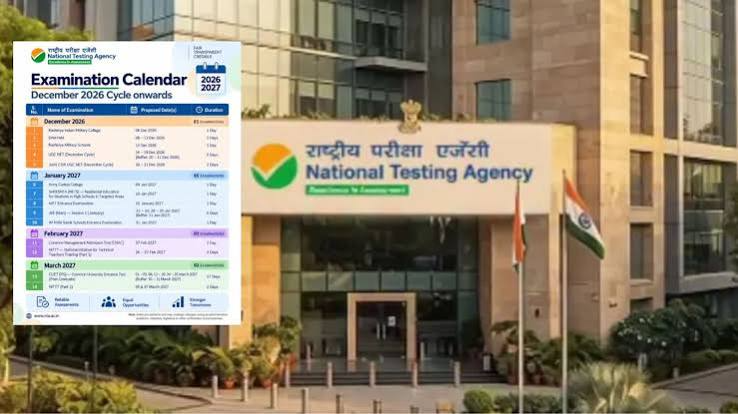
The National Testing Agency has released an updated examination calendar covering upcoming entrance and assessment activities, giving students and universities a revised timeline for a demanding academic admissions cycle. The update comes as standardized testing continues to play a central role in higher education admissions, including pathways used by students seeking opportunities beyond their home regions. For students preparing applications, the latest schedule is more than a list of dates. It can determine when to register, when to prepare documents, when to sit for an examination and when to plan the next stage of an academic journey.
NTA Updates Its Examination Calendar
The National Testing Agency, commonly known as NTA, has published an examination calendar extending through March 2027. The agency conducts major entrance and eligibility examinations for higher education institutions across India, including examinations connected with engineering, medical education, university admissions and other academic pathways. Its official website describes NTA as an organization responsible for research based, reliable and transparent assessments for admissions and fellowships.
The updated calendar matters because entrance examinations often involve several connected deadlines. Students must monitor registration announcements, application windows, correction opportunities, examination dates, admit card releases and result schedules. A change in one part of that sequence can affect travel plans, preparation timetables and university application decisions.
Students can monitor the latest examination notices through the official National Testing Agency website, where examination calendars and public notices are published.
Why Updated Entrance Exam Dates Matter for Students
For a student preparing for a competitive entrance examination, a date on a calendar can carry considerable weight. Preparation may already involve months of study, mock examinations, coaching sessions and personal commitments. When an examination schedule changes, students may suddenly need to reorganize that entire routine.
We often think about entrance examinations as a single test, but the admission process is much larger. Students must first identify eligible programs, review admission requirements, complete applications, prepare for the examination and then track results and counselling procedures. International applicants may also need to coordinate these steps with visa requirements, language documentation, financial planning and university deadlines.
That is why students should treat the latest NTA calendar as a planning document rather than simply checking the examination date shortly before the test.
Which Major Examinations Are Connected With NTA?
NTA administers a broad range of examinations. Its examination portfolio includes the Joint Entrance Examination Main for engineering admissions, the National Eligibility cum Entrance Test for undergraduate medical admissions, the Common University Entrance Test for university admissions and several other national level examinations.
The Common University Entrance Test is particularly relevant to students seeking admission to participating central universities and other institutions. NTA describes CUET as a single window opportunity through which students can seek admission to participating universities across India.
Other examinations administered by NTA cover postgraduate admissions, management education, agricultural education, research fellowships, teaching eligibility and specialized academic programs. Because the examination calendar covers different groups of students, applicants should rely on the notice for their specific examination instead of assuming that every examination follows the same timetable.
International Students Face a More Complicated Planning Process
Students applying from outside India can face additional planning challenges. A domestic applicant may need to coordinate school examinations with an entrance test, while an international applicant may also have to consider passport documentation, travel arrangements, immigration procedures and university specific requirements.
The phrase global entrance examination framework can therefore describe a wider shift in how students approach standardized testing, but it should not be interpreted as meaning that every NTA examination has identical international eligibility rules. Individual examinations and universities can establish their own requirements concerning eligibility, documentation and admission.
Students outside India should carefully check whether the examination they intend to take accepts international candidates, whether an examination centre is available in their country and whether the institution they are targeting accepts the resulting score for the relevant program.
Digital Testing Continues to Shape Entrance Examinations
Another important feature of India’s examination system is the growing use of computer based testing. NTA has increasingly relied on digital examination infrastructure to manage large candidate populations across multiple cities and examination centres.
For students, this means preparation should include more than memorizing academic material. Candidates should become comfortable reading questions on a computer screen, managing time across sections and navigating the digital testing interface. Technical familiarity can reduce unnecessary stress on examination day.
NTA has previously announced digital security measures for major examinations, including identity verification and technology based safeguards. These measures reflect the broader effort to manage large scale standardized testing while protecting examination integrity.
Students Should Track More Than the Examination Date
One of the easiest mistakes applicants can make is to record only the final examination date. The application period can be equally important because missing registration deadlines may prevent a candidate from appearing for the examination altogether.
A practical schedule should include several separate checkpoints:
- Application opening and closing dates
- Correction or modification periods
- Examination city and centre information
- Admit card or examination city slip announcements
- Final examination date and shift information
- Answer key and result announcements
- Counselling and university admission deadlines
Students should also check their email and the official examination portal regularly. Social media posts and coaching websites can be useful for alerts, but the official NTA notice should remain the final reference when dates or instructions appear to conflict.
How Schedule Changes Can Affect University Applications
Entrance examination schedules do not exist separately from university admission calendars. A student may be preparing for an NTA examination while simultaneously applying to institutions that have their own deadlines.
This creates a planning challenge when an examination date changes. A candidate may need to reconsider travel arrangements, accommodation, interview schedules or document submissions. International applicants may face additional pressure because travel and visa arrangements can require advance planning.
We recommend that students maintain a simple admissions calendar containing both examination dates and university deadlines. Keeping these dates together makes it easier to identify conflicts before they become urgent.
What the Updated Calendar Means for Exam Preparation
The release of an updated schedule gives students an opportunity to make preparation more structured. Rather than studying without a fixed endpoint, candidates can divide their preparation into phases based on the confirmed examination timeline.
Build a Preparation Plan Around the Confirmed Date
Students should begin by identifying the subjects and topics that carry the greatest importance for their examination. The remaining preparation period can then be divided between learning concepts, solving practice questions, completing mock examinations and reviewing mistakes.
Students who have already completed much of their syllabus should use the schedule to shift their focus toward timed practice. Those who are still building foundational knowledge may need to divide their available time more carefully between new material and revision.
Keep Documents Ready
Applicants should also review the identification and academic documents required for their particular examination. Names, dates of birth, photographs, category documentation and other information should be checked before the application process begins whenever possible.
For international applicants, document preparation can take additional time. Academic records, identification documents and other supporting materials may require verification or specific formats depending on the institution and examination.
A Changing Testing Environment Requires Careful Verification
The updated NTA schedule arrives during a period when standardized testing systems are receiving greater attention. Large scale examinations must balance accessibility, security, technology and administrative reliability while serving students from different educational backgrounds.
NTA itself says its role is to provide assessments designed around reliability, transparency, fairness and international level standards. Its official examination information covers a wide range of admission and eligibility tests, reflecting the increasingly centralized role of standardized assessment in India’s higher education system.
For students, however, the most useful response to a changing examination environment is straightforward. Check the official notice, record every relevant deadline and avoid relying on an old timetable saved months earlier.
What Students Should Do Next
Students affected by the updated examination calendar should first identify the examination they intend to take and verify its individual notice. They should then record the application deadline, examination date, admit card information and subsequent admission deadlines in one place.
International students should take the additional step of checking whether their chosen examination and university accept international applicants and whether an examination centre is available within their region. They should also review immigration and university documentation requirements separately rather than assuming that an entrance examination registration automatically completes the admission process.
The latest NTA calendar provides a clearer framework for planning the months ahead, but individual examination notices remain essential. Entrance testing is only one stage of the higher education journey, and careful attention to registration, documentation, preparation and admission deadlines can prevent avoidable problems later.
Why the New Schedule Matters Beyond a Single Examination Cycle
The significance of the updated calendar extends beyond individual candidates. Standardized entrance examinations influence how universities manage admissions, how students compare academic opportunities and how institutions coordinate large numbers of applicants.
For students sitting at a desk with preparation books open and an examination date circled on a calendar, the schedule can make an uncertain process feel more manageable. A confirmed timeline gives candidates a fixed point toward which they can organize their preparation.
As entrance testing continues to become more coordinated and increasingly digital, students will need to remain attentive to official announcements and flexible when schedules change. The latest NTA calendar is therefore not simply an administrative update. For thousands of applicants, it is a planning signal that can shape the next stage of their education.