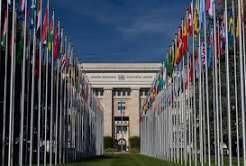
The United Nations Human Rights Council is examining serious allegations surrounding military strikes in Iran after an independent fact finding mission reported reasonable grounds to believe that two United States airstrikes may have amounted to war crimes. The findings place civilian protection, military targeting decisions, evidence collection, and international accountability at the center of a growing legal debate.
UN Investigation Places Civilian Protection at the Center
The findings released on September 17 have drawn international attention because they concern attacks that investigators say killed at least 178 civilians, including women and children. The Independent International Fact Finding Mission on Iran examined two February strikes, including an attack on the Shajareh Tayyebeh Primary School in Minab and another strike involving a sports complex and nearby residential areas in Lamerd.
The mission said there were reasonable grounds to believe that the attacks constituted the war crime of launching indiscriminate attacks resulting in civilian deaths, injuries, or damage to civilian objects. That wording is significant because a fact finding mission does not function as a criminal court. Its conclusions represent an assessment of evidence gathered under its mandate rather than a final criminal judgment establishing individual guilt.
For families affected by the strikes, however, the legal terminology exists alongside a much more immediate reality. A school, residential neighborhood, or public facility can become a place of mourning within seconds when a military strike reaches a civilian area. Investigators therefore face the difficult task of reconstructing what happened, what commanders knew, what targets were identified, and what precautions were considered before an attack was launched.
What the Mission Examined in Iran
The investigation focused on events that followed the beginning of major United States and Israeli military operations against Iran on February 28, 2026. Investigators reviewed information concerning the two strikes and assessed them against obligations under international humanitarian law.
The Minab School Strike
One of the most consequential findings concerns the Shajareh Tayyebeh Primary School in Minab. Reports cited by international news organizations indicate that the strike caused a large number of civilian deaths, with Iranian authorities previously reporting 168 fatalities, most of them children. The UN mission said the civilian character of the school should have been apparent and questioned whether sufficient measures were taken to verify that the site represented a legitimate military objective.
The distinction between a military target and a civilian object is fundamental to the law governing armed conflict. International humanitarian law requires parties to distinguish between military objectives and civilians or civilian objects. Attacks must also comply with rules concerning proportionality and precautions designed to reduce civilian harm.
The mission’s assessment does not by itself determine the criminal responsibility of a specific commander or government official. Establishing such responsibility would require additional legal proceedings and evidence concerning decisions, intent, knowledge, command structures, and other circumstances surrounding an attack.
The Lamerd Strike
The second case examined by investigators involved a sports complex and residential area in Lamerd. The mission reported that the strike killed 22 civilian men and women. Investigators also examined the characteristics of the weapons used and the circumstances in which the attack occurred.
These details matter because international humanitarian law does not judge an attack solely by its outcome. Civilian casualties can occur even during attacks directed at lawful military objectives. The legal question can involve what the attacker knew or should have known, whether the target was a military objective, whether feasible precautions were taken, and whether anticipated civilian harm was excessive in relation to the concrete and direct military advantage expected.
Why a UN Finding Is Not the Same as a Court Judgment
The phrase reasonable grounds to believe is likely to remain central to the legal discussion. A fact finding body operates differently from a criminal court. Its role can include documenting incidents, preserving evidence, identifying patterns, and assessing whether conduct may violate international law.
The United Nations Human Rights Office supports a broad international system of investigations, monitoring mechanisms, commissions, and fact finding missions. Such investigations can preserve detailed records that may later assist national authorities, international institutions, or courts examining alleged violations.
This distinction is essential when interpreting the current findings. The report does not automatically create a criminal conviction, impose a sentence, or establish that every allegation has been proven beyond a reasonable doubt. Instead, it adds an official body of evidence and legal analysis to an international record that may be examined in later accountability processes.
International Humanitarian Law Faces a Difficult Test
The controversy illustrates why the laws governing armed conflict are often difficult to apply after an airstrike. Investigators may have photographs, satellite imagery, witness testimony, medical records, weapon fragments, videos, communications, and information about the intended target. Yet determining what a military commander knew at the moment an attack was approved can be much harder.
A destroyed building can show the physical consequences of an attack, but it cannot by itself reveal the intelligence available to the attacking force before the strike. Investigators therefore need to reconstruct the decision making process as accurately as possible.
The legal analysis can involve several interconnected principles, including distinction, proportionality, military necessity, precautions in attack, and protection of civilian objects. The same incident may also raise questions under international criminal law if investigators believe the available evidence meets the relevant threshold for a war crime.
Iranian Government Also Faces Serious Allegations
The UN mission’s report does not focus exclusively on foreign military operations. Investigators also examined the Iranian government’s response to nationwide protests that began in late 2025 and continued into 2026.
The mission reported widespread lethal force, mass killings, injuries, extensive arrests, and other serious abuses. It concluded that some conduct by Iranian authorities could amount to crimes against humanity. These allegations involve a different legal context from the airstrikes and concern the treatment of civilians by state authorities during internal unrest.
For civilians in Iran, the two sets of findings describe overlapping forms of vulnerability. People faced the consequences of military conflict while others experienced repression connected to political protests and internal security operations. The mission argued that civilians were caught between these separate sources of danger.
What Accountability Could Look Like
International accountability can take several forms, depending on jurisdiction, evidence, political decisions, and the legal obligations of states involved. Investigations can lead to domestic criminal proceedings, military inquiries, parliamentary scrutiny, international litigation, or proceedings before courts with appropriate jurisdiction.
The International Criminal Court is one institution involved in investigating and prosecuting individuals accused of certain serious international crimes. Its jurisdiction is governed by specific legal requirements, so the existence of a UN investigation does not automatically mean that a particular case will reach the court.
Accountability can also involve less visible but significant processes. Preserving evidence, identifying victims, documenting attacks, locating witnesses, and establishing reliable records can become critical years after a conflict. Investigations conducted during or soon after hostilities can therefore influence legal proceedings long after the immediate political controversy has faded.
Why Evidence Preservation Matters
War crimes investigations are especially dependent on reliable evidence because physical sites can change rapidly. Buildings may be cleared, damaged areas reconstructed, witnesses may leave, and digital material can disappear. Investigators therefore place substantial value on photographs, videos, satellite imagery, medical documentation, testimony, and other independently verifiable records.
The credibility of any future legal process will depend partly on whether investigators can establish a clear chain between an alleged attack, the people responsible for planning or carrying it out, and the information available when the decision was made. Evidence must also be assessed carefully to distinguish verified facts from unconfirmed accounts.
What Happens Next at the Human Rights Council
The findings are being presented in the context of the Human Rights Council’s 63rd regular session in Geneva, which runs from September 7 through October 7, 2026. The council can debate the findings, hear responses from states, and consider further action within its institutional authority.
The political and legal responses are likely to remain contested. United States officials have rejected the allegations and questioned the credibility of the Human Rights Council’s findings. Iranian authorities have also faced extensive scrutiny from international investigators over their domestic conduct.
For observers, the most useful approach is to separate established facts from allegations, investigative conclusions, government responses, and future legal possibilities. That distinction matters because international law depends not only on the seriousness of an allegation but also on evidence, jurisdiction, legal standards, and due process.
A Larger Question About Accountability in Modern Warfare
The investigation arrives at a time when long range missiles, precision weapons, surveillance systems, and increasingly complex military operations can place civilians far from traditional battlefields at risk. Technology may improve targeting capabilities, but it does not remove the legal responsibility to protect civilians.
The central question raised by the report is therefore broader than the fate of two individual strikes. It concerns how governments, militaries, investigators, and courts determine responsibility when civilians are killed during international conflict. The answer depends on evidence and law rather than political rhetoric.
For families who have lost relatives, accountability can never reverse the damage caused by a strike. It can, however, establish an authoritative record of what happened and provide a pathway toward justice where legal responsibility is ultimately proven. The Human Rights Council’s continuing examination of the findings will show how far the international system is prepared to carry that process.