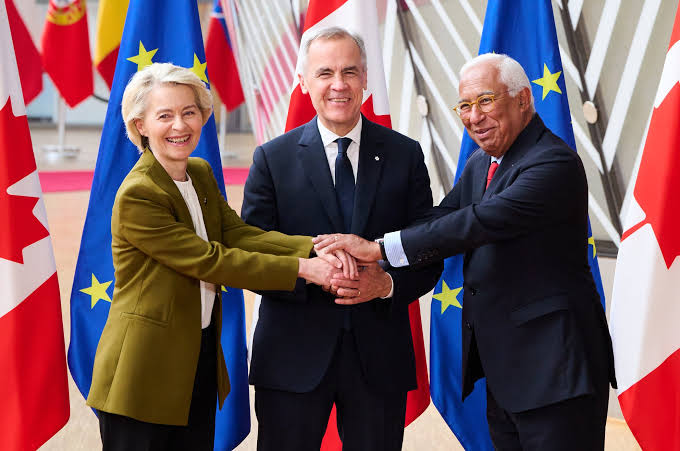
Canada is looking beyond its traditional economic dependence on the United States, and the United Kingdom has now been invited to take part in that broader effort. Canadian Finance Minister François Philippe Champagne has urged Britain to join a proposed economic alliance involving Canada and the European Union, arguing that changing global conditions require countries with shared interests to work more closely together. The proposal arrives as Ottawa manages serious trade friction with Washington while seeking stronger relationships across Europe and other international markets.
Canada Puts a New Economic Partnership on the Table
Champagne’s proposal represents another step in Canada’s effort to diversify its economic relationships. Speaking to the BBC, the Canadian finance minister said Britain should team up with Canada and Europe as part of a future focused economic partnership. He argued that the international environment has changed and that countries need to adapt by building stronger connections with partners that share common interests.
The proposal does not amount to a formal agreement between Canada, Britain and the European Union. It is instead an invitation to explore a wider framework for cooperation at a time when traditional assumptions about global trade are being tested.
For Canada, that distinction matters. The United States remains an enormous trading partner, but recent disputes over American tariffs and broader trade policy have encouraged Ottawa to look for additional markets. Canadian officials have increasingly discussed trade diversification as a way to reduce economic vulnerability and create more opportunities for Canadian companies and workers.
The Canadian government’s official economic and trade information shows that expanding international partnerships has become a major part of its economic strategy.
Why Britain Is Central to the Proposal
Britain occupies an unusual position in the proposed arrangement. It has close historical, political and economic ties with Canada while also maintaining a deep relationship with European markets despite leaving the European Union.
Canada and the UK already have an established trading relationship. Their Trade Continuity Agreement has been in force since April 2021, while Britain also became fully integrated into the Comprehensive and Progressive Agreement for Trans Pacific Partnership in September 2026. The UK government has also confirmed that it is negotiating an upgraded trade agreement with Canada.
These existing connections could provide a practical foundation for deeper cooperation. Rather than beginning with no institutional relationship, Ottawa and London already have channels covering goods, services and investment. The question now is whether those arrangements could become part of something substantially broader involving European partners.
British Prime Minister Andy Burnham and Canadian Prime Minister Mark Carney also discussed closer cooperation during their September 16 meeting. Their governments highlighted the importance of building stronger connections between Britain, Canada and European partners, particularly in areas such as trade and defence.
Canada’s Search for Greater Trade Diversification
The timing of Champagne’s proposal is closely connected to Canada’s difficult relationship with the United States. Canadian officials have spent months responding to new American tariffs and assessing their effect on businesses, workers and investment.
Ottawa has not abandoned its relationship with Washington. Instead, Canadian policymakers are pursuing a broader strategy in which the United States remains important while Europe, Britain and other markets become more significant sources of trade and investment.
Champagne has repeatedly presented this approach as an effort to build economic resilience. At a G20 meeting earlier this month, he said Canada was seeking stronger partnerships abroad while promoting critical minerals, energy, agriculture and other areas where Canadian companies can compete internationally.
For Canadian businesses, diversification can mean more than diplomatic announcements. New trade relationships can potentially create additional customers, suppliers, investment opportunities and routes into foreign markets. For workers, the longer term question is whether these relationships translate into higher exports and sustained employment.
Europe and Canada Are Already Discussing a Deeper Relationship
The British proposal comes shortly after discussions between Canada and European leaders about creating a closer economic and strategic partnership. European Commission President Ursula von der Leyen has publicly raised the possibility of an associate relationship for Canada, although such an associate membership does not currently exist under European Union treaties.
Canadian Prime Minister Mark Carney has welcomed the broader concept while making clear that Canada is not seeking full European Union membership. Instead, Ottawa has been exploring a model that could provide closer cooperation in areas including trade, technology, energy, critical minerals, security and the movement of people.
That ambition still faces substantial practical questions. Existing European Union rules and institutions would need to accommodate any new arrangement, and individual member states would have an important role in approving formal agreements. European governments have also expressed different levels of interest in how far the relationship should go.
What a Wider Canada UK Europe Partnership Could Cover
If the concept develops beyond political discussions, several areas could become central to negotiations.
- Trade in goods and services across Canada, Britain and European markets
- Critical minerals needed for advanced manufacturing and energy technologies
- Energy cooperation involving conventional and clean energy resources
- Digital commerce and technology standards
- Artificial intelligence and other emerging technologies
- Defence financing, security cooperation and economic resilience
These areas reflect a broader shift in how governments view economic security. Trade policy is increasingly connected with access to energy, technology, industrial capacity and strategic resources. Canada has substantial supplies of minerals and energy, while Europe has large consumer and industrial markets. Britain adds financial expertise, technology capabilities and an established international trading network.
Britain’s Existing Global Trade Strategy
The UK has also been pursuing a broader international trade strategy. Its full access to the CPTPP became effective on September 1, giving British businesses access to all participating member economies. Canada is among those members, creating another channel through which Canadian and British companies can expand their commercial relationships.
The British government has separately maintained its trade relationship with Canada while negotiating an upgraded bilateral agreement. That means London has several existing mechanisms through which it can deepen economic cooperation with Ottawa without immediately committing to a new multinational structure.
The UK government’s official trade guidance confirms that Britain and Canada are already working through existing trade arrangements while discussing an upgraded agreement.
The Proposal Still Faces Major Questions
Champagne’s invitation is politically significant, but much remains uncertain. The British government has not publicly committed to joining the proposed Canada Europe economic alliance. It is also unclear what legal structure such an alliance would ultimately have or how it would interact with existing agreements.
There are also questions about regulatory alignment. Canada, Britain and European Union countries operate under different standards, tax systems and market rules. Creating meaningful economic integration would require detailed negotiations rather than simply a political declaration.
There is another consideration that cannot be ignored. Canada’s economic relationship with the United States remains far larger than its trade relationship with Europe. Any diversification strategy therefore has to operate alongside Canada’s existing North American economic ties.
A Potential New Chapter in Transatlantic Cooperation
For now, the most important development is the direction of travel. Canada is openly seeking a wider network of economic relationships, Europe is discussing deeper cooperation with Ottawa, and Britain has been invited to participate in that conversation.
We should therefore view Champagne’s proposal as the beginning of a discussion rather than the creation of a finished alliance. The substance will ultimately matter more than the name. Any successful arrangement would need concrete benefits for businesses, workers, investors and consumers across the participating economies.
Canada’s outreach also reflects a larger economic reality. Countries that have historically relied heavily on established trading relationships are now examining how to build greater flexibility into their economies. For Ottawa, closer cooperation with Europe and Britain could provide another route toward that goal.
Whether London ultimately joins the proposed framework remains an open question. What is already clear is that Canada wants its next phase of economic policy to involve more partners, more markets and deeper international cooperation. The invitation to Britain places that ambition directly at the centre of the transatlantic economic conversation.