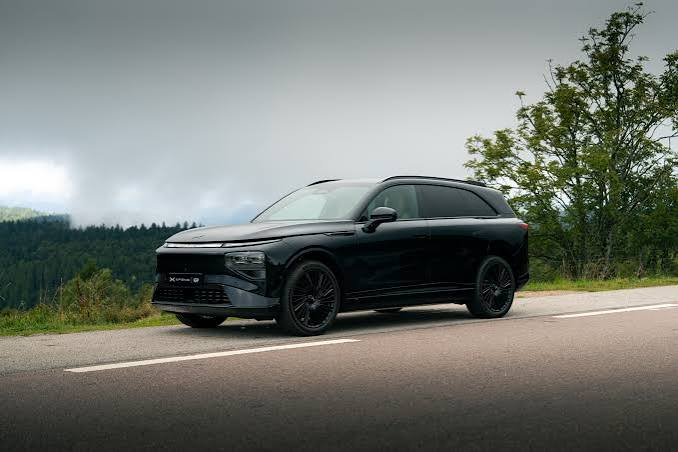
XPENG is preparing to place artificial intelligence at the center of its global automotive strategy as the company brings its new G9L flagship SUV to the 2026 Paris Motor Show. The electric vehicle maker says the G9L will make its global debut in Paris on October 12, alongside a wider showcase of its Physical AI technology, intelligent driving systems, humanoid robotics and future mobility projects. For European drivers, the event offers an early look at how XPENG wants artificial intelligence to function not only inside a vehicle but throughout the physical experience of transportation.
XPENG G9L Takes Center Stage in Paris
The G9L is positioned above the existing G9 in XPENG’s SUV lineup and represents the company’s latest attempt to combine premium vehicle design with advanced artificial intelligence. The company has already launched the model in China and says it will introduce the vehicle to 64 global markets.
At the Paris Motor Show, XPENG plans to open European order books and reveal pricing for the G9L. The vehicle will be presented as part of a broader international strategy rather than as a model designed exclusively for the Chinese market.
That distinction matters because European expansion has become a major part of XPENG’s plans. The company says the G9L will become its fourth model produced in Europe, following the G6, G9 and P7 Plus. Production is planned at Magna’s facility in Graz, Austria, giving XPENG a localized manufacturing presence for a growing European product range.
The official XPENG website provides additional information about the company’s vehicle portfolio, technology development and international operations.
What XPENG Means by Physical AI
Physical AI describes artificial intelligence systems designed to interact with the physical world. In XPENG’s strategy, that concept extends beyond voice assistants or software applications. The company is applying AI to vehicle perception, intelligent driving, cockpit functions, robotics and other forms of mobility.
The idea becomes easier to understand when we consider what happens inside a modern vehicle. Cameras and other sensors observe the road. Computing systems interpret surrounding objects. Software helps determine how the vehicle should respond. The driver then experiences those decisions through steering, acceleration, braking and information displayed inside the cabin.
XPENG is attempting to connect these individual functions through a broader AI architecture. The G9L is therefore being positioned as more than an electric SUV with additional software. It is intended to demonstrate how AI can become a central part of the vehicle’s operating system.
AI Moves From the Screen Into the Vehicle
The phrase Physical AI also reflects a wider change taking place across the technology industry. Artificial intelligence has traditionally been associated with screens, databases and cloud services. Physical AI brings those capabilities into environments where software must respond to real objects and changing conditions.
For a vehicle, that means the system must operate around pedestrians, cyclists, traffic signals, other cars, road markings and unexpected situations. A digital assistant can take a moment to process a request and respond later. A driving system operates in an environment where timing and reliability are much more consequential.
That is why intelligent driving technology requires extensive testing and careful attention to safety. XPENG says the G9L has undergone road testing across 26 countries and regions, with cumulative testing mileage exceeding 6.74 million kilometers. The company also says the vehicle has completed crash testing across four major safety protocols.
G9L Uses AI for a Global Vehicle Strategy
XPENG has described the G9L as a global vehicle rather than a model simply exported from one market to another. The company says its approach involves adapting research, development, safety requirements and technology to different markets while maintaining a common technological foundation.
The G9L will be offered in both battery electric and range extended electric versions in China. Its overall length is 5,120 millimeters and its wheelbase measures 3,100 millimeters, placing it firmly within the large premium SUV category.
The vehicle is also built around XPENG’s VLA 2.0 artificial intelligence model, which the company says is designed to support generalization across different regions. That capability is particularly relevant to international expansion because roads, traffic patterns and driving conditions differ substantially from one country to another.
European Production Gives the G9L Greater Regional Relevance
Manufacturing the G9L in Austria represents another important part of XPENG’s European strategy. Local production can bring the company closer to customers while giving it a stronger regional manufacturing base.
The Graz facility is operated by Magna, a major automotive manufacturing and technology company. XPENG has been using the facility for European production as it expands its local lineup.
For European consumers, regional production can also become part of the broader conversation around vehicle availability, supply chains and service support. An international electric vehicle brand needs more than attractive technology to establish itself. Customers also need access to dealerships, maintenance, replacement parts and reliable after sales services.
XPENG Will Showcase More Than an SUV
The G9L will be the central attraction at XPENG’s Paris display, but the company plans to present a much broader technology ecosystem. Its exhibition will cover more than 1,000 square meters in Hall 6 and is being organized around four areas focused on the company’s technology foundation, AI defined vehicles, humanoid robots and flying cars.
The presentation is designed to communicate a larger idea: XPENG does not see itself only as an electric car manufacturer. It wants to develop a technology platform that can be applied across several forms of physical mobility.
The company’s IRON humanoid robot will be part of that story. XPENG has been developing the robot alongside its automotive AI systems and recently commissioned a production line for the machine. The connection between cars and humanoid robots is central to the company’s argument that both products can benefit from related artificial intelligence technologies.
The Car as a Robot Concept
XPENG’s car as a robot concept gives the G9L an unusual position within the company’s portfolio. Rather than treating the vehicle as a fixed mechanical product with software added afterward, XPENG is presenting it as an intelligent machine capable of sensing, interpreting and responding to its surroundings.
That approach could influence how consumers think about vehicle upgrades in the future. Traditional cars become outdated largely because of mechanical wear or changing design preferences. AI focused vehicles could also evolve through software updates, improvements in perception systems and new digital services.
There are still important questions around how quickly such systems can improve and what limitations they will face. Advanced driver assistance does not remove the need for responsible human supervision unless a specific system has been legally approved for a higher level of automation. Consumers therefore need to distinguish between driver assistance and fully autonomous driving.
XPENG and Tesla to Participate in the Autonomous Lab
One of the most closely watched parts of XPENG’s Paris appearance will be the official Autonomous Lab at the motor show. XPENG says it and Tesla will be the only automakers participating in the event’s Autonomous Lab program.
For XPENG, the participation represents its first large scale NGP test ride experience outside China. NGP refers to the company’s intelligent driving technology, which is designed to assist with driving tasks in supported environments.
A public demonstration can provide visitors with a more tangible experience of the technology than a presentation on a screen. Instead of simply hearing about automated driving, passengers can observe how the system responds to real road conditions under controlled circumstances.
Why Paris Matters for XPENG’s International Ambitions
Paris offers XPENG a significant stage because the company will be presenting its technology alongside established European automotive brands and other international manufacturers. The Paris Motor Show runs from October 12 through October 18, giving XPENG several days to introduce the G9L to journalists, industry professionals and consumers.
The timing also comes as Chinese electric vehicle manufacturers continue expanding their presence in international markets. Competition is no longer based solely on battery range or vehicle price. Software, driver assistance, charging technology, cabin technology and digital services are increasingly part of the customer experience.
XPENG’s strategy places artificial intelligence near the center of that competition. The company is effectively asking whether advanced software and physical AI can become a defining feature of its brand as it moves deeper into Europe.
What the G9L Could Mean for Future Electric SUVs
The importance of the G9L will ultimately depend on how its technology performs in real conditions and how European consumers respond to it. Specifications and demonstrations can show what a vehicle is designed to do, but long term customer experience will determine whether those features become genuinely useful.
For drivers, the most meaningful improvements are likely to be the ones that make everyday travel easier without creating additional complexity. A smart vehicle should ideally help a driver understand its surroundings, manage navigation, operate cabin functions and handle supported driving tasks while keeping the person behind the wheel informed and engaged.
There is also a human side to this technological transition. Buying a vehicle is a major financial decision, and many drivers remain cautious about unfamiliar brands and new automated features. Trust will therefore depend on transparent information, dependable service and clear communication about what an AI system can and cannot do.
XPENG’s Broader Physical AI Vision
The Paris launch shows that XPENG is trying to connect several ambitious projects under one technological vision. The G9L represents intelligent electric vehicles. IRON represents humanoid robotics. The company’s flying car and Robotaxi projects point toward other possible forms of automated mobility.
Whether all of these ideas reach mass adoption remains to be seen. What is already clear is that XPENG wants artificial intelligence to become a common foundation across its future products rather than a feature limited to the vehicle cabin.
That strategy could make the G9L one of the company’s most important international products. It is arriving at a moment when electric vehicle buyers are increasingly evaluating software and intelligence alongside traditional automotive qualities such as comfort, safety, efficiency and performance.
A New Chapter for XPENG in Europe
XPENG’s G9L global launch in Paris represents more than the arrival of another electric SUV. It is a public demonstration of the company’s ambition to bring Physical AI into everyday transportation while expanding its manufacturing and sales presence beyond China.
The October 12 unveiling will give European customers their first major opportunity to see the G9L in its global presentation, while the Autonomous Lab will provide a closer look at XPENG’s intelligent driving technology. With European production, a growing vehicle lineup and a broader robotics strategy, the company is attempting to build an identity around intelligent mobility rather than electric propulsion alone.
For the automotive industry, the more significant question may be how consumers respond when artificial intelligence becomes a central part of the vehicle itself. The G9L is XPENG’s latest answer to that question. Paris will provide the stage, but the real test will take place on roads and in garages as drivers begin deciding whether Physical AI can genuinely improve the experience of owning and using an electric vehicle.