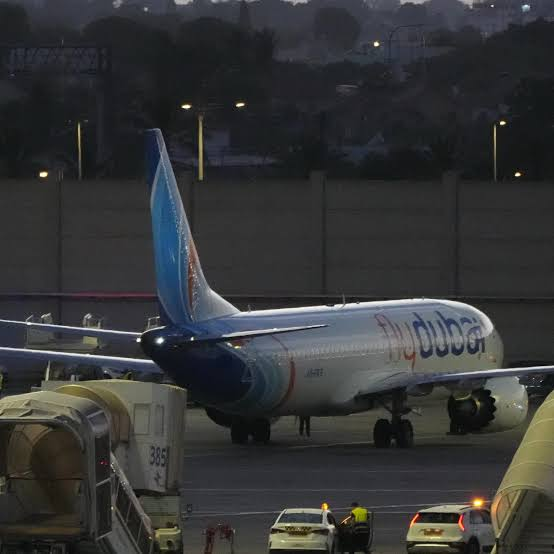
A routine flight from Dubai to Tel Aviv became a frightening aviation emergency on September 30 when Flydubai flight FZ1073 experienced an incident inside the cockpit and was diverted to Saudi Arabia. The aircraft landed safely in Tabuk, and Flydubai said all passengers and crew were safe and accounted for. The episode has since triggered renewed international discussion about cockpit security, pilot screening, emergency response and whether commercial aircraft should eventually carry video recording systems capable of showing what happens inside the flight deck.
What Happened Aboard Flydubai Flight FZ1073
Flight FZ1073 was operating from Dubai International Airport to Ben Gurion International Airport in Tel Aviv when an altercation occurred inside the cockpit. Flydubai confirmed that an incident took place while the aircraft was en route and later stated that the aircraft was brought under control by crew members who were on duty aboard the flight.
The Boeing 737 MAX 8 was diverted to Tabuk Airport in northwestern Saudi Arabia, where it landed safely. Flydubai said its teams were working with the relevant authorities and that additional information would be released as confirmed details became available.
Reports from Israeli officials and international media described a far more serious sequence of events, including an attack involving members of the flight crew and a dramatic loss of altitude. Reuters reported that the aircraft descended nearly 14,000 feet in less than 30 seconds before control was restored. Flight tracking information also showed the aircraft making sharp altitude changes during the emergency.
The distinction between confirmed facts and claims under investigation matters. Flydubai has publicly confirmed the cockpit altercation and safe diversion, while authorities are still examining the precise circumstances, motive and sequence of events.
A Safe Landing Did Not End the Security Questions
For passengers, the most reassuring part of the story is also the simplest. The aircraft reached the ground safely. But the incident has raised a difficult question for aviation authorities: what happens when the greatest security threat on an aircraft is not outside the cockpit door, but inside it?
Modern commercial aviation relies on layers of protection. Flight crews undergo training, aircraft contain multiple redundant systems, cockpit doors are reinforced, air traffic controllers monitor flights and emergency procedures are practiced repeatedly. Yet an event involving a member of the flight crew presents a different type of risk because the person involved may already have authorized access to the most restricted area of the aircraft.
That is why the FZ1073 incident has attracted attention well beyond the route between Dubai and Tel Aviv. It touches a security question shared by airlines across continents: how can investigators reconstruct an event when the people directly involved are also part of the event itself?
Why Cockpit Video Recorders Are Being Discussed
Aircraft already use sophisticated recording equipment. A cockpit voice recorder captures the cockpit audio environment and communications involving flight crew members. A flight data recorder preserves information about aircraft systems and performance. Together, these systems can provide investigators with a detailed technical record of an emergency.
The United States Federal Aviation Administration explains that cockpit voice recorders are designed to preserve cockpit audio for accident and incident investigations. Its current guidance also recognizes that new recording technologies can provide additional safety functions. The FAA has separately moved toward longer cockpit voice recording retention requirements for covered aircraft.
The question raised by FZ1073 is whether audio and flight data are enough when an emergency involves physical actions inside the cockpit.
A video system could potentially provide investigators with information that audio and flight data cannot show. It could reveal movement around the cockpit, interactions between crew members, the use of controls and the timing of physical events. Such information could become especially valuable when accounts differ or when an incident unfolds within seconds.
At the same time, cockpit video recording would introduce significant privacy, labor and security questions. A cockpit is a workplace containing sensitive operational procedures. Continuous visual recording could expose personal information and create concerns about how footage is stored, accessed and protected.
Those issues mean that any move toward mandatory cockpit video would involve far more than installing cameras. Regulators would need rules governing encryption, retention, access, investigator use and protection against unauthorized disclosure.
Existing Recorder Rules Already Reflect Lessons From Aviation History
The aviation industry has spent decades developing flight recording systems because investigators need reliable evidence after serious incidents. A cockpit voice recorder can preserve conversations that might otherwise depend entirely on human memory. A flight data recorder can show altitude, speed, heading and numerous aircraft parameters during a critical period.
The Federal Aviation Administration guidance on cockpit voice recorders describes the equipment as an important investigation tool and provides regulatory approval guidance for these systems.
The United States has also adopted a requirement for longer cockpit voice recording capability on covered aircraft. Federal legislation requires qualifying aircraft manufactured after May 16, 2025 to have recorders capable of retaining the previous 25 hours of cockpit audio, with broader installation requirements applying within a specified period.
These measures show how aviation regulation can change after investigators identify limitations in existing systems. The debate surrounding FZ1073 may become another example of that process, although it is far too early to say what regulatory changes will ultimately follow.
Pilot Screening Is Now Under a New Spotlight
The incident also raises questions about how airlines and regulators assess flight crew members before they are trusted with responsibility for hundreds of passengers.
Pilot selection involves professional qualifications, training, medical requirements, operational assessments and recurrent checks. Security screening is also part of the broader aviation protection system. Yet no screening process can predict every future action by an individual.
This creates a difficult balance. Airlines must protect passengers without treating every pilot as a potential security threat. Regulators must identify genuine risks while respecting employment rights and personal privacy. Any new screening system would need clear evidence showing that it improves safety without creating unnecessary barriers or discrimination.
The Passengers Who Became Part of the Emergency Response
One of the most striking aspects of the FZ1073 story is the role reportedly played by passengers and crew members during the crisis. Accounts published by international news organizations describe passengers helping to restrain the person involved after the cockpit emergency developed.
That detail is a reminder that aviation safety does not always depend entirely on technology. When an aircraft is thousands of feet above the ground, people may have only seconds to respond to an unexpected threat. Cabin crew training, passenger awareness and clear emergency procedures can become crucial when an unusual situation falls outside normal flight operations.
For people sitting in an aircraft cabin, aviation security often feels invisible. Passengers see seat belts, emergency exits and safety demonstrations, but much of the protection surrounding a flight operates quietly behind the scenes. The FZ1073 emergency demonstrated how quickly that invisible system can be tested.
Authorities Continue Investigating the Incident
The United Arab Emirates has ordered an investigation into the incident, while authorities in Saudi Arabia and Israel are also examining aspects of what happened. Flydubai has said that the causes and motives must be established through the official investigation rather than premature speculation.
The UAE General Civil Aviation Authority investigation resources show the formal role of aviation investigators in examining safety breaches, unauthorized access and security concerns.
Investigators will have several forms of evidence available, including aircraft flight data, cockpit audio, air traffic communications, crew statements, passenger accounts and airport records. They may also examine security procedures, crew histories and the sequence of decisions made during the diversion.
Could Global Aviation Rules Change?
The strongest lesson from FZ1073 may not be a single technology requirement. Instead, it could prompt regulators to review several layers of cockpit security together.
- Cockpit access procedures could receive additional scrutiny.
- Pilot screening and recurrent security assessments could be reviewed.
- Airlines could examine emergency procedures for threats originating within the flight deck.
- Regulators could study the privacy and security implications of cockpit video recording.
- Investigators could assess whether existing audio and flight data systems provide enough evidence during security incidents.
Any new requirement would also have to consider cost, aircraft design, data protection and international coordination. Commercial aircraft operate across national borders, so a recording requirement adopted in one country could have consequences for airlines operating worldwide.
Aviation Safety Depends on Evidence, Not Fear
The natural reaction to an event like FZ1073 is fear. Passengers understandably want to know that an aircraft can protect them from threats they cannot see. But aviation safety has historically advanced through careful investigation rather than reaction alone.
The aircraft involved in FZ1073 landed safely. Passengers and crew survived an extraordinarily serious emergency, and investigators now have the responsibility of determining exactly how the incident unfolded and why existing safeguards were tested in such a dramatic way.
Whether the outcome is new cockpit recording technology, revised crew screening, stronger access controls, improved emergency training or a combination of measures remains to be determined. What is already clear is that the incident has reopened a global aviation security conversation about the cockpit, the people inside it and the evidence needed when something goes wrong.
What Happens Next for Global Flight Security
For airlines and regulators, the coming investigation will be more consequential than the initial headlines. A detailed reconstruction can identify which safeguards worked, which safeguards were tested and where additional protection may be possible.
For passengers, the most meaningful result may be a quieter one. Aviation security improvements rarely announce themselves during an ordinary flight. They appear as procedures, training, technology and safeguards that passengers may never notice. The ultimate goal of the FZ1073 investigation will be to ensure that a frightening event becomes a source of evidence and learning rather than a repeated vulnerability.
As authorities continue gathering facts on October 1, 2026, the central issue is not simply whether cockpit video should become mandatory. The larger question is how aviation can preserve the extraordinary safety record of commercial flying while preparing for rare threats that traditional systems were not designed to capture. The answer will depend on evidence from this investigation and on how regulators around the world choose to act on what that evidence reveals.