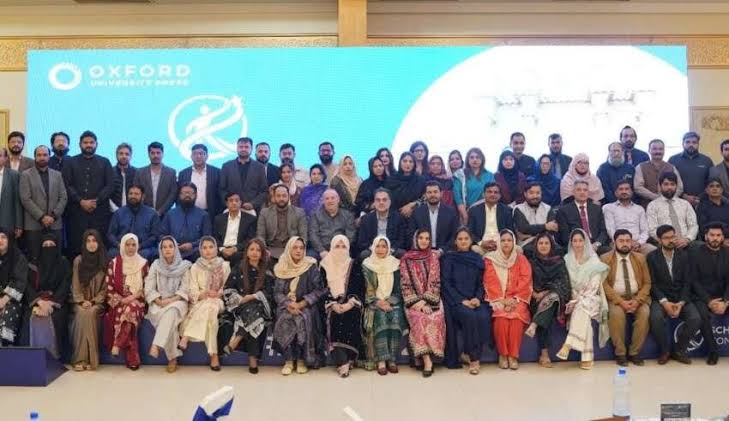
School leaders, education specialists and teachers gathered in Pakistan in November 2026 as Oxford University Press (OUP) brought its School Leaders’ Conference 2026 to Islamabad and Multan. Under the theme “Shaping Tomorrow: Navigating Change, Driving Impact,” the events explored how schools can respond to artificial intelligence, changing workplace expectations and new approaches to classroom teaching. The discussions placed a central responsibility on educational leadership: preparing students for an uncertain future while ensuring that technology and curriculum changes continue to serve meaningful learning.
The conferences brought together educators working with local and international examination boards, creating opportunities to discuss challenges that schools increasingly share. From the changing role of mathematics in an AI driven economy to student centred science education, the programme focused on practical questions facing school communities. The message was clear: future ready education requires more than new devices or digital resources. It depends on capable leadership, supported teachers, relevant skills and classrooms where students learn to think independently.
OUP’s School Leaders’ Conference Focuses on Changing Educational Priorities
Oxford University Press Pakistan organised its School Leaders’ Conference 2026 as part of its wider engagement with schools across the country. The Islamabad programme took place earlier in November, while the Multan conference was reported on November 26. Both events were held under the same theme, “Shaping Tomorrow: Navigating Change, Driving Impact.”
The sessions addressed the growing expectations placed on school leaders as education systems respond to technological change, evolving employment needs and demands for stronger learning outcomes. Participants considered how schools could integrate technology without allowing new tools to overshadow sound teaching practices. They also discussed how curriculum planning and professional development could help students develop skills that remain useful beyond examinations.
Arshad Saeed Husain, Managing Director of Oxford University Press Pakistan, said the organisation aimed to support schools throughout the curriculum implementation process. He described OUP’s education offering as a 360 degree learning ecosystem combining curriculum aligned resources, teacher professional development, assessment and guidance for families.
That approach reflects a wider recognition that school improvement cannot depend on textbooks or technology alone. Teachers need appropriate training, school leaders need reliable information about student progress, and families need ways to understand where children may require additional support. Bringing these elements together can help schools respond more effectively to learning gaps.
School Leadership Takes Centre Stage
One of the main themes was the changing responsibility of school leadership. Principals and school heads are increasingly expected to guide teachers through curriculum changes, evaluate digital learning tools, support student wellbeing and prepare institutions for new academic and professional expectations.
At the Multan conference, Dr Zubair Iqbal, Vice Chancellor of Bahauddin Zakariya University, delivered a keynote address titled “Transformative School Leadership: Enabling and Inspiring Futures.” He highlighted the connection between school education, higher education and the competencies students will need when entering the workplace.
His message focused on critical thinking, intellectual curiosity and continuous learning. These capabilities are important because students will enter a world where many tasks, tools and professional expectations may change during their working lives. Schools therefore need to develop the ability to learn and adapt, rather than prepare students only to reproduce information in examinations.
The Islamabad programme also examined leadership through a keynote by Dr Nadeem ul Haque, former Vice Chancellor of the Pakistan Institute of Development Economics and Chairperson of the Research Advisory Committee. His session, titled “Transformative School Leadership in Changing Times,” addressed the pressures facing educators working within local examination board systems.
For school leaders, the practical challenge is to turn broad ideas about educational change into decisions that affect everyday classroom experience. This can include setting clear learning priorities, giving teachers time to develop new methods, reviewing student progress and ensuring that innovation is connected to measurable educational needs.
Artificial Intelligence Is Changing the Way Schools Teach Mathematics
Artificial intelligence was a prominent subject across the conference discussions. As AI tools become more accessible, schools face questions about how students should use them, which skills will remain essential and how teachers can adapt lessons without weakening fundamental understanding.
At the Islamabad conference, Shazia Asad, Senior Product Manager for Mathematics at OUP Pakistan, presented a session titled “Mathematics in the Age of AI: New Imperatives and the Way Forward.” The discussion addressed the changing demands on mathematics education as automated systems become more capable of solving routine problems and generating answers.
The challenge for schools is not simply to teach students how to operate AI tools. They must help learners understand mathematical concepts, interpret results, identify errors and explain their reasoning. A student who can obtain an answer from an automated system but cannot assess whether it is correct may struggle when faced with an unfamiliar problem.
Mathematics teaching can therefore place greater attention on problem solving, logical reasoning, data interpretation and the ability to apply concepts in practical situations. AI may support teachers with explanations, practice activities and personalised learning resources, but its use needs clear educational objectives and appropriate oversight.
Teachers also need guidance on academic integrity. Students should understand when AI assistance is acceptable, how to check generated information and why submitting machine generated work without understanding it can undermine learning. These questions make teacher training and school policies essential parts of any responsible AI strategy.
Future Ready Skills Must Go Beyond Examination Results
Another major focus was the development of skills that prepare students for further education, employment and changing social demands. At the Islamabad programme, Emma Baxter, Product Manager at Oxford University Press UK, discussed how quality learning resources, teaching expertise and skills development can help prepare young people for the future.
The discussion reflects a growing concern among education leaders that academic achievement alone does not capture every capability students need. Communication, collaboration, creativity, critical thinking and the ability to solve unfamiliar problems are increasingly important across professional fields.
These skills are not separate from academic learning. They can be developed through well designed lessons in mathematics, science, languages and other subjects. Group investigations, presentations, practical projects and open ended questions give students opportunities to explain ideas, consider different perspectives and learn from mistakes.
For schools, adapting the curriculum does not necessarily mean removing established subjects or abandoning examination requirements. It means examining how knowledge is taught and assessed, and whether students have enough opportunities to apply what they learn. A curriculum that combines strong subject knowledge with practical thinking can better prepare learners for further study and work.
Student Centred Science Education Encourages Curiosity
Science education was another important part of the programme. At both the Islamabad and Multan conferences, international author and educator Dr Nicolas Brasch discussed student centred and inquiry based approaches through a session titled “The Science Learning Ecosystem.”
Inquiry based learning encourages students to ask questions, investigate evidence, test explanations and communicate what they discover. Rather than receiving every answer from a teacher, learners take an active role in exploring scientific ideas. This approach can make lessons more engaging while helping students understand how scientific knowledge is developed.
For example, a classroom investigation into plant growth can ask students to compare how different conditions affect development. Learners can form predictions, record observations, examine results and explain what the evidence suggests. Such activities connect scientific concepts with the process of investigation and encourage students to think carefully about the reliability of their conclusions.
Student centred teaching does not mean that teachers become less important. Their role remains central in designing appropriate activities, correcting misconceptions, guiding discussion and ensuring that learners build accurate subject knowledge. The approach requires preparation and professional expertise, not simply a change in classroom seating or the introduction of digital equipment.
Why Teacher Development Matters as Much as Technology
A recurring theme across the conferences was the need to combine innovation with effective teaching. Digital platforms, AI applications and updated learning materials can create useful opportunities, but their value depends on how they are used. A school may invest in new technology without seeing better learning outcomes if teachers do not receive the training and support needed to integrate it into lessons.
Professional development can help teachers evaluate digital resources, adapt activities to different learning needs and use assessment information to identify areas where students are struggling. It can also provide a space for educators to exchange experiences and learn from colleagues facing similar challenges.
OUP Pakistan presented its wider education support as a combination of curriculum aligned resources, teacher development, assessment and family guidance. The approach recognises that student progress is influenced by the relationship between classroom instruction, school management and support at home.
For school communities, this means that education reform should be planned as an ongoing process. Teachers need opportunities to practise new methods, school leaders need to review whether changes are working, and families should be included in conversations about learning progress.
Interactive Discussions Give Educators a Voice
The conference programmes included audience polls and panel discussions under the theme “Shaping Tomorrow: Challenges and Opportunities.” These sessions gave participants an opportunity to share experiences and discuss how emerging educational priorities could be addressed within their own institutions.
Such exchanges are valuable because schools operate in different circumstances. A large institution with extensive digital resources may face different challenges from a smaller school with limited technology and fewer opportunities for teacher training. Schools also work under different examination systems, curriculum requirements and financial constraints.
Discussions among school leaders can help identify practical approaches that are adaptable to these different settings. They can also highlight where national education policy, publishers, training providers and school management need to work more closely.
What the Conference Means for the Future of Schools
The OUP events took place in Pakistan, but the issues discussed reflect wider international debates about the future of education. Schools in many countries are reconsidering how to prepare students for a labour market influenced by automation, how to use AI responsibly and how to ensure that technology supports rather than replaces effective teaching.
International education organisations have also stressed the importance of skills, teacher development and responsible technology use. The OECD education programme provides research and policy analysis on learning outcomes, education systems and the skills needed for changing economies. Such work offers a useful context for school leaders considering how curriculum and teaching practices should evolve.
For Pakistan, the discussions are particularly relevant as schools serving different examination systems seek to improve learning quality while responding to new expectations from students, families and employers. Conferences can help build professional connections, but their longer term value will depend on whether the ideas discussed lead to practical changes in classrooms.
Turning Educational Ideas Into Better Learning Outcomes
Oxford University Press Pakistan’s School Leaders’ Conference 2026 brought attention to a central challenge facing modern education: schools must prepare students for change without losing sight of the fundamentals of learning. Strong subject knowledge, effective teaching, curiosity and independent thinking remain essential, even as AI and digital resources become more common.
The events in Islamabad and Multan highlighted the role of school leaders in supporting teachers, developing future focused skills and making thoughtful decisions about technology. They also showed why curriculum improvement requires cooperation among educators, publishers, universities and families.
The real measure of success will not be the number of new tools introduced or the number of conferences held. It will be whether students become more confident learners, whether teachers have the support to teach effectively and whether schools can connect classroom knowledge with the challenges young people will face beyond school.
As education systems continue to adapt, the discussions initiated through the OUP conference series offer a reminder that preparing for the future begins with decisions made in classrooms today. Further information about educational resources and professional learning is available through Oxford University Press.