The Asian Games in Aichi Nagoya are entering a decisive stretch, with medal hopes rising across cricket, hockey, weightlifting, shooting and athletics as athletes from across the continent compete for national records and personal milestones. By September 25, the Games had already produced memorable performances, including India’s cricket gold, Mirabai Chanu’s weightlifting silver and a growing medal haul that reflects the depth of competition at Asia’s largest multisport event.
Aichi Nagoya Games Reach a Critical Stage
The 2026 Asian Games are being held across Aichi and Nagoya in Japan from September 19 through October 4. The competition features around 17,000 athletes and officials representing 45 countries and regions, with 469 medal events across 43 sports. The scale of the event has created a packed sporting calendar in which established powers and emerging teams are competing almost continuously for medals. :contentReference[oaicite:0]{index=0}
We are seeing a particularly broad medal race because the program combines globally established Olympic sports with disciplines that have a strong Asian following. Cricket, hockey, weightlifting, shooting, athletics, kabaddi, badminton and other events are producing different kinds of sporting drama, from high scoring team contests to individual attempts decided by fractions of a kilogram.
The medal table is also beginning to reveal the competitive structure of the Games. China entered the tournament seeking to maintain its long standing position at the top of the Asian Games standings, while Japan and South Korea remain major forces. At the previous edition in Hangzhou, China won a record 201 gold medals, followed by Japan with 52 and South Korea with 42. :contentReference[oaicite:1]{index=1}
Cricket Produces One of the Early Landmark Moments
Cricket has again demonstrated why its inclusion in the Asian Games carries enormous interest across the region. India’s women secured the country’s first gold medal of the 2026 Games after defeating Sri Lanka by 147 runs in the T20 final.
India posted 216 runs for three wickets, powered by Smriti Mandhana’s 79 and Shafali Verma’s 48. Richa Ghosh then provided a late surge with an unbeaten 49 from 22 deliveries. Sri Lanka struggled during the chase and was dismissed for 69 in fewer than 16 overs. Pakistan claimed the bronze medal after defeating Bangladesh by 31 runs. :contentReference[oaicite:2]{index=2}
The result carried significance beyond the medal itself. India had also won the women’s cricket gold at the previous Asian Games in Hangzhou, meaning the victory strengthened its position in a competition that has quickly become an important stage for Asian cricket.
Mandhana also reached a personal milestone during the tournament by becoming the first woman to reach 11,000 international runs. Her achievement added an individual landmark to a team victory and illustrated how the Asian Games can create moments that resonate beyond the medal ceremony. :contentReference[oaicite:3]{index=3}
Men’s Cricket Adds Another Layer of Competition
The men’s cricket tournament began later than the women’s competition, with the preliminary phase starting on September 24. India, Pakistan, Bangladesh and Sri Lanka received direct places in the knockout stage alongside host nation Japan and other qualifying teams.
The men’s competition includes Afghanistan, Hong Kong, Japan, Malaysia, Nepal and Oman in the preliminary stage, with the strongest teams advancing toward the quarterfinals. The final is scheduled for October 3, giving cricket another opportunity to influence the medal picture before the Games close. :contentReference[oaicite:4]{index=4}
Weightlifting Brings Strength, Pressure and Precision
Few sports illustrate the physical intensity of the Asian Games more clearly than weightlifting. Every attempt carries immediate consequences, and athletes have only a small number of opportunities to establish a winning total.
India’s Mirabai Chanu secured a silver medal in the women’s 49 kilogram category, adding an important medal to her country’s growing tally. Her result was particularly significant because it represented her first Asian Games medal after previous attempts at the continental event had not produced the same outcome. :contentReference[oaicite:5]{index=5}
Weightlifting also highlights how medal milestones cannot always be measured by gold medals alone. For an athlete returning to one of the sport’s most demanding stages, standing on the podium can represent years of training, recovery and repeated competition under enormous pressure.
The sound of weights striking the platform, the brief silence before an attempt and the immediate reaction when a lift is completed capture something different from the atmosphere of a cricket stadium. The competition may last only minutes, but those minutes are built on years of preparation.
Hockey Remains a Major Test of Asian Sporting Depth
Hockey continues to occupy an important place in the Asian Games program, particularly for teams such as India, Japan, South Korea, China and other established hockey nations. Unlike individual medal events, hockey places the outcome of an entire tournament on a sequence of matches in which consistency matters as much as individual brilliance.
India entered the Games with particular attention surrounding its women’s hockey team. Lalremsiami Hmarzote has been one of the prominent figures in that campaign. Reuters reported before the Games that the player from Mizoram was seeking an Asian Games gold after building an international career that included Olympic and Asian Games experience. She began playing hockey barefoot on dirt pitches before joining a national academy and eventually becoming the first female Olympian from Mizoram. :contentReference[oaicite:6]{index=6}
Stories such as hers give the hockey competition a human dimension. Behind every national jersey is a different journey through local clubs, school fields, academies and family decisions. The medal eventually displayed on a podium represents only the final visible part of that journey.
India’s Medal Count Shows Strength Across Multiple Sports
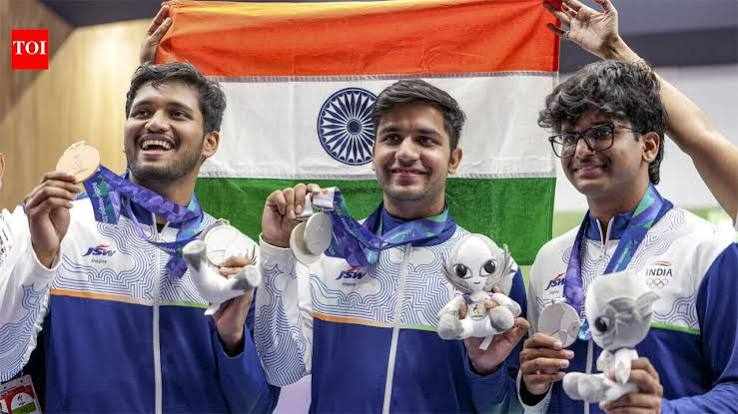
By September 25, India had collected 19 medals, comprising two gold, eight silver and nine bronze medals. Shooting had produced nine of those medals, making it the country’s largest medal contributor at that stage of the competition. :contentReference[oaicite:7]{index=7}
India’s second gold came from Kamaljeet and Suruchi Singh in the mixed team 10 metre air pistol event. The pair finished with 484.6 points after entering the final having topped qualification with 587 points and 29 inner tens. India also collected a silver in the men’s 50 metre rifle three positions team event through Aishwary Pratap Singh Tomar, Rudrankksh Patil and Niraj Kumar. :contentReference[oaicite:8]{index=8}
The distribution of India’s medals demonstrates why the Asian Games medal race cannot be judged through one sport alone. Cricket supplied a gold, weightlifting delivered a silver, shooting produced a substantial share of the overall total and athletics and other disciplines continued to provide additional opportunities.
China, Japan and South Korea Set the Pace
The leading Asian sporting nations have again established strong positions in the medal standings. China has maintained its historic dominance of the Asian Games medal table since 1982 and arrived in Aichi Nagoya after its record medal performance in Hangzhou. Japan, as host, is also competing on home soil with a large and experienced delegation, while South Korea remains one of the continent’s most consistent medal producers. :contentReference[oaicite:9]{index=9}
For Japan, the home setting adds another dimension to the competition. The country secured the first gold medal of the Games through Takumi Hojo in the men’s individual triathlon, while China quickly established a large gold medal presence in the pool and other disciplines. :contentReference[oaicite:10]{index=10}
These early results are not necessarily a prediction of where the final medal table will stand. Hundreds of events remain across the Games, and medal standings can change rapidly as athletics, team sports and other major competitions reach their finals.
Why These Medal Milestones Matter
Medal counts provide an easy way to follow the Asian Games, but they tell only part of the story. A gold medal can represent national sporting depth, while a silver or bronze may mark a breakthrough for an athlete or a country developing a stronger presence in a particular discipline.
For smaller sporting nations, reaching a final can itself become a significant achievement. For established powers, a medal may reinforce a long tradition of success or demonstrate progress in a discipline where competition is becoming stronger.
That is particularly visible in sports such as cricket and hockey, where national programs have developed distinct regional identities, and in weightlifting, where individual athletes carry the hopes of entire countries onto the platform.
The Road Ahead as the Games Enter Their Decisive Phase
The Aichi Nagoya Asian Games continue through October 4, leaving substantial opportunities for athletes and teams to add to the medal totals already established. Athletics, hockey, cricket, combat sports and several other disciplines will remain central to the closing stages of the competition.
For viewers following the medal table, the most useful approach is to look beyond the total number of medals and consider how those medals were won. A cricket final can turn on one exceptional batting partnership, a hockey tournament can depend on defensive discipline across several matches and a weightlifting medal can come down to a single successful attempt.
That variety is what gives the Asian Games their distinctive character. Across packed stadiums, quiet shooting ranges and weightlifting platforms, athletes are competing for medals while also creating milestones that can shape their sporting histories.
The latest results show that the medal race is already producing significant moments, but the final picture remains unfinished. With more events still to come, the Asian Games will continue to test the depth, consistency and resilience of Asia’s leading sporting nations until the last medals are awarded.
Readers can follow official Olympic movement information and competition coverage through the Olympics website and broader international reporting through Reuters.