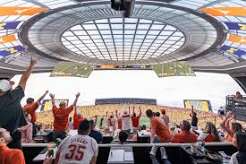
On September 5, 2026, Cosm’s immersive stadium dome concept is drawing renewed attention as the company expands its approach to live sports viewing through enormous LED displays, live production, and shared audience experiences. The idea is simple but striking: instead of watching a game on a conventional television or a large flat screen, fans sit beneath an enormous curved display that surrounds their field of view and places them inside a digitally recreated version of the event. With NFL coverage now forming a major part of the programming strategy, Cosm is showing how live broadcasting can become something audiences physically experience rather than simply watch.
A Stadium Atmosphere Without Sitting Inside the Stadium
Cosm’s central attraction is its Dome, an approximately 27 meter diameter curved LED display designed to surround the audience. The company describes the screen as measuring 87 feet across and offering a 12K horizontal by 10K vertical viewing experience. That scale matters because the display does more than make an image larger. Its curved structure fills a substantial portion of the viewer’s peripheral vision, creating the sensation of standing much closer to the action.
For a football fan, that can change the emotional character of a broadcast. A conventional screen keeps the viewer physically separated from the game. Cosm’s Shared Reality format attempts to reduce that separation by presenting specially produced live imagery across the curved display while fans watch together in the same physical venue. The result is intended to feel closer to being inside the stadium than attending a conventional watch party.
Cosm has already used the technology for major sporting events, including NFL games and international soccer. The company’s partnership with the NFL has allowed selected live games to be produced and distributed through its immersive venues, while its collaboration with FOX Sports and FIFA brought selected 2026 World Cup matches to its venues in Los Angeles, Dallas, and Atlanta. :contentReference[oaicite:0]{index=0}
Why the 12K Dome Matters
Resolution alone does not create an immersive experience, but it becomes particularly significant when an image is stretched across a display of this size. Cosm says its Dome uses a fine pitch LED system with 12K horizontal and 10K vertical resolution. The audience is therefore not simply looking at a giant television. The image occupies a much larger physical field around the viewer, requiring high resolution and carefully produced visual content to maintain clarity.
The production system behind the screen is equally important. Cosm has described its live sports approach as Shared Reality, combining live capture, immersive production, large scale LED technology, and a social venue environment. For NFL coverage, the company says its production can provide views that place audiences behind the goalpost or directly on the field. :contentReference[oaicite:1]{index=1}
That distinction helps explain why this technology is attracting attention beyond the traditional giant screen market. The objective is not simply to make a broadcast bigger. It is to change the relationship between the audience and the broadcast itself.
NFL Coverage Is Becoming a Major Test for Immersive Broadcasting
Football is particularly well suited to immersive presentation because the sport already depends heavily on perspective. A normal broadcast switches between wide field views, closeups, replays, sideline cameras, and specialized angles. On a massive curved screen, those images can become dramatically more physical.
Cosm’s NFL programming now draws from several major broadcast and streaming partners. The company says its NFL viewing experience involves CBS, FOX, ESPN, NBC, and Amazon, giving audiences access to a broad selection of regular season games. Its Hall space can also show multiple games at once, while the Dome focuses on selected major matchups. :contentReference[oaicite:2]{index=2}
This model gives Cosm another advantage. A traditional sports bar may have dozens of televisions competing for attention, while a stadium screen usually focuses on a single live event. Cosm can combine the communal atmosphere of a sports venue with the flexibility of modern broadcasting, creating a hybrid environment where fans can socialize while still receiving a highly focused presentation.
The Experience Goes Beyond the Screen
The technology would have limited value if audiences simply sat silently and stared upward. Cosm has designed its venues around the social nature of watching sports. Seating inside the Dome includes individual seats, high top seating, doubles, and larger lounge areas. Food and drinks can also be delivered directly to guests, reinforcing the idea that the venue is designed as a social destination rather than a conventional cinema.
That distinction could prove important as entertainment companies compete for audiences who can increasingly watch major sporting events from home. A person watching an NFL game in a living room may have a comfortable seat, multiple screens, instant statistics, and easy access to food. Cosm has to offer something television cannot provide easily: a shared physical experience that makes people feel surrounded by the event and surrounded by other fans.
The emotional component should not be underestimated. When a team scores, the value of the experience comes partly from hearing hundreds of people react at the same moment. A successful immersive venue therefore depends on crowd energy as much as display technology. Cosm’s model places that collective reaction at the center of the experience.
From Sports Broadcasting to a Wider Immersive Platform
The significance of Cosm may ultimately extend beyond American football. The company already positions its venues as destinations for sports, entertainment, art, and other immersive programming. Its World Cup partnership demonstrated how the same infrastructure can be used for international soccer, while its programming has also included immersive entertainment experiences. :contentReference[oaicite:3]{index=3}
That creates an interesting possibility for esports. Competitive gaming is already built around digital environments, real time data, spectator cameras, and online communities. Bringing esports into a giant immersive venue could allow audiences to experience game environments at a physical scale that ordinary monitors cannot reproduce. Players, maps, statistics, replays, and live action could potentially occupy an enormous shared visual space while fans react together.
That does not mean immersive venues will replace arenas, televisions, or online streaming. Each format serves a different purpose. Instead, Cosm points toward a future in which live broadcasting becomes another type of physical entertainment venue. Fans may still watch from home, attend a traditional stadium, or choose an immersive venue depending on the event and the experience they want.
A New Competition for the Attention of Sports Fans
The larger technological shift is therefore not simply about screen resolution. It is about competing for attention in a market where viewers have more choices than ever. Sports leagues can distribute games through television networks, streaming services, mobile applications, social platforms, and physical venues. Immersive domes introduce another category between watching remotely and attending the actual event.
For sports organizations, this could create additional opportunities for international audiences. A fan who cannot travel to an NFL stadium could potentially experience a game through an immersive venue thousands of miles away. Cosm’s existing approach suggests that the physical location of the audience may become less important when the visual presentation can reproduce the scale and perspective of a live sporting environment.
For broadcasters, the model also highlights the growing importance of production designed specifically for immersive displays. A conventional television feed is not necessarily enough for a giant curved screen. Camera placement, perspective, resolution, movement, graphics, replays, and sound all have to work together so that the audience does not feel as though it is simply watching an enlarged television image.
What Cosm’s Expansion Could Mean for the Future
Cosm’s progress suggests that the next stage of live sports technology may be less about putting another screen in front of fans and more about changing the physical environment in which they watch. Its 12K LED Domes demonstrate how display engineering, live production, entertainment design, and social interaction can converge in one venue.
There are still practical questions. Immersive venues require substantial investment, specialized equipment, carefully produced content, and locations capable of attracting large audiences. Ticket prices also vary by event and seating area. The long term success of the model will depend on whether fans consider the experience valuable enough to return regularly rather than treating it as a novelty.
Yet the appeal is easy to understand. When the lights dim and a massive curved screen fills the viewer’s vision with a live football field, the distinction between watching and being there becomes less obvious. That emotional response is precisely where Cosm’s strategy has its strongest potential.
The Bigger Picture for Live Interactive Broadcasting
We are moving toward a media environment in which the same live event can exist simultaneously in several forms. One fan may watch on a phone, another on a home television, another inside a conventional stadium, and another inside an immersive dome. The content may be identical, but the experience can be completely different.
Cosm’s 12K Dome technology represents an ambitious attempt to make that final experience feel physical. Its growing use of NFL programming provides a high profile proving ground, while international sports and potential esports applications could broaden the audience considerably.
The most important question is no longer whether a screen can become larger. Displays have been growing for decades. The more consequential question is whether technology can make audiences feel present inside an event they are actually experiencing somewhere else. Cosm is betting that the answer is yes, and its enormous LED Domes are among the clearest examples yet of how live sports broadcasting could become a shared physical experience rather than a passive screen based activity.
Readers interested in Cosm’s current immersive programming can explore the company’s official venue and experience platform, while fans can follow the latest professional football coverage through the NFL’s official website.