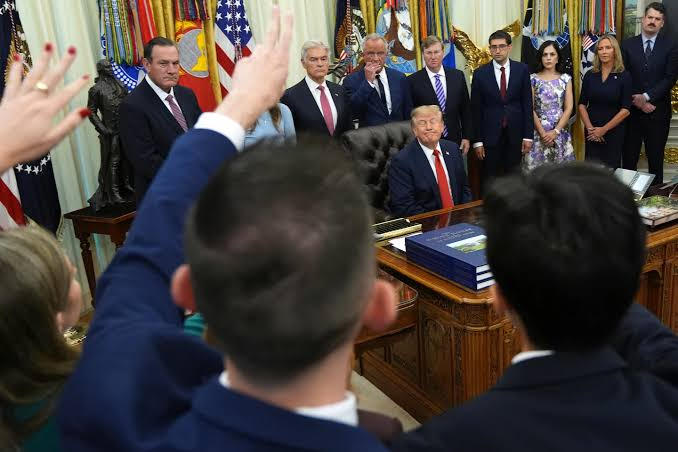
A federal judge has ordered the Trump administration to restore White House access for journalists from CNN, MS NOW and Politico, finding that the administration’s decision to exclude the outlets was likely unconstitutional. The September 24 ruling has placed due process and freedom of the press at the center of a major constitutional dispute, while renewing a longstanding legal principle that government officials cannot arbitrarily withdraw press credentials in response to unfavorable reporting.
Federal Court Challenges White House Media Restrictions
The ruling came after President Donald Trump announced on September 18 that CNN, MS NOW and Politico would be barred from the White House. The administration linked the decision to what Trump described as persistently negative or false coverage. Reporters from the affected organizations subsequently faced restrictions on entering the White House complex, with some press credentials confiscated.
On September 24, U.S. District Judge Timothy Kelly ordered the administration to restore the journalists’ access and temporarily blocked enforcement of the ban. The decision represents a significant development in the continuing legal dispute between the White House and news organizations over access to government officials and facilities.
The administration has argued that access to the White House grounds is not an unrestricted constitutional right and that officials retain authority to determine which journalists participate in certain forms of presidential coverage. The news organizations have argued that once journalists receive government issued credentials, removing those credentials because officials object to their reporting raises serious First Amendment and Fifth Amendment concerns.
We should distinguish the court’s immediate order from a final resolution of every constitutional question surrounding presidential control of press access. The latest ruling concerns the enforcement of the current ban while the broader legal dispute continues. Even so, the order draws heavily on established constitutional principles governing press credentials and procedural protections.
Why Due Process Matters for Journalists
Press passes may appear to be simple identification cards, but for a White House correspondent they can determine whether that journalist can perform a central part of the job. A credential can provide access to briefings, government officials, press areas and events that are difficult or impossible to cover from outside the building.
That practical importance has long influenced federal courts. In the landmark Sherrill v. Knight case, the D.C. Circuit Court of Appeals ruled in 1977 that journalists seeking White House press passes must receive meaningful procedural protections when access is denied. The court held that reporters must receive notice of the reasons for denial, an opportunity to respond and a final written explanation.
The reasoning behind that precedent reaches beyond one journalist or one administration. The court recognized that press credentials can implicate First Amendment interests because restricting a journalist’s access can interfere with the ability to practice journalism. The Fifth Amendment’s due process protections therefore become relevant when the government takes action that affects those interests.
Notice and an Opportunity to Respond
Due process does not necessarily mean that every journalist must be granted unrestricted access to every government location. Security requirements can exist, and government facilities can impose reasonable rules governing entry. The constitutional concern arises when officials remove access without clear standards or use the power selectively because they disagree with a journalist’s reporting or viewpoint.
The legal framework established by earlier cases generally requires the government to explain the basis for a significant press credential decision and provide an affected journalist with a meaningful opportunity to respond. Those safeguards are designed to prevent an access decision from becoming an arbitrary punishment for protected speech.
The First Amendment Issue at the Center of the Case
The dispute also raises a fundamental First Amendment question. Government officials routinely interact with journalists who criticize their policies, question their statements and publish investigations that may be politically uncomfortable. A democratic press does not depend on government approval of individual stories.
That does not create an unlimited right for every journalist to enter every government facility. Instead, courts examine whether access decisions are based on legitimate, viewpoint neutral reasons or whether the government is responding to the content of protected reporting.
Recent litigation involving White House access has repeatedly returned to this distinction. Courts have examined whether officials relied on published standards, whether journalists received adequate notice and whether the stated justification was connected to legitimate security or operational concerns rather than disagreement with coverage.
The current case therefore carries significance beyond the three organizations directly involved. A ruling that allows government officials to remove established press credentials simply because they dislike an outlet’s coverage could affect how journalists approach reporting on future administrations. Conversely, a legal framework that permits reasonable access restrictions while requiring procedural safeguards can preserve both government security and journalistic independence.
A Long History of Press Credential Disputes
The present controversy is not the first time a White House has faced constitutional challenges over press access. During President Trump’s first term, CNN correspondent Jim Acosta temporarily lost his White House hard pass following a contentious exchange at a presidential news conference. A federal judge ordered the credential temporarily restored after finding significant due process concerns.
Another dispute involving journalist Brian Karem produced an appellate ruling addressing similar procedural issues. The D.C. Circuit concluded that restrictions on a White House press credential could implicate Fifth Amendment protections when the government lacked adequate standards and procedures.
More recently, federal litigation involving the Pentagon has brought similar questions into focus. News organizations and press groups challenged restrictions that could have allowed officials to revoke credentials from journalists under broad security related standards. The dispute demonstrated that the constitutional questions surrounding government press access extend beyond the White House.
Reuters has reported that the Pentagon also faced litigation in 2026 after adopting restrictions on journalists and subsequently revising its media policy following a federal court ruling. These cases illustrate why press credential disputes are closely watched by journalists, constitutional lawyers and civil liberties organizations.
What the Ruling Means for News Organizations
For news organizations, the immediate consequence is practical. Journalists from CNN, MS NOW and Politico are entitled to restored White House access under the judge’s order while the legal proceedings continue.
The broader significance concerns the standards government agencies use when granting and withdrawing press credentials. Newsrooms depend on predictable access rules because reporters must be able to work without constantly calculating whether an unfavorable article could result in the loss of access.
Several principles remain particularly relevant:
- Government agencies can maintain legitimate security and operational requirements for press access.
- Press credential decisions can implicate First Amendment protections.
- Due process may require notice and an opportunity to respond before credentials are withdrawn.
- Restrictions based on disagreement with protected reporting can face serious constitutional scrutiny.
The Global Significance of the Constitutional Debate
Although the ruling concerns American constitutional law, its implications are being watched beyond the United States. Press credential systems exist in many countries, and journalists around the world regularly confront questions about government access, accreditation, censorship and retaliation.
The American First Amendment framework is distinctive, but the underlying issue is broadly recognizable. Independent journalism depends on the ability of reporters to investigate public officials without having their professional access conditioned on favorable coverage.
International organizations that monitor freedom of expression frequently examine whether journalists can operate without government interference. The United Nations has repeatedly recognized freedom of expression and access to information as important elements of open societies. Court decisions involving press credentials can therefore become part of wider discussions about media independence and government accountability.
What Happens Next in the White House Media Case
The September 24 order does not necessarily end the dispute. The administration can continue defending its position through the legal process, while the affected news organizations can continue arguing that the ban violated constitutional protections.
The courts will ultimately have to examine the specific reasons offered for the restrictions, the procedures used to withdraw the credentials and the extent to which the administration’s stated justification was connected to legitimate governmental interests. Those questions will help determine how existing First Amendment and due process principles apply to the current dispute.
For journalists arriving at the White House, the legal argument has a very concrete meaning. A press credential is not merely a plastic card carried through a security checkpoint. It can determine whether a reporter is inside the room where a presidential statement is made, whether a question can be asked directly and whether a news organization can independently document the actions of the government it covers.
The latest federal ruling places that practical reality alongside a longstanding constitutional principle: government access rules may serve legitimate security and operational needs, but those rules cannot simply become a mechanism for punishing journalists because officials object to what they report. As the case develops, the balance between executive authority, press freedom, due process and public accountability will remain at the heart of the constitutional debate.