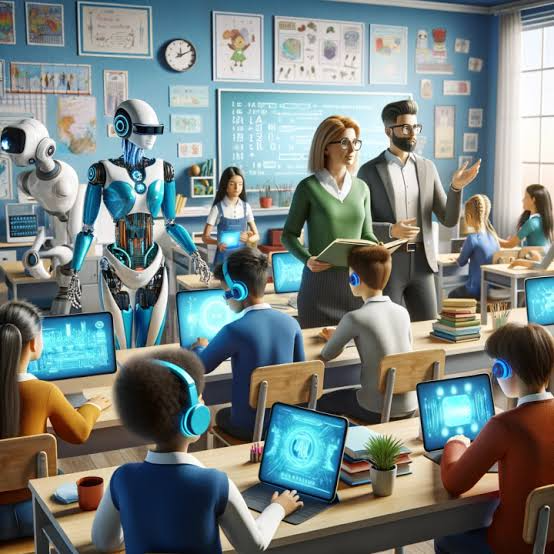
Artificial intelligence is moving beyond computer laboratories and technology departments to become an increasingly important part of mainstream education. On November 3, 2026, growing international attention is focused on the integration of generative AI literacy into high school and undergraduate curricula, as education policymakers, universities, and academic networks reconsider how students should prepare for a technology driven future. From learning how AI systems generate information to using intelligent tools in science, mathematics, engineering, and research, students are being encouraged to develop skills that extend far beyond traditional computer education.
This development represents a significant change in educational priorities. For generations, schools concentrated on teaching students how to use established technologies and apply scientific knowledge. Today, the challenge is different. Young people must learn how to work alongside intelligent systems, recognize their limitations, question their outputs, and make responsible decisions. We are seeing the beginnings of an educational approach in which artificial intelligence literacy is treated as a fundamental skill rather than an optional specialization.
International Education Policies Put AI Literacy on the Curriculum Agenda
International education organizations are increasingly calling for structured AI education across different stages of learning. Rather than limiting artificial intelligence to university engineering programs or specialist computer science courses, policymakers are exploring ways to introduce foundational concepts during secondary education and develop more advanced competencies at undergraduate level.
The Organisation for Economic Co operation and Development and the European Commission published their 2026 report, Empowering Learners for the Age of AI, on June 18. The report establishes an AI literacy framework for primary and secondary education, outlining the knowledge, skills, and attitudes students need to understand artificial intelligence, evaluate its outputs, and use it ethically and creatively.
The framework reflects an important change in educational thinking. Students should not simply learn which buttons to press or how to write effective prompts. They should understand how AI systems operate, why their responses can be inaccurate, and how automated decisions can affect individuals and communities.
UNESCO has also developed an AI Competency Framework for Students, identifying 12 competencies across four dimensions: a human centered mindset, AI ethics, AI techniques and applications, and AI system design. These competencies are organized around three levels of progression: understanding, applying, and creating. This approach provides educators with a foundation for introducing AI knowledge into official school curricula.
These international frameworks offer a clearer direction for governments and academic institutions seeking to prepare students for the growing influence of artificial intelligence in employment, research, communication, and public life.
Generative AI Is Becoming Part of Everyday Classroom Learning
Generative AI tools can produce explanations, summarize complicated material, generate practice questions, assist with writing, and provide guidance on mathematical problems. Their accessibility has changed how students approach assignments and independent study.
A student struggling with a difficult physics concept can request a simpler explanation. Another student learning programming can ask an AI assistant to identify an error in a piece of code. Someone preparing for an examination can use intelligent tools to generate practice questions and receive explanations of incorrect answers.
However, the growing availability of these tools has created an important educational question: are students actually learning, or are they simply becoming better at completing assignments with automated assistance?
The OECD addressed this concern in its January 19, 2026 publication, OECD Digital Education Outlook 2026. The report explains that generative AI can support meaningful learning when guided by sound teaching principles. However, completing an assignment successfully with AI assistance does not automatically demonstrate that a student has developed the underlying knowledge or skills.
This distinction is becoming central to curriculum planning. Schools are being encouraged to teach students when AI assistance is appropriate, when independent thinking is necessary, and how to evaluate information rather than accepting generated answers without examination.
STEM Education Gains a New Artificial Intelligence Dimension
Science, technology, engineering, and mathematics are among the academic fields most directly affected by the integration of artificial intelligence. These subjects already depend on problem solving, experimentation, logical reasoning, and the interpretation of complex information. AI tools can introduce new opportunities for students to explore these concepts through practical exercises and interactive learning.
Artificial Intelligence in Science Education
Science students can use AI supported educational tools to explore scientific processes, examine datasets, develop research questions, and understand complicated theories. In biology, students may investigate how computational systems help researchers analyze biological information. In chemistry, AI assisted simulations can help explain molecular structures and chemical interactions.
These applications can make abstract concepts easier to explore, particularly when students have limited access to advanced laboratory equipment. However, simulated results must not be confused with actual experimental evidence. Teachers remain responsible for explaining scientific methods, validating conclusions, and helping students distinguish between reliable findings and generated information.
AI and Mathematics Learning
Mathematics education can also benefit from carefully designed AI learning activities. Intelligent tutoring systems can explain mathematical procedures, provide additional exercises, and help identify areas where students need more practice.
Instead of immediately displaying an answer, well designed educational systems can guide students through individual steps. This encourages learners to understand why a mathematical method works rather than memorizing a final result.
Programming and Engineering Become More Interactive
Computer science students are encountering AI assistants that can explain programming concepts, review code, identify potential errors, and suggest improvements. Engineering students can explore applications involving robotics, simulations, automation, and intelligent systems.
These capabilities can make practical learning more accessible, but they also create a need for stronger foundational knowledge. Students must understand the code, mathematical principles, and engineering decisions behind an AI generated solution. Without that understanding, they may struggle to identify errors or explain why a particular system behaves in an unexpected way.
Universities Introduce AI Literacy Across Undergraduate Programs
Higher education institutions are also reconsidering how artificial intelligence should fit into undergraduate education. Previously, students could complete degrees in business, medicine, law, engineering, or social sciences without receiving formal instruction about AI systems. That approach is becoming increasingly difficult to maintain as intelligent technologies influence professional research, workplace decisions, and industry practices.
The OECD published its policy paper, Policies Supporting Responsible and Systematic GenAI Adoption in Higher Education, on July 17, 2026. The publication examines how governments and universities are responding to generative AI through institutional guidance, common procurement standards, competency development, research evaluations, and specialized educational tools.
This approach suggests that AI literacy should not be restricted to students pursuing technology careers. Business students need to understand automated analysis and decision making. Medical students should learn how AI assisted systems support clinical research while recognizing that professional judgment remains essential. Law students need to examine questions involving privacy, accountability, intellectual property, and automated decisions.
For undergraduate students, the objective is to develop enough technical understanding to use AI appropriately within their chosen professions. Universities are therefore being encouraged to consider AI related learning outcomes across different academic departments rather than treating the subject as an isolated computer science requirement.
Teachers Must Prepare for a Different Kind of Classroom
Curriculum integration cannot succeed through technology purchases alone. Teachers are central to the process because they determine how educational tools are introduced, how students interact with information, and how academic progress is evaluated.
Many educators are already experimenting with generative AI for lesson preparation, personalized explanations, assessment development, and classroom activities. However, teachers also need training to identify inaccurate AI responses, protect student information, and select tools that support educational objectives.
The OECD Digital Education Outlook 2026 reported that 37 percent of lower secondary teachers used AI for their professional work in 2024. It also found that 72 percent of lower secondary teachers believed AI could harm academic integrity by allowing students to present generated work as their own.
These findings illustrate why teacher preparation must accompany curriculum changes. An educator who understands both the capabilities and limitations of AI can guide students more effectively than one who simply introduces a chatbot and expects independent learning to follow.
Professional development programs, practical workshops, subject specific training, and shared teaching resources can help educators develop confidence. Schools should also give teachers opportunities to exchange experiences and evaluate which approaches genuinely improve student understanding.
Academic Integrity, Privacy, and Responsible AI Use Remain Major Concerns
As AI tools become more common in education, institutions must establish clear rules governing their use. Students need to understand the difference between using an AI assistant to explore an unfamiliar concept and submitting automatically generated work as an entirely independent assignment.
Academic honesty policies should explain when AI assistance is permitted, how its contribution should be acknowledged, and which tasks must demonstrate independent student understanding. These expectations should be communicated consistently across subjects so that learners are not left guessing about acceptable practices.
Data privacy presents another important challenge. Some AI platforms collect information entered by users, including personal details, uploaded documents, and academic work. Schools and universities must carefully assess these practices before recommending particular services to students.
Responsible AI education should therefore cover several essential areas:
- Information accuracy: Students should verify generated explanations and compare important claims with reliable academic materials.
- Data protection: Learners should avoid entering sensitive personal or institutional information into unapproved AI platforms.
- Academic honesty: Students should disclose AI assistance when institutional policies require it.
- Bias and fairness: Learners should recognize that automated systems can reproduce inaccurate assumptions and unfair patterns.
- Human responsibility: Important decisions should involve appropriate human judgment rather than unquestioned reliance on automated recommendations.
UNESCO has also placed these concerns at the center of its 2026 global consultation on education in the age of AI. The initiative brings together academics, government officials, and other stakeholders to examine educational governance, learner safety, digital sovereignty, and the public responsibilities associated with artificial intelligence.
Global Access to AI Education Could Determine Who Benefits
One of the biggest challenges facing international curriculum integration is educational inequality. Students attending well funded universities may have access to advanced computers, reliable internet connections, specialized software, and experienced instructors. Learners in rural communities and underfunded schools may not have the same opportunities.
This difference could create a new educational divide between students who receive practical AI training and those who encounter the technology without structured guidance. A curriculum that assumes every student owns a modern device or has uninterrupted internet access risks excluding the very communities that could benefit from additional educational support.
Governments and education institutions should consider affordable learning platforms, accessible classroom devices, offline educational materials, and teacher training programs when introducing AI related subjects. Public investment will be particularly important in regions where schools face infrastructure limitations.
Educational institutions must also consider language accessibility. Many AI tools perform better in widely represented languages, leaving students who learn primarily in less widely supported languages with fewer reliable resources. Developing multilingual educational materials and evaluating AI performance across different languages can help make these programs more inclusive.
What Students Should Learn as AI Becomes Part of Standard Education
For students preparing to enter higher education or the professional workforce, the growing focus on AI literacy creates a practical opportunity to develop valuable skills. Formal curriculum changes may take time, but learners can begin building their understanding through existing subjects and responsible independent practice.
Students should focus on understanding basic AI concepts, evaluating generated information, developing effective research habits, and applying technology to genuine problems. They should also continue strengthening mathematics, communication, writing, scientific reasoning, and independent problem solving.
These foundational abilities remain essential because AI tools are only useful when people can evaluate their results. A student who understands a scientific concept can recognize when an automated explanation is misleading. A programmer with strong fundamentals can identify errors in generated code. A researcher with sound analytical skills can distinguish useful findings from unsupported claims.
We should view artificial intelligence as an additional learning resource rather than a replacement for the intellectual effort that education is designed to develop.
The Future of Education Will Depend on Balancing Technology With Human Judgment
The growing integration of artificial intelligence into high school and undergraduate education signals a broader reconsideration of what students need to know before entering professional life. AI literacy is becoming relevant across academic disciplines, while STEM education is gaining new opportunities for practical experimentation, computational learning, and interdisciplinary research.
Nevertheless, successful implementation will require more than adding AI applications to existing classrooms. Governments must establish responsible policies, universities must develop meaningful academic standards, and schools must provide teachers with the training and resources needed to support students.
Education should continue to develop curiosity, creativity, independent reasoning, communication, and ethical responsibility. These qualities cannot be reduced to the ability to operate an AI application. They are the foundations that allow individuals to use advanced technology thoughtfully and contribute meaningfully to society.
The November 3, 2026 education discussion reflects an important direction for schools and universities worldwide. Artificial intelligence is increasingly becoming part of what students need to understand, not simply something they will encounter after graduation. The challenge ahead is to ensure that every learner has the opportunity to participate in this shift while preserving the human judgment, critical thinking, and genuine understanding that make education valuable.