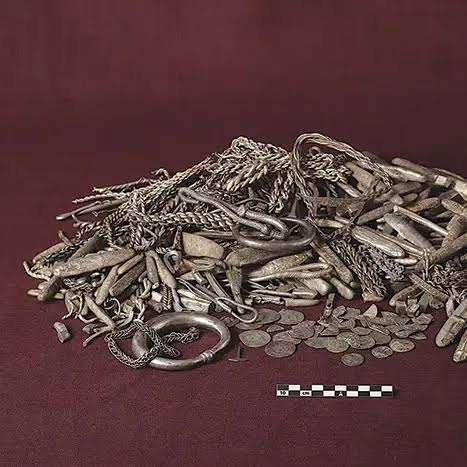
A routine home improvement project in northern Denmark has uncovered an extraordinary archaeological discovery, revealing approximately 18.5 kilograms of Viking Age silver buried beneath a private garden for more than a thousand years. The homeowner was preparing the backyard for a new tiled patio when an unexpected metallic sound led to the discovery of hundreds of ancient objects, including silver bars, bracelets, coins, and a miniature hammer associated with the Norse god Thor. The remarkable find, announced by North Jutland Museums on August 31, 2026, has been recognized as the largest known Viking Age silver hoard discovered in Denmark.
Located in the municipality of Rebild, the treasure contains approximately 700 objects and fragments believed to have been buried during the 10th century. Archaeologists say the collection offers valuable evidence of how silver functioned as wealth, currency, and a means of exchange during the Viking Age. Beyond its impressive size, the discovery provides an unusual opportunity to examine the commercial relationships and economic practices that connected Scandinavia with distant parts of the world.
A Backyard Renovation Turns Into an Extraordinary Archaeological Discovery
The discovery happened while a homeowner was clearing stubborn grass, stones, and gravel to prepare the ground for a new outdoor terrace. What initially appeared to be an ordinary gardening task quickly became an experience that would attract international archaeological attention.
After approximately half an hour of digging, the homeowner’s garden fork struck something that produced an unusual sound. At first, the individual suspected that the object might be old iron, fencing material, or fragments of pottery. However, closer examination revealed several metallic objects hidden beneath the soil.
As the homeowner carefully removed more earth by hand, additional pieces began appearing. What seemed like an isolated metal object gradually revealed itself as a collection of jewellery, coins, and silver bars.
The homeowner, who has chosen to remain anonymous, described the discovery as the biggest surprise of their life. A project intended to improve an ordinary backyard had unexpectedly exposed an important part of Denmark’s Viking history.
Recognizing the potential historical importance of the objects, the finder contacted archaeological experts. Specialists from North Jutland Museums subsequently became involved in documenting and investigating the discovery.
What Was Found Inside the Ancient Viking Treasure?
The recovered hoard contains approximately 700 silver objects and fragments, with a combined weight of around 18.5 kilograms. Archaeologists have identified several different categories of artifacts, suggesting that the collection represented a substantial store of wealth rather than a random assortment of valuable possessions.
Among the most significant discoveries are numerous silver ingots, bracelets, complete coins, coin fragments, and pieces of jewellery that had been deliberately cut into smaller sections.
One particularly interesting object is a small hammer associated with Thor, the Norse god of thunder. Such objects are commonly connected with Viking religious beliefs and provide insight into the cultural traditions of the people who lived in Scandinavia during this period.
The collection also includes approximately 47 complete coins and fragments. These coins are especially valuable to researchers because their origins and designs can help establish historical connections between Viking communities and other civilizations.
More than 320 objects remained inside an ancient clay vessel
One of the most remarkable aspects of the discovery is the condition in which part of the treasure was preserved. Approximately 320 objects, weighing a combined 6.4 kilograms, were still inside their original clay vessel when the collection was uncovered.
The remaining objects were scattered throughout the surrounding soil. This distribution suggests that the original container had deteriorated or broken over the centuries, allowing some of its contents to spread into the nearby ground.
The clay vessel provides important archaeological context because it helps researchers understand how the treasure was originally stored. Rather than placing individual objects randomly into the earth, someone had gathered a considerable quantity of silver and placed it inside a container before burying it.
Why Archaeologists Believe the Treasure Dates Back to the 10th Century
Dating an archaeological discovery requires more than examining its physical appearance. Researchers often study coins, inscriptions, manufacturing techniques, and the historical characteristics of individual objects to establish when a collection was created or buried.
In the Rebild discovery, several coins provide particularly useful chronological evidence. Among the recovered pieces are two Anglo Saxon silver pennies associated with Edward the Elder, who ruled parts of England from 899 to 924.
Because these coins could only have entered circulation during or after his reign, they provide an important clue about the earliest possible burial date of the collection. Archaeologists therefore place the treasure within the 10th century.
The discovery also includes Arabic silver coins, commonly known as dirhams. Their presence demonstrates that the silver collection contained objects originating from different economic and geographical networks.
These findings help researchers reconstruct the movement of valuable goods during the Viking Age, when merchants and traders maintained connections extending across Europe and into regions influenced by the Islamic world.
Viking Silver Was More Than Jewellery and Decorative Wealth
One of the most important lessons from the discovery concerns the economic role of silver in Viking society. Modern audiences often associate ancient treasure with beautiful jewellery, royal possessions, and ceremonial objects. However, silver also served a practical purpose as a means of payment and a store of wealth.
Unlike modern monetary systems, Viking Age commerce frequently relied on the weight and quality of precious metals. Silver could be exchanged according to its weight rather than requiring every transaction to involve a standardized coin.
Merchants could use silver bars, bracelets, and other valuable objects to complete transactions. When a smaller payment was necessary, pieces could be cut from larger objects. Archaeologists refer to this practice as hacksilver.
The Rebild hoard contains several examples of this practice, including fragments of silver jewellery and other objects that appear to have been deliberately divided into smaller pieces.
Researchers have also observed that many objects can be grouped according to particular weight categories. This organization suggests that the silver was carefully collected and arranged according to its economic value.
Torben Sarauw, archaeologist and head of cultural heritage at North Jutland Museums, has described the discovery as comparable to finding a Viking Age safe. The collection provides unusually clear evidence of how silver could function as both accumulated wealth and a practical payment system.
Ancient Coins Reveal Viking Connections With Europe and the Islamic World
The geographical origins of the coins offer another important dimension to the discovery. The presence of Anglo Saxon pennies and Arabic dirhams demonstrates that Viking communities were connected to trading networks extending far beyond modern Denmark.
During the Viking Age, Scandinavian merchants participated in commercial exchanges involving different regions, cultures, and political territories. Goods, precious metals, and other valuable materials moved through extensive trading routes connecting northern Europe with western Europe and territories farther east.
The coins discovered in Rebild provide physical evidence of these relationships. Anglo Saxon currency points toward connections with England, while Islamic silver coins demonstrate links with the wider eastern trading world.
These connections challenge the simplified image of Viking society as consisting primarily of isolated settlements and maritime raids. Archaeological evidence increasingly demonstrates that trade, craftsmanship, travel, and international exchange were important parts of Viking economic life.
The Rebild treasure is particularly valuable because its different objects bring these connections together in one archaeological collection. Researchers can study the materials and coin origins to develop a better understanding of how wealth circulated throughout the Viking world.
A Mysterious Runic Inscription Adds Another Layer to the Discovery
One of the silver bars contains a runic inscription that has attracted additional archaeological interest. Researchers believe the markings may read “hutu,” although the precise interpretation remains uncertain.
Runes were used by Scandinavian communities during the Viking Age for writing names, messages, ownership marks, and other forms of communication. An inscription on a silver object can therefore provide information that goes beyond its material value.
Researchers have suggested that the inscription could represent a personal name or an ownership mark. However, without a definitive interpretation, it would be premature to assign a specific identity or meaning to the markings.
Further examination may help specialists understand the inscription’s structure and determine whether it provides clues about the person who originally possessed the silver.
Why the Rebild Discovery Is a Historic Record for Denmark
The size of the collection makes it particularly significant within Danish archaeology. Before this discovery, the Terslev hoard was recognized as the country’s largest known Viking Age silver treasure, weighing approximately 6.5 kilograms.
The newly discovered Rebild collection weighs approximately 18.5 kilograms, making it nearly three times larger than the previous record.
This difference is not simply a matter of quantity. A larger collection containing coins, ingots, jewellery, and cut silver provides researchers with more material for studying economic practices, trade relationships, and the circulation of wealth.
The discovery also adds to a growing body of archaeological evidence from northern Jutland. The Rebild region has produced other important Viking Age discoveries, including a silver hoard found in 1971 containing approximately four kilograms of silver objects.
Six Viking gold arm rings were also discovered in the nearby Rold area in April 2026. Together, these discoveries suggest that northern Jutland may have played a more important economic and political role during the Viking Age than researchers previously understood.
Who Owns the Treasure Under Danish Law?
Although the treasure was discovered on private residential property, the homeowner does not automatically become its legal owner. Denmark has specific heritage protection legislation covering valuable archaeological objects discovered within the country.
Under the country’s treasure trove rules, known as Danefæ, qualifying archaeological objects made from precious materials or possessing exceptional cultural and historical importance belong to the Danish state when no private ownership can be established.
The finder is required to submit qualifying objects to the National Museum of Denmark. However, the law also provides for a financial reward determined by the museum.
The reward takes several factors into consideration, including the material value of the objects, their rarity, and the care taken by the finder when handling and preserving the discovery.
This legal framework encourages members of the public to report archaeological discoveries rather than keeping potentially important historical objects privately or selling them without proper assessment.
Readers interested in the country’s archaeological heritage regulations can explore the National Museum of Denmark’s official treasure trove guidelines for information about reporting discoveries, state ownership, and finder rewards.
What Happens to the Viking Treasure Next?
Following its discovery, the collection entered the archaeological assessment process. Specialists must carefully document, examine, and preserve the objects before their full historical significance can be established.
Each artifact can provide different information. Coins may reveal the geographical origins of the silver, while inscriptions can offer clues about ownership or communication. Differences in weight, manufacturing techniques, and object design can also help researchers understand how the collection was assembled.
Preservation is equally important. Ancient silver objects can be vulnerable to damage when exposed to air, moisture, and changes in their surrounding environment. Professional conservation allows museums to protect the material while making it available for future research and public education.
The possibility of displaying selected objects in museum exhibitions would also give visitors an opportunity to experience the discovery beyond photographs and archaeological descriptions. Seeing the original coins, silver bars, and jewellery together could help audiences appreciate the scale of Viking wealth and craftsmanship.
A Thousand Year Old Mystery Beneath an Ordinary Garden
Despite the remarkable quantity of silver, one central question remains unanswered: why was the treasure buried in the first place?
Archaeologists have suggested several possibilities. The owner may have hidden the collection during a period of political instability, conflict, or economic uncertainty. It could also have been stored near an important settlement or trading route for safekeeping.
During the Viking Age, burying valuable possessions was one way to protect wealth. However, the original owner may have died, been displaced, or simply lost the opportunity to retrieve the collection.
The exact circumstances may never be established. The modern development of the surrounding property also makes extensive archaeological investigation of the original location difficult.
What remains is an extraordinary collection of evidence from a society that existed more than a thousand years ago. Its coins, jewellery, silver bars, and religious symbols offer researchers a rare opportunity to examine how Viking communities accumulated wealth and interacted with the wider world.
The Rebild discovery began with a homeowner preparing a backyard for a new patio. It ended with the recovery of Denmark’s largest known Viking Age silver hoard, a collection that has already changed the archaeological understanding of northern Jutland. More than a remarkable renovation surprise, the treasure is a valuable historical record of trade, economic life, and human activity during one of Scandinavia’s most fascinating periods.
Further information about the discovery and its archaeological significance is available through North Jutland Museums, the institution responsible for announcing the historic find.