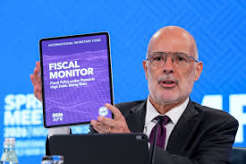
The global economy is showing more resilience than many feared, but the latest outlook from the International Monetary Fund carries a clear warning: steady growth does not mean the risks have disappeared. The IMF continues to project global economic growth of about 3% in 2026, even as energy markets remain volatile, geopolitical tensions continue across the Middle East, public debt reaches historically high levels, and progress against inflation has stalled. For households, businesses, investors, and governments, the message is both reassuring and sobering. The world economy is moving forward, but it is doing so on increasingly narrow ground.
Global Growth Holds Near 3% Despite Major Economic Shocks
The IMF’s latest assessment points to global growth of approximately 3% in 2026, with the outlook supported by stronger activity in several major economies and continued investment in technology and energy infrastructure. The projection remains broadly consistent with the IMF’s July World Economic Outlook Update, which placed global growth at 3% for 2026 and 3.4% for 2027.
That resilience deserves attention because the global economy is operating under unusually difficult conditions. Energy supply disruptions, geopolitical uncertainty, elevated borrowing costs, trade tensions, and uneven inflation trends have all created obstacles for economic expansion. Yet economic activity has not fallen into the broad slowdown that some earlier scenarios had feared.
We should not mistake that resilience for comfort. A 3% global growth rate is not equally distributed. Countries that import large quantities of oil and gas face a very different environment from nations that produce energy or benefit from strong technology investment. Emerging markets with limited fiscal room can also feel pressure much sooner when fuel prices rise or international financing becomes more expensive.
The IMF has described the global outlook as uneven, with energy importers and vulnerable economies facing greater pressure while countries connected to the technology investment cycle receive stronger support. The organization’s global economic research and World Economic Outlook resources provide a broader view of these differences.
Energy Volatility Remains a Major Threat to Economic Stability
Energy remains one of the most immediate sources of uncertainty. Oil and gas prices can move quickly when geopolitical tensions affect production, transportation, or shipping routes. For families, the consequences can appear first at the fuel station, then in electricity bills, transportation costs, food prices, and household budgets.
For businesses, the pressure can be even broader. Manufacturers must account for energy used in production, while transportation companies face higher operating costs when fuel prices rise. Retailers can eventually pass some of those expenses to consumers, creating another source of inflationary pressure.
The Middle East remains central to this risk because disruptions in major energy routes can influence markets far beyond the countries directly involved in a conflict. The IMF has warned that continued energy disruptions could increase inflation, tighten financial conditions, weaken consumer purchasing power, and reduce economic activity.
There is, however, a degree of resilience that was less visible during earlier energy shocks. Many economies have expanded renewable energy capacity, improved energy efficiency, diversified suppliers, and strengthened strategic reserves. These changes do not eliminate exposure to energy volatility, but they can reduce the size of the shock.
Inflation Is No Longer Falling as Quickly
The most concerning part of the IMF assessment may be the stalled disinflation process. Inflation had been gradually declining across much of the global economy after reaching extremely high levels earlier in the decade. That progress has now slowed, leaving central banks with a difficult policy problem.
Energy prices are particularly challenging because monetary policy cannot directly increase global oil production or reopen disrupted shipping routes. A central bank can raise interest rates to reduce domestic demand, but doing so cannot directly control the price of crude oil or natural gas.
This creates a delicate balance. If policymakers respond too aggressively to temporary energy price increases, they risk weakening employment and economic growth. If they respond too slowly while higher prices become embedded in wages and expectations, inflation can become more persistent.
The IMF has therefore continued to stress the importance of keeping inflation expectations anchored. Central banks need to remain focused on price stability while carefully assessing whether energy related price increases are temporary or becoming part of a broader inflation cycle.
Public Debt Has Become a Global Economic Vulnerability
Alongside energy and inflation concerns sits another problem that is less visible to ordinary consumers but potentially more consequential over time: public debt. The IMF has warned that worldwide public debt is approaching 100% of global GDP and is expected to rise further.
High debt levels reduce the room governments have to respond when the next crisis arrives. During a major emergency, governments can borrow and spend to protect households, support businesses, or stabilize financial markets. But when debt is already elevated, additional borrowing can become more expensive and politically difficult.
The challenge becomes particularly serious when interest rates remain high. Governments must devote more of their budgets to servicing existing obligations, leaving fewer resources available for infrastructure, education, health services, energy security, and targeted support for vulnerable communities.
The IMF has urged governments to rebuild fiscal space and develop credible medium term plans for managing public finances. That does not necessarily mean sudden spending cuts. A more sustainable approach can involve improving tax systems, reducing inefficient spending, strengthening economic growth, and creating clearer priorities for public investment.
Why the 3% Growth Forecast Does Not Tell the Whole Story
A single global GDP number can hide enormous differences between countries. A 3% expansion may appear reassuring on a headline economic chart, yet the experience of a manufacturing worker in an energy importing country can be very different from that of a technology worker in an economy benefiting from strong investment.
For consumers, the most meaningful indicators may be real wages, food prices, housing costs, employment opportunities, borrowing rates, and household purchasing power. Businesses are watching demand, financing costs, energy expenses, currency movements, and supply chain conditions.
Investors, meanwhile, are assessing whether economic growth can remain strong enough to support corporate earnings without reigniting inflation. They must also consider whether high public debt and elevated bond yields could eventually place additional pressure on financial markets.
Technology Investment Is Supporting Parts of the Global Economy
One of the strongest forces supporting growth is continued investment in artificial intelligence, computing infrastructure, data centers, semiconductors, electricity generation, and related technologies. The IMF has pointed to technology driven investment as an important source of momentum for some economies.
This creates another unusual feature of the current global outlook. The same period that is marked by geopolitical instability and energy uncertainty is also witnessing enormous private investment in technology. Countries positioned within global technology supply chains can benefit from increased demand for advanced computing equipment, electronics, power infrastructure, and digital services.
Yet this opportunity also carries risks. Expectations surrounding artificial intelligence have become deeply connected to financial markets. If investors conclude that expected productivity gains will take longer to materialize, technology valuations could come under pressure. A sharp market correction could then affect investment and confidence beyond the technology sector.
What Policymakers Need to Watch Through 2026
For governments and central banks, the coming months will require careful decisions rather than a single broad policy response. The economic environment is too uneven for one solution to work everywhere.
- Central banks need to monitor inflation expectations as closely as headline inflation.
- Governments need credible plans to stabilize public debt without unnecessarily weakening economic activity.
- Energy importing countries need stronger supply diversification and greater protection for vulnerable households.
- Policymakers should continue structural reforms that improve productivity and reduce barriers to investment.
International cooperation will also matter. Energy markets, trade networks, financial flows, and supply chains cross national borders, meaning that economic shocks rarely remain contained within one country. Cooperation can help countries manage debt pressures, reduce spillovers, and strengthen resilience when another disruption arrives.
What the IMF Outlook Means for Households and Businesses
For ordinary households, the IMF’s 3% growth projection should not be interpreted as a promise that living costs will immediately become easier. Growth can continue while food, energy, housing, and borrowing costs remain uncomfortable. The stalled decline in inflation is particularly relevant for families that have already seen their purchasing power weakened by years of price increases.
Businesses face a similarly mixed picture. Continued global growth means demand has not disappeared, but energy volatility and financing costs can squeeze margins. Companies with strong balance sheets and efficient operations may be better positioned to manage uncertainty, while smaller firms with limited access to credit can be more exposed to sudden cost increases.
For consumers and businesses alike, financial planning remains especially valuable in this environment. Maintaining reasonable cash reserves, limiting unnecessary debt exposure, monitoring energy costs, and avoiding decisions based solely on short term market movements can provide greater stability when economic conditions change quickly.
A Resilient Economy Still Needs Room to Absorb the Next Shock
The IMF’s message is ultimately more nuanced than a simple growth forecast. The global economy has absorbed significant shocks and continues to expand, which is encouraging. But resilience should not become an excuse for complacency.
High public debt limits fiscal flexibility. Energy volatility can quickly revive inflation. Stalled disinflation complicates interest rate decisions. Geopolitical tensions can disrupt trade and commodity markets. Rapid technology investment can support growth while also creating new financial risks.
We should therefore view the 3% global GDP forecast as evidence that the world economy still has substantial capacity to adapt, rather than evidence that the major risks have passed. The IMF’s World Economic Outlook analysis shows why the quality and distribution of growth matter just as much as the headline number.
The next stage of the global economy will depend on whether policymakers can use this period of continued growth to rebuild financial buffers, restore progress on inflation, improve energy security, and place public finances on a more sustainable path. If they can, the current resilience may become a foundation for stronger and more balanced growth. If they cannot, another energy shock or financial disruption could expose vulnerabilities that today’s 3% growth rate is temporarily masking.