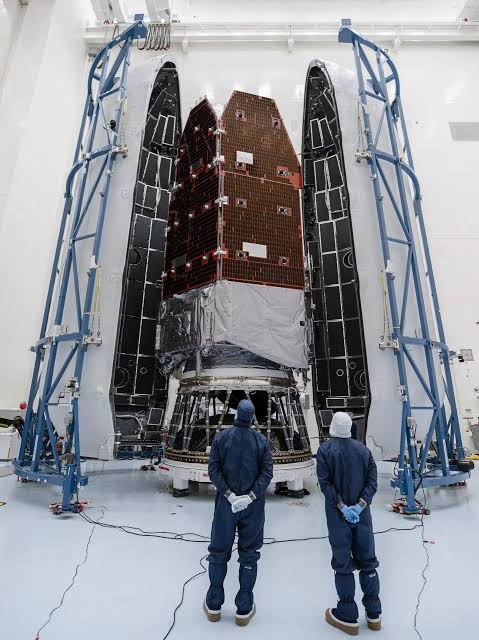
NASA’s Nancy Grace Roman Space Telescope successfully launched into space Sunday aboard a SpaceX Falcon Heavy, beginning a mission that could reshape our understanding of the universe. The observatory lifted off at 7:26 a.m. EDT from Launch Complex 39A at NASA’s Kennedy Space Center in Florida and later separated from the rocket’s second stage, putting Roman on its own path toward an orbit roughly one million miles from Earth. :contentReference[oaicite:0]{index=0}
A New Observatory Begins Its Journey Into the Deep Universe
The launch marks the beginning of a three month journey for Roman, NASA’s next generation space telescope designed to investigate some of astronomy’s most difficult questions. The spacecraft will travel toward the second Sun Earth Lagrange point, known as L2, where it will operate in a carefully selected region of space that allows the observatory to maintain a stable observing environment while looking deep into the cosmos. :contentReference[oaicite:1]{index=1}
For scientists who have spent years preparing the mission, the moment is more than another successful rocket launch. Roman represents a new way of surveying the universe. Instead of concentrating on relatively small portions of the sky, the telescope is designed to capture enormous areas with sharp infrared vision, allowing researchers to build large scale maps of galaxies, investigate the distribution of matter and search for planets beyond our solar system.
NASA describes Roman as a flagship observatory capable of studying dark energy, dark matter, exoplanets, black holes and the evolution of galaxies. Its wide field of view is at least 100 times larger than that of the Hubble Space Telescope, giving astronomers the ability to survey huge regions of space much more rapidly. :contentReference[oaicite:2]{index=2}
Falcon Heavy Provides a Powerful Start
The spacecraft was carried by SpaceX’s Falcon Heavy, one of the most powerful rockets currently used for orbital missions. During the opening moments of the flight, its 27 Merlin engines generated more than five million pounds of thrust as the vehicle climbed away from Florida. The rocket consists of a central core and two side boosters, with a second stage carrying the Roman observatory. :contentReference[oaicite:3]{index=3}
The ascent quickly moved through one of the most demanding portions of any rocket flight. Falcon Heavy passed Max Q, the point during which aerodynamic pressure places its greatest mechanical stress on the vehicle. Side booster separation followed as the rocket continued carrying Roman toward space. :contentReference[oaicite:4]{index=4}
For people watching from the ground, the launch may have lasted only minutes, but the precision required was extraordinary. Every stage of the ascent had to work correctly before the telescope could begin its own journey.
Roman Is Now Flying on Its Own
At 7:58 a.m. EDT, Roman separated from Falcon Heavy’s second stage and began flying independently. The observatory had already established communications with NASA through a Tracking and Data Relay Satellite, allowing mission controllers to begin monitoring its condition as it headed toward L2. :contentReference[oaicite:5]{index=5}
The spacecraft will now go through a series of deployments and checks. Among the early tasks is deployment of its solar array sun shield. The system provides power while also helping protect the observatory from heat, an essential requirement for a telescope that must maintain carefully controlled conditions while making sensitive infrared observations.
Mission teams will spend the coming months preparing Roman for scientific operations. The spacecraft has a planned primary mission duration of five years, with a goal of operating for as long as 10 years if its systems remain healthy. :contentReference[oaicite:6]{index=6}
Why Dark Energy Is One of Roman’s Biggest Targets
One of Roman’s most important scientific goals is investigating dark energy, the mysterious phenomenon associated with the accelerating expansion of the universe.
Astronomers know that the universe has been expanding for billions of years. They also know that this expansion has been accelerating, but the physical explanation remains one of the largest unanswered questions in modern cosmology.
Roman will examine this problem by studying enormous populations of galaxies and measuring how the universe has changed across cosmic history. By mapping structures at different distances, researchers can investigate how matter has gathered over time and how cosmic expansion has influenced that process.
The value of the mission comes partly from its scale. Scientists need vast quantities of observations to distinguish between competing explanations for cosmic acceleration. Roman is designed to provide that statistical power by surveying huge sections of the sky.
Dark Matter Is Another Piece of the Puzzle
Dark matter is different from dark energy, although the two mysteries are often mentioned together. Dark matter does not appear to emit or reflect light in the way ordinary matter does, but astronomers can infer its presence through its gravitational effects.
By mapping galaxies and the distribution of matter across the universe, Roman will help scientists study how dark matter shapes cosmic structures. Those observations could provide important clues about the fundamental composition of the universe.
The mission therefore addresses two enormous questions at once: what is driving cosmic expansion, and what invisible matter is helping shape the galaxies and structures we can see?
Roman Will Search for Thousands of Exoplanets
The telescope will also play an important role in the search for planets beyond our solar system. NASA expects Roman to discover and study large numbers of exoplanets through its wide field observations and specialized survey techniques.
The mission will use methods including gravitational microlensing, in which the gravity of a star and its planets can temporarily magnify light from a more distant star. Tiny changes in that light can reveal the presence of planets that are otherwise extremely difficult to detect.
That approach is especially useful for finding planets farther from their stars than many of the worlds discovered by other missions. Scientists will be able to build a broader picture of the types of planetary systems that exist throughout the Milky Way.
NASA has said Roman will help discover and characterize planets outside our solar system while providing a large volume of additional scientific information. :contentReference[oaicite:7]{index=7}
The Mission Could Reveal More Than Scientists Originally Expected
One of the most exciting aspects of Roman is that its discoveries will not be limited to the questions that scientists already know how to ask. Large astronomical surveys frequently produce unexpected findings because they examine enormous numbers of objects.
Roman will map billions of galaxies and study objects ranging from planets in our own solar system to distant galaxies near the limits of the observable universe. Its observations could therefore reveal unusual stars, previously unknown planetary systems, distant black holes or other phenomena that scientists have not yet predicted.
NASA expects Roman to generate enormous quantities of data for astronomers to analyze. Its technical specifications indicate a science data volume of roughly 11 terabits per day, demonstrating the extraordinary scale of the mission. :contentReference[oaicite:8]{index=8}
A Telescope Designed for Speed and Scale
Hubble changed astronomy by providing exceptionally sharp observations, while the James Webb Space Telescope has opened a powerful window into infrared astronomy and the early universe. Roman adds another capability by combining detailed infrared imaging with an exceptionally wide field of view.
That difference is crucial. A telescope can produce beautiful images of a small region of space, but answering some cosmological questions requires observing enormous numbers of galaxies and stars.
Roman is designed for that kind of work. Rather than spending all of its observing time on individual targets, it can sweep across large areas and create extensive datasets that scientists can use for statistical studies.
The result could be less about one spectacular photograph and more about an enormous astronomical map that allows researchers to examine the universe at a scale that was previously difficult to achieve.
Roman’s Coronagraph Will Test New Exoplanet Technology
The mission also carries technology designed to demonstrate advanced methods for studying planets around other stars. Roman’s Coronagraph Instrument will suppress the overwhelming light from a star so that scientists can investigate much fainter objects nearby.
This is an important technological step because directly studying exoplanets is extremely difficult. A planet can be billions of times fainter than the star it orbits, making it comparable to trying to see a tiny candle beside an extremely bright searchlight.
The coronagraph is therefore not simply another camera. It is a technology demonstration that could help inform future missions designed specifically to directly image and study potentially habitable planets.
NASA’s Jet Propulsion Laboratory developed the instrument, which will test techniques intended to improve future observations of planets around other stars. :contentReference[oaicite:9]{index=9}
An International Scientific Effort
Although NASA manages the Roman mission, its scientific reach extends beyond the United States. Researchers and institutions from multiple countries are contributing to the mission, including the European Space Agency, the Japan Aerospace Exploration Agency, France’s CNES and Germany’s Max Planck Institute for Astronomy. :contentReference[oaicite:10]{index=10}
Ground systems will also rely on international support. NASA has identified facilities and networks in the United States, Europe, Australia and Japan that will help track the spacecraft and support the transmission of scientific information.
That international structure reflects the nature of modern astronomy. The questions Roman is designed to answer are not limited by national borders. Understanding dark energy, dark matter and the distribution of planets across the galaxy requires collaboration between scientists, engineers and institutions around the world.
What Happens During the Next Three Months
Launch is only the beginning. During the journey to L2, mission teams will carefully deploy and test Roman’s major systems. Engineers will monitor the spacecraft’s power, communications, thermal environment and navigation while preparing its instruments for future observations.
Once Roman reaches its destination, teams will continue commissioning the observatory before scientific surveys begin. The process is deliberately methodical because a telescope operating nearly one million miles from Earth cannot simply be repaired in the same way as equipment on the ground.
Every major system must perform reliably, and scientists need to understand how the instruments behave in the actual space environment before the telescope can begin its primary research program.
A New Era of Wide Field Astronomy
The launch of the Nancy Grace Roman Space Telescope represents a major addition to NASA’s fleet of space observatories. Its purpose is not to replace Hubble or Webb. Instead, Roman is designed to answer questions that require a different combination of field of view, infrared sensitivity and survey speed.
For the public, the mission may eventually produce spectacular images, but its greatest contribution could be less immediately visible. Roman will create vast datasets that allow scientists to measure the universe with unprecedented breadth.
Researchers could use those observations to refine estimates of cosmic expansion, study the invisible structure created by dark matter, identify distant planets and investigate how galaxies developed over billions of years.
The Universe May Look Different After Roman
We often imagine astronomy as the search for individual discoveries, such as a new planet or a distant galaxy. Roman offers something broader. It is designed to survey the universe on a scale that could change the statistical picture of cosmic history.
That distinction matters. A single observation can challenge an existing theory, but millions or billions of observations can reveal patterns that were previously impossible to see.
Roman’s mission is therefore a long term investment in understanding the architecture and history of the universe. Its observations could answer existing questions, strengthen theories that survive new tests and perhaps expose entirely new mysteries.
The successful Falcon Heavy launch on August 30 has moved that scientific effort from preparation into reality. Roman is now traveling toward its distant operating orbit, carrying instruments built to investigate some of humanity’s most profound questions.
For astronomers, the waiting period now begins. Over the coming months, mission controllers will turn a newly launched spacecraft into a functioning observatory. Once Roman starts surveying the sky, the universe will begin giving scientists a new set of clues about dark energy, dark matter, exoplanets, galaxies and the forces that have shaped cosmic history.
NASA is providing continuing mission information through its Nancy Grace Roman Space Telescope mission page, where the public can follow the observatory as it moves from launch and commissioning toward its first scientific observations.