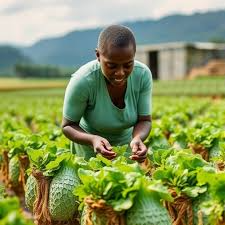
A new global study published in Nature suggests that the world’s food system could look dramatically different by 2050 if governments, businesses, and consumers shift toward healthier diets and cut food waste in half. Under the modelled transition, global agricultural land use could fall by about 6 percent and livestock production could drop by 42 percent, a scale of change large enough to reshape rural economies, trade flows, and the geography of farming itself.
[pik-potsdam](https://www.pik-potsdam.de/en/news/latest-news/healthier-more-sustainable-diets-would-reshape-global-agriculture-a-new-study-shows-by-how-much)
What the study found
Researchers used ten global food system models to compare a business as usual future with a transformation scenario built around healthier eating patterns, better farm productivity, and a 50 percent reduction in food waste. The result was not a modest adjustment but a structural shift. The study found that the total value of agricultural production would remain near current levels overall, yet the mix of what the world grows would change sharply, with livestock shrinking and fruits, vegetables, nuts, and legumes gaining ground.
[bioengineer](https://bioengineer.org/sustainable-healthy-diets-could-reshape-global-agriculture/)
The headline figures are stark. Global agricultural land use could decline by roughly 6 percent, an area about the size of India, while the economic value of livestock production could fall by 42 percent, or about 630 billion dollars, by 2050. Ruminant production, including beef, lamb, and related sectors, would be hit hardest, with one analysis of the study projecting a 70 percent drop in production value and about 400 million fewer ruminant animals worldwide.
[pik-potsdam](https://www.pik-potsdam.de/en/news/latest-news/healthier-more-sustainable-diets-would-reshape-global-agriculture-a-new-study-shows-by-how-much)
Why diets matter so much
The study’s core message is simple but powerful: what people eat determines what farmers raise, what land is cleared, and how much pressure the food system places on the climate and ecosystems. A shift toward healthier diets means less demand for resource intensive livestock and feed crops, and more demand for plant rich foods that typically require less land and emit fewer greenhouse gases per calorie.
[oxfordmartin.ox.ac](https://www.oxfordmartin.ox.ac.uk/news/201810-springmann-nature)
Matthew Gibson, the study’s lead author, said the scale of the change is enormous and requires policy ambition equal to the challenge, not just individual good intentions. That point matters because many public debates still frame healthy eating as a matter of personal choice alone. The research argues that food systems are too deeply tied to subsidies, prices, habits, and infrastructure for consumer willpower to carry the burden by itself.
[news.cornell](https://news.cornell.edu/stories/2026/07/diet-could-remake-modern-agriculture)
The pressure on livestock
Livestock is where the transition becomes most visible. The study projects a sharp contraction in the economic value of meat and dairy production, with livestock value falling far more than crop value rises. In practical terms, that means fewer cattle, fewer grazing herds, less demand for soy and corn used as animal feed, and less land devoted to pasture and feed production.
[news.cornell](https://news.cornell.edu/stories/2026/07/diet-could-remake-modern-agriculture)
For many regions, especially those built around cattle, dairy, and feed markets, the change could be painful. Rural communities depend on those sectors not only for income but for identity, land use, and local commerce. The researchers say that without careful planning, a food transition of this size could produce real losses for producers even if it benefits public health and the environment.
[news.cornell](https://news.cornell.edu/stories/2026/07/diet-could-remake-modern-agriculture)
Who gains and who loses
The study suggests that plant based production would expand significantly, especially for vegetables, fruits, nuts, and legumes. That means new opportunities for farmers, processors, storage operators, and transport firms that serve those markets. At the same time, the livestock sector would face a much steeper adjustment, and some countries would need targeted support to keep rural livelihoods intact.
[bioengineer](https://bioengineer.org/sustainable-healthy-diets-could-reshape-global-agriculture/)
Regional impacts vary widely. One analysis tied to the study projects the United States could see livestock production value fall sharply even as crop value grows, while India could experience a different pattern with overall agricultural value rising. That uneven geography is a reminder that food system reform is never uniform. It moves through cultures, climates, and economies in different ways.
[bioengineer](https://bioengineer.org/sustainable-healthy-diets-could-reshape-global-agriculture/)
Food waste is a major lever
Halfing food waste is not a side issue in this research. It is one of the main levers that helps drive down land use and production pressure. When food is lost in fields, spoiled in transport, or thrown away by consumers, all the water, fertilizer, fuel, and land used to produce it are also wasted. Cutting waste means the world can feed more people with less farming expansion.
[oxfordmartin.ox.ac](https://www.oxfordmartin.ox.ac.uk/news/201810-springmann-nature)
That argument carries practical weight because one third of all food is currently lost or wasted, according to the research summary. Reducing waste would not just spare land. It would also reduce pressure on prices, storage systems, cold chains, and landfill emissions, making the whole food economy more efficient.
[pubmed.ncbi.nlm.nih](https://pubmed.ncbi.nlm.nih.gov/41197650/)
Climate and environmental stakes
The environmental implications extend far beyond farmland. The study links healthier diets and lower food waste to a substantial drop in agriculture related emissions and land use change emissions by 2050. That is especially important because food systems are already a major source of greenhouse gases, water stress, fertilizer pollution, and habitat loss.
[pik-potsdam](https://www.pik-potsdam.de/en/news/latest-news/healthier-more-sustainable-diets-would-reshape-global-agriculture-a-new-study-shows-by-how-much)
Less livestock also means lower methane emissions, which matters for near term climate progress because methane warms the planet quickly but does not linger as long as carbon dioxide. If land currently used for agriculture is freed up, some of it could potentially return to forests, grasslands, or other natural systems, creating room for biodiversity recovery and carbon storage.
[news.cornell](https://news.cornell.edu/stories/2026/07/diet-could-remake-modern-agriculture)
Policy choices ahead
The study is not a forecast so much as a roadmap of possible outcomes, and it points to a hard truth: the food system will not change itself. Governments would need to rethink subsidies, nutrition guidance, waste rules, procurement policies, and support for farmers if they want healthy diets to become the norm rather than the exception.
[pik-potsdam](https://www.pik-potsdam.de/en/news/latest-news/healthier-more-sustainable-diets-would-reshape-global-agriculture-a-new-study-shows-by-how-much)
That is where the politics get difficult. The researchers warn that large scale food system change requires coordination among governments, industry, and consumers, not isolated fixes at the grocery store. A credible transition would likely need compensation for producers, investment in new supply chains, and labor policies that help rural communities adapt instead of absorbing the shock alone.
[news.cornell](https://news.cornell.edu/stories/2026/07/diet-could-remake-modern-agriculture)
What this means for readers
For households, the research does not mean everyone must make a sudden personal overhaul. It does suggest that diets with more plant foods and less waste are not only compatible with health goals but also have measurable effects on how much land the world needs to feed itself. For policymakers, the message is more urgent. The path to a more sustainable food system runs through public action, not just consumer advice.
[oxfordmartin.ox.ac](https://www.oxfordmartin.ox.ac.uk/news/201810-springmann-nature)
Anyone wanting to follow the broader science can explore the Nature journal platform for the underlying paper and the Food and Agriculture Organization for global food and land use data. Taken together, the evidence suggests a future in which better diets do more than improve health. They could redraw the map of agriculture itself.
[oxfordmartin.ox.ac](https://www.oxfordmartin.ox.ac.uk/news/201810-springmann-nature)