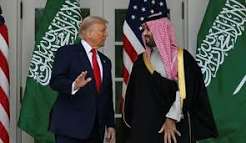
The United States has formally tied a proposed civilian nuclear cooperation agreement with Saudi Arabia to Riyadh’s joining the Abraham Accords with Israel, turning one of the region’s most sensitive diplomatic files into a broader test of Middle East normalization. The move raises the stakes for both energy cooperation and regional politics, while signaling that Washington wants a single framework linking nuclear partnership, security strategy, and Arab Israeli diplomacy.
What Washington is asking
At the center of the dispute is a simple but consequential condition: no nuclear deal without normalization. The executive branch is making clear that any civilian nuclear arrangement with Saudi Arabia would not stand alone as a technical energy agreement. Instead, it would be folded into a wider diplomatic bargain that includes formal ties with Israel under the Abraham Accords, the U.S. backed set of normalization agreements that has already reshaped relations between Israel and several Arab states.
That linkage matters because Saudi Arabia is not just another regional partner. It is the Arab world’s most influential power center, a guardian of Islam’s holiest sites, and a key player in global energy markets. When Washington conditions a nuclear accord on diplomatic recognition, it is not merely negotiating over reactors or fuel cycle safeguards. It is asking Riyadh to take a geopolitical step that could alter the regional balance for years.
Why the nuclear file is sensitive
Civilian nuclear cooperation agreements are often presented as energy policy, but in practice they carry deep security implications. A deal of this kind can involve reactor construction, nuclear fuel supply, oversight standards, and long term monitoring. The central question for many governments is not whether a country may generate civilian nuclear power, but what restrictions, inspections, and proliferation safeguards will be attached to that right.
For Saudi Arabia, the appeal of civilian nuclear technology is tied to energy diversification, industrial growth, and long term planning beyond oil. For the United States, any agreement must be consistent with nonproliferation goals and regional stability. Those concerns become even sharper when the country in question is seeking advanced nuclear cooperation while also navigating a tense security environment and an unresolved regional conflict landscape.
Normalization as leverage
By linking the nuclear deal to the Abraham Accords, the White House is using one major policy objective to advance another. That is classic diplomacy by leverage. The logic is that Saudi normalization with Israel would not only serve American strategic interests, but also provide a political foundation that makes deeper technical cooperation easier to defend in Washington.
Yet the move also introduces a harder reality: Saudi leaders may view recognition of Israel as a major concession that cannot simply be traded for a civilian energy agreement. Public opinion in the region, the status of Palestinians, and the Kingdom’s own diplomatic posture all shape how far Riyadh can go. In that sense, the condition is both a bargaining chip and a barrier.
What is at stake for the region
The implications extend far beyond one bilateral relationship. If Saudi Arabia were to join the Abraham Accords, it would likely mark the most consequential normalization step in the region since the original agreements were signed. It could influence trade, security cooperation, air routes, investment flows, and the way other Arab governments calibrate their own positions toward Israel.
For Israelis, a Saudi breakthrough would carry enormous symbolic and strategic weight. For Palestinians, it could raise fears that regional priorities are moving ahead of core political demands. For the United States, it could create a diplomatic achievement that strengthens its hand in the Middle East, but only if the arrangement is seen as credible, stable, and not merely transactional.
Why Washington chose this path
The Biden era had already left behind a complicated regional landscape, and the current executive approach appears focused on aligning the pieces around a larger strategic architecture. Nuclear cooperation gives Washington a practical tool. Normalization gives it a diplomatic prize. Tying the two together allows the administration to present the package as a coherent vision rather than two unrelated policy tracks.
There is also a domestic dimension. Any civilian nuclear agreement with Saudi Arabia would attract scrutiny from lawmakers, security analysts, and nonproliferation advocates. By attaching normalization, the administration may believe it can create a stronger political case, arguing that the deal is part of a broader regional stabilization effort rather than a narrow concession to a wealthy partner.
The Israeli factor
Israel’s role remains central, even when it is not speaking loudly at the negotiating table. The Abraham Accords were built on the idea that shared interests, especially around security and economic cooperation, could justify formal normalization. A Saudi entry would take that logic into a new level of regional significance. It would also give Washington a way to frame nuclear cooperation as part of a more integrated Middle East order.
Still, normalization is not just a signature on paper. It requires visible political acceptance, structured channels of communication, and enough public legitimacy to survive criticism. Without those elements, any agreement may look sturdy from afar but remain fragile once domestic or regional pressures begin to rise.
Concerns about precedent
There are also broader policy concerns about what this kind of linkage means for future diplomacy. If civilian nuclear assistance becomes contingent on political normalization, other states may conclude that Washington is willing to attach major strategic conditions to technical cooperation. That could make some deals harder to negotiate, even as it strengthens U.S. leverage in the short term.
Nonproliferation specialists will also be watching the terms closely. The details of any agreement would need to address enrichment, fuel supply, safeguards, and inspection rights. Those are the places where a civilian program can remain civilian in practice. Without strong provisions, critics may worry that the line between energy ambition and strategic capability could blur.
What comes next
The next phase will likely be defined by quiet bargaining rather than public ceremony. Saudi officials will want to know exactly what they would receive, what they would be expected to concede, and how the agreement would affect their regional posture. American officials will be weighing how much diplomatic capital they are willing to spend, and whether the political conditions they are imposing can actually be met.
In the near term, the condition itself may be more important than the final text of any agreement. It reveals the administration’s view that nuclear cooperation, security architecture, and Israel Arab normalization are now part of the same strategic conversation. That is a bold move, but also a risky one, because it binds together issues that are individually difficult and collectively explosive.
Why this matters now
This is not just another diplomatic update. It is a signal about how Washington sees the future of the Middle East. The U.S. is saying that major civilian nuclear cooperation will not be treated as an isolated energy deal. It will be used as leverage to encourage a broader political realignment, one that could reshape regional relations if it succeeds and create new friction if it fails.
For readers trying to make sense of the moment, the key takeaway is that the nuclear file has become inseparable from the normalization file. That makes the Saudi deal more ambitious, more complicated, and far more consequential than a standard civilian energy agreement. Whether it advances or stalls will depend not only on technical safeguards, but on whether both sides believe the political price is worth paying.
For background on U.S. diplomacy and regional normalization efforts, readers can follow the U.S. Department of State and the International Atomic Energy Agency.